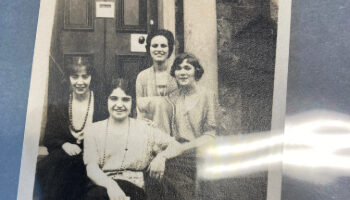
What was life like for women who studied at the Edinburgh Medical School in the early twentieth century? Archival material provides insight into the challenges many medical women faced.
By Juliet Gartside
Forty women matriculated at the University of Edinburgh between 1869 and 1873, including the renowned Edinburgh Seven, making them the first women to matriculate in the United Kingdom. They were denied graduation, and it was only in 1894 that the University announced that it would admit women for graduation. Women were still excluded from university courses until 1916.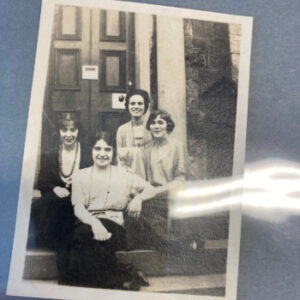
Yet behind these famous milestones lie questions of what life was actually like for these women and what challenges they faced in an often-hostile academic setting.
The issue of women’s education is raised
In 1908 the issue of women’s education was raised through the imminent sale of Minto House, where the Edinburgh Medical College for Women (EMCW) was based. This brought the possibility of integrating the women into the Medical Faculty.
However, the backlash was almost immediate. The minutes of a Student Representative Council meeting on the 4 March 1908 record the motion that “This Council considers it very undesirable that women should be admitted to the Ordinary Classes in the Faculty of Medicine in this University and believes that the interests of all parties will best be furthered by Women Students receiving their training as at present in a distinct and separate college,” which was sent to the University Court, along with a petition signed by 450 medical students expressing their concern at the prospect of opening up the Medical School to women.
The University advised that no reorganising of the EMCW was needed and instead merely a change of “locality.” Letters were sent contesting this decision, including a petition signed by 90 students from the EMCW stating, “We wish to impress on the Court the total inadequacy of the present teaching arrangements, especially in respect of the deplorable want of proper laboratories and equipment, and of our restriction to one lecturer in each subject instead of enjoying a choice; we would also point out that these disadvantages under which we labour are year by year increasing.”
Some changes were made, including moving the ECMW to Surgeon’s Hall, under a new name, Edinburgh School of Medicine for Women – the same name as Sophia Jex-Blake used when she started training women in Edinburgh in 1886. However, women had to wait another eight years before they were officially allowed into the Faculty of Medicine and could attend university classes with male students.
Edinburgh Women’s Medical Society meetings
Meanwhile, in 1904 the Edinburgh Women’s Medical Society was formed with an aim “to foster corporate life and social intercourse among the women medical students.” The society’s minute books show regular meetings, which featured guest speakers and student debates. During the First World War this included several speakers who had been working in hospitals on continental Europe. One speaker, Joseph Fayner, when asked what women could do to help during the war, replied that students should “stick to their guns” adding that “If, however, an opportunity of being of service as a dresser or cook offered itself to any individual, she would do well to take it.”
Nevertheless, other female speakers had more encouraging words, such as Dr Helen McDougall who “gave an account of her experiences in the Scottish Women’s Hospital at Kragujevac”11 or Dr Beatrice Russell “who gave an account of the work of the Scottish Women’s Hospitals on foreign service” in Serbia and France, describing what it was like to work there and the experience of “prejudiced or slightly hostile authorities turn[ing] into friends.”
These meeting minutes provide fascinating insight into attitudes towards women in medicine and the challenges that they faced at the time. The meeting minutes also display a wide range of interests among students, with topics ranging from “the advantages of bobbed hair” to women working in the Mission Field.
Updates to the constitution
Later on in the 1950s, the constitution was updated to add the aim “To encourage women medical undergraduates and graduates to take an active interest in the environment of those who are their potential patients,” reflecting an increasing interest in public health of the time. This was also carried out through society activities such as visiting a coalmine “to see the actual conditions under which the miners work so that we may have a better understanding of any miners whom we may have as our patients in the future.”
While many women’s voices in history remain unheard, this archival material goes some way in illuminating the lives of women students at Edinburgh in the first half of the twentieth century, both the challenges they faced, as well as the interests and ambitions they aspired to.
Juliet Gartside is an Edinburgh Medical School 300 Archival Research Intern and University of Edinburgh history student.
Bibliography
Court Minutes (signed) 1859-, University of Edinburgh Archive and Manuscript Collections, Court minutes (signed), 1859- | University of Edinburgh Archive and Manuscript Collections
Our History. “Admission of Women to Faculty of Medicine, 1916,” August 18, 2014. https://ourhistory.is.ed.ac.uk/index.php?title=Admission_of_Women_to_Faculty_of_Medicine,_1916.
Records of the Edinburgh Women’s Medical Society, The University of Edinburgh Archive and Research Collections, Collection: Records of the Edinburgh Women’s Medical Society | University of Edinburgh Archive and Manuscript Collections.
Students’ Representative Council 1884-1956, University of Edinburgh Archive and Manuscript Collections, Students’ Representative Council, 1884-1956 | University of Edinburgh Archive and Manuscript Collections.
The University of Edinburgh. “Sophia Jex-Blake and the Edinburgh Seven.” The University of Edinburgh, September 9, 2024. https://medicine-vet-medicine.ed.ac.uk/about/history/women/sophia-jex-blake-and-the-edinburgh-seven.