26 March 2026 is Purple Day; a global day of recognition and to increase awareness of epilepsy. Here, Lucy, Daniel, Jessica and Tina – current PhD researchers – explore their work and its importance. Discussing ion channels, the menstrual cycle, sleep, and genetic epilepsies, they give us a glimpse of the diversity and complexities of this wide-ranging, multi-faceted disorder as well as approaches to treatment.
Why Sleep Matters in Epilepsy – Lucy Pritchard

For many people living with epilepsy, seizures are only part of the challenge. Many also experience memory problems, difficulty concentrating, and ongoing fatigue. This is not surprising, as seizures can disrupt the normal activity of the brain. However, another important piece of the puzzle is sleep.
Sleep and seizures are closely connected
People living with epilepsy often have difficulty getting a good night’s sleep. Seizures can interrupt sleep during the night, and poor sleep can in turn increase the risk of having seizures. This can create a difficult cycle, where seizures disturb sleep and disrupted sleep makes further seizures more likely. Most people know how hard it is to focus after a bad night’s sleep. You might struggle to concentrate at work, forget simple things, or feel unusually tired during the day. Now imagine if your sleep was regularly interrupted by seizures, what effect might that have on memory, learning, or daily activities such as working, studying, or just doing the weekly shop?
My research focuses on understanding the relationship between sleep and epilepsy. In particular, I study how sleep changes after seizures and how these changes might affect memory and daily functioning. To do this, I record brain activity during sleep, which allows me to see how different stages of sleep are affected in people with epilepsy. Sleep is not a single, uniform state — it is made up of several stages that each play an important role in restoring the brain and supporting memory and learning.
I am also interested in how commonly prescribed anti-seizure medications influence sleep. These medications can be very effective at controlling seizures for some people, but they can also affect sleep patterns. By studying both seizures and medications, I hope to understand the different factors that influence sleep and how these changes affect how people feel and function during the day.
Might sleep actually help protect the brain from seizures?
One particularly interesting question is whether sleep might actually help protect the brain from seizures. We know that good sleep can make seizures less likely for many people with epilepsy, but we do not fully understand why. One possibility is that certain stages of sleep help stabilise brain activity, preventing the abnormal electrical signals that lead to seizures. Another possibility is that sleep helps the brain “reset” itself after a day of activity, restoring the balance between different brain networks.
Part of my research aims to explore these possible mechanisms. By looking closely at brain activity during sleep, I hope to understand what changes are happening in the brain and whether certain sleep patterns might help protect against seizures.
Understanding these processes could help us identify new ways to improve the lives of people living with epilepsy
This research is particularly important because current treatments do not work for everyone. The main treatment for epilepsy is anti-seizure medication. While these drugs are effective for many people, they can also cause side effects that make them difficult to tolerate. In addition, around half of people with epilepsy continue to experience seizures despite trying medication. This is known as drug-resistant, or refractory, epilepsy. Because of this, researchers are increasingly interested in other factors that influence seizures. Sleep is one of the most important of these factors, yet we still do not fully understand how sleep affects the brain in people with epilepsy.
By learning more about how sleep and seizures interact, we may be able to find new ways to support people living with epilepsy. Improving sleep will not replace existing treatments, but it could offer an additional way to reduce seizures and improve everyday life. Sometimes, the answers to better understanding seizures may lie in the quiet hours of the night, when the brain is asleep but still very active.
Tiny Gates, Big Consequences: Ion Channels, Epilepsy, and How We Study the Brain – Daniel Fong
 The human brain is made up of billions of neurons communicating with each other in incredibly complex ways. Every thought, every movement of a finger, every memory recalled depends on electrical signals travelling across these networks. Yet behind this extraordinary system lies something remarkably small: microscopic proteins known as ion channels.
ion channels enable neurons to communicate with one another and shape the brain’s electrical language that underlies movement, decision-making and memory
Ion channels are tiny protein “gates” embedded in the membrane of cells. Their job is to control the movement of ions, electrically charged particles such as sodium, potassium, calcium, and chloride, in and out of the cell. When ion channels permit ions to flow across the cell membrane, changes in currents and voltages are generated. These electrical changes determine when and how neurons transmit signals through firing. By operating in the right place at the right time, ion channels enable neurons to communicate with one another and shape the brain’s electrical language that underlies movement, decision-making, memory, and much more.
Given their central role in brain function, it is perhaps unsurprising that disruptions in ion channel activity can have profound consequences. If ion channels do not open or close in the right way, neurons may become overly excitable, fire too frequently, or fail to regulate their signals properly. One manifestation of this imbalance can be epilepsy, a neurological condition characterised by recurrent seizures caused by abnormal electrical activity in the brain.
Many forms of epilepsy have been linked to what scientists call channelopathies
That is, disorders caused by mutations in genes that encode ion channels or closely related proteins. These genetic changes can alter the behaviour of ion channels, with effects that ripple outward through neuronal networks. The idea that perturbations in ion channel activities can ultimately reshape activity across entire brain circuits has attracted researchers to study how neuronal networks are altered in channelopathies.
My research focuses on one particularly fascinating type of ion channel in the brain: the NMDA receptor. NMDA receptors play a central role in communication between neurons. They are especially important for processes such as learning and memory, helping to strengthen the connections between brain cells as we acquire new information and experiences. The proteins that make up NMDA receptors are encoded by a family of genes known as GRIN. When mutations occur in these genes, they can give rise to a group of conditions collectively referred to as GRIN-related disorders. These disorders can affect brain development and are often associated with epilepsy, intellectual disability, and developmental delay.
Despite growing recognition of GRIN-related disorders, the underlying mechanisms remain elusive. Although we know that NMDA receptors behave differently in patients with GRIN-related disorders, but exactly how these changes translate into neurological symptoms, like epilepsy, is still not fully understood.
current treatment options remain limited and are often based on managing symptoms rather than addressing the underlying cause
This is where basic research becomes essential. By studying how changes in NMDA receptor activity influence the electrical behaviour of neurons, we hope to uncover the mechanisms that link genetic mutations to changes in brain function, gaining insights into why seizures and other symptoms occur. Ultimately, this knowledge could help guide the development of more targeted treatment options.

Studying how neurons communicate requires tools that can measure extremely small electrical signals. One of the most elegant techniques used in neuroscience to do this is called patch clamp electrophysiology. Patch clamp is a method that allows scientists to measure the electrical currents flowing through ion channels in individual cells. Using a very fine glass pipette, we gently attach to the membrane of a neuron. This acts as a “plug-in” that allows us to record the tiny electrical currents produced when ion channels open and close. With this technique, we can us listen in on the electrical conversations happening inside the brain. In combination with animal models that replicate conditions like GRIN-related disorders, patch clamp allows us to study how electrical behaviours in the brain are potentially altered in these conditions.
Importantly, these systems also allow us to evaluate possible therapies. If a drug is postulated to correct abnormal activities, we can test whether it restores normal electrical behaviour in neurons. This provides valuable information about whether a treatment might be effective before moving toward clinical studies.
Ion channels may be microscopic, but their impact on brain function is enormous. By studying how these tiny molecular gates control neuronal communication, and how mutations disrupt their function, we can gain crucial insight into conditions like GRIN-related disorders. Through techniques such as patch clamp electrophysiology and the use of animal models, researchers are working behind the scenes to uncover the mechanisms behind these diseases, in hopes to develop more informed and effective treatments in the future.
Catamenial Epilepsy: How the Menstrual Cycle Influences Seizures – Martyna Stasiak
 Did you know that seizures can increase or only occur in specific stages of the menstrual cycle? This is what we call catamenial epilepsy, where seizures cluster depending on the fluctuation of hormones across the ~28-day cycle. Between 25%-70% of females with an existing diagnosis of epilepsy fit the criteria to be diagnosed with catamenial epilepsy.

Catamenial epilepsy can occur in three main periods across the menstrual cycle: at the start of a woman’s period, around ovulation, in the middle of the period, and the week before the period, in the luteal phase.
It is thought that hormones play different roles in catamenial epilepsy. For instance, progesterone and estrogen, which are both made in the ovary, tend to have opposite effects. Progesterone is often referred to as a protective hormone, as women are less likely to see an increase in seizures around the time when progesterone peaks. However, estrogen has the opposite effect, where a surge of estrogen around the time when the egg is released from the ovaries increases the number of seizures for some women. This pattern is also seen in women with anovulatory cycles, when the egg does not get released, although we only see an increase in estrogen, but not progesterone.
In absence seizures, a specific kind of seizure where the individual loses consciousness and often goes into a ‘staring spell’, early research has shown that hormones might have the opposite effect. That being, decreased seizure risk with high levels of estrogen and an increased seizure risk with high levels of progesterone. Many other hormones may play an important role in catamenial epilepsy, including those that are created in the brain and communicate with ovarian hormones via a feedback loop, which requires greater exploration.
Whilst research on catamenial epilepsy remains limited, current treatments include the use of oral contraceptives. Some women also track their periods and take anti-seizure medications around the time of when they tend to experience seizures. However, the effectiveness of these treatments varies greatly. Issues arise when taking both medications, as certain anti-seizure medications significantly reduce the effectiveness of oral contraceptives and vice versa.
There is a pressing need to investigate the role of the menstrual cycle and hormones in epilepsy, specifically across the entire reproductive cycle, with the inclusion of the onset of puberty, pregnancy, and menopause. Women with epilepsy are more likely to have an array of reproductive health issues, including irregular cycling, polycystic ovarian syndrome (PCOS), and anovulatory cycles. This need is greatest in non-convulsive types of seizures, such as absence seizures, where research is extremely limited.
the role of fluctuating hormones and their influence on seizures, as well as behaviour, remains limited
Women’s health has largely been overlooked in the history of scientific research. In some countries, women were excluded from participating in research. Indeed, in the US such a law was only overturned in 1993! Despite the time that has elapsed since, the role of fluctuating hormones and their influence on seizures, as well as behaviour, remains limited.
Our goal is to address this research gap by investigating the role of the reproductive cycle and hormones on seizures and behaviour across the life course in a rodent model of absence epilepsy. This research will not only enhance our understanding of hormones and their role in epilepsy but may also shed light on the millions of girls and women who are affected by catamenial epilepsy and the desperate need for better treatment options.
Targeting the Cause: The Future of Treatments for Rare Genetic Epilepsies – Jessica Mahon
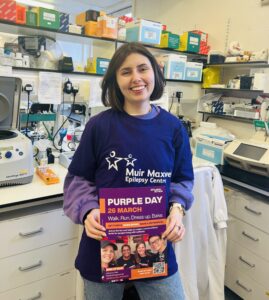 Imagine living with seizures that no medication can fully control. For many people living with genetic epilepsies, this is reality. Seizures are sudden, unpredictable, and profoundly affect daily life.
Traditional anti-seizure medications (ASMs), which have revolutionised care since the 1850s, have successfully treated seizures by dampening neuronal excitability across the brain. However, for rare genetic epilepsies, these medications often fall short. That’s because the problem isn’t just hyperactive neurons; it’s a specific molecular pathway gone awry.
A gene mutation disrupts a pathway that normally keeps neuronal activity in check, effectively removing the brakes that keep neurons under control. Knowing which brake is broken opens the door to therapies that target the system itself, not just the resulting hyperactivity.
therapies that reduce seizures address only one important piece of the condition
Although rare, these conditions can greatly affect families. Dravet syndrome, affecting roughly 1 in 15,700 births, causes severe, drug-resistant seizures often triggered by fever, along with developmental delays. Rett syndrome, affecting approximately 7 per 100,000 girls, leads to slowed development, motor difficulties, and seizures. It is important to note that these are complex syndromes, not just seizure disorders. While seizures are an urgent symptom, movement and development are also affected, so therapies that reduce seizures address only one important piece of the condition.
recent advances in genetic therapies for these conditions offer hope
Gene therapies aim to replace a faulty gene with a new copy, while antisense oligonucleotides (ASOs) are short pieces of genetic material that adjust how a gene works. In Dravet syndrome, the ASO zorevunersen has shown early signs of reducing seizures in Phase 1/2 trials and is now moving into Phase 3 to explore clinical benefits. In Rett syndrome, two AAV-based gene therapies are in early Phase 1/2 trials, with initial results suggesting they are safe and may improve symptoms. These approaches show how targeting the root genetic cause can directly address the mechanisms driving seizures.
While genetic therapies offer a promising avenue, challenges remain. Delivering the therapy to the right cells, at the right time to have the best effect, and ensuring long-term safety are all critical hurdles. Most treatments are still in early trials, so widespread availability is likely several years away. Despite this, pathway-targeted therapies are a major step toward helping people whose seizures do not respond to conventional medications.

Alongside scientific advances, awareness and support are crucial
Seizures can happen anywhere, in schools, workplaces, or at home, and knowing how to respond can make a real difference while medicine catches up. Ideally, everyone would know how to respond to a seizure just as they know what to do for an allergic reaction, heart attack, or stroke: no panic, no stigma, just clear steps to keep someone safe. Organisations such as Epilepsy Action offer training and resources to help people respond safely to seizures, alongside other local or national programmes (see epilepsy.org.uk/your-support). Purple Day highlights the importance of both community awareness and scientific progress, showing that managing epilepsy is about understanding, preparedness, and inclusion, not just treatments.
Seizures may last only minutes, but their effects can shape a lifetime. Awareness, research, and new treatments are all part of changing that.

With many thanks to our authors this Purple Day: Lucy, Daniel, Tina and Jessica!
Lucy Pritchard is undertaking a PhD in the Simons Initiative for the Developing Brain at the The University of Edinburgh. Her research focuses on understanding the relationships between sleep, seizures, and cognition. She uses EEG recording and analytical techniques to examine how sleep dynamics contribute to seizure occurrence and cognitive function.
Daniel Fong is a 1st year PhD student at the Institute for Neuroscience and Cardiovascular Research within The University of Edinburgh. His research is funded by Epilepsy Research Institute UK and the Simons Initiative for the Developing Brain, to investigate the role of NMDA receptors in neurological conditions like epilepsy.
Martyna Stasiak is a Translational Neuroscience PhD student at the Institute for Neuroscience and Cardiovascular Research within the University of Edinburgh. PhD is titled: Investigating the role of the reproductive cycle and hormones on seizures and behaviour across the life cycle in Syngap1-related disorder.
Jessica Mahon is a 2nd year Translational Neuroscience PhD student at the Institute for Neuroscience and Cardiovascular Research within the University of Edinburgh. Her research is funded by the Wellcome Trust and focuses on developing gene therapies for mTORopathies.