1.Introduction
Sound not only shapes emotions but also plays a crucial role in guiding immersive experiences. This project, centered on the concept of “Denial,” explores how sound represents the five stages of negative emotions and enhances emotional resonance through interactive installations. To establish a solid theoretical foundation for sound design, I conducted extensive research on relevant literature and case studies, analyzing how sound influences emotions, the key elements of immersive sound design, and the integration of interactive technology. Through the fusion of sound and visuals, this project aims to create a profound emotional journey for the audience.
2.Theoretical Background
2-1 Denial
Our project is based on the concept of “Denial,” commonly associated with Kübler-Ross’s (1969) Five Stages of Grief, introduced in On Death and Dying. This model describes the emotional responses individuals experience when facing death or major life changes, progressing through denial, anger, bargaining, depression, and acceptance. Denial is more than just temporary avoidance; it serves as a psychological defense mechanism that helps individuals cope with overwhelming emotional shock.
| Stage | Overview | Emotional Manifestation |
| Denial | Rejecting reality, avoiding painful truths. | Numbness, indifference, refusal to acknowledge or face reality. |
| Anger | Feeling frustration and resentment when unable to escape reality. | Hostility, irritability, possible aggressive behavior. |
| Bargaining | Attempting to reduce pain through negotiation or compromise. | Self-consolation, hoping to change the outcome through “deals.” |
| Depression | Recognizing the unchangeable reality, leading to sadness and helplessness. | Loneliness, despair, loss of motivation and interest. |
| Acceptance | Ultimately accepting reality and facing the future with a calm mindset. | Inner peace, relief, gradually adapting to change. |
These five stages describe the emotional changes individuals experience when facing significant loss or trauma. Psychologist Anna Freud (1936) identified denial as a primitive yet common defense mechanism that allows individuals to temporarily escape reality when emotions become overwhelming, helping to reduce psychological stress. When a person struggles to accept inevitable loss or change, denial may persist, manifesting as avoidance of facts or self-soothing to maintain a false sense of reality. Immersive sound installations can enhance this emotional experience, allowing individuals to more intuitively perceive and explore denial and its psychological impact.
2-2 Sound
Huang and Wu (2007) found a strong correlation between music selection and emotional responses. The impact of sound on emotions is a multidimensional process influenced by key factors such as pitch, intensity, rhythm, and sharpness. Research indicates that high-frequency noise and sharp sounds can trigger stress responses, whereas low-frequency vibrations may induce a sense of calmness or suppression (HEAD acoustics, n.d.). Additionally, fast and irregular rhythms are often linked to anxiety, while dissonant intervals—such as minor seconds, augmented fourths/diminished fifths, and major sevenths—stimulate the amygdala, a brain region responsible for processing emotions, particularly fear and distress (Pankovski, 2023). Musical scales also play a crucial role in emotional expression; major scales are generally associated with positive emotions, whereas minor scales tend to evoke negative feelings. Moreover, slow-tempo music is often linked to sadness (Sun, Liu, & Nan, 2009).
In terms of sound design, different frequencies elicit distinct emotional experiences. Low-frequency sounds (20 Hz to 250 Hz) can create physical resonance, which in turn provokes anxiety and fear. For instance, the low-frequency vibrations of thunder and earthquakes are commonly associated with danger and threat, intensifying feelings of unease. In contrast, high-frequency sounds (2,000 Hz to 20,000 Hz) are highly stimulating, heightening alertness and inducing emotions such as anger and anxiety (Wemore8888, n.d.). Additionally, high volume, fast-paced, and irregular rhythms can further amplify tension or aggression, making sound a powerful tool in shaping psychological experiences.
These findings highlight the critical role of sound characteristics in emotional modulation. Variations in pitch, musical scale, rhythm, and frequency can direct and enhance different psychological experiences, effectively influencing the emotional state of an audience in immersive environments.
3.Case Studies
3-1 Sound Installations or Immersive Art Cases:
TeamLab’s Interactive Art Exhibition
https://www.teamlab.art/zh-hans/e/artsciencemuseum
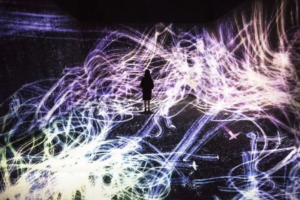
Guqi Cultural Tourism Performing Arts (2022)
“THE DAY LEFT FIELD” is an immersive audiovisual installation, set within a 144-square-meter space.
https://www.bilibili.com/video/BV1CM411B7Ls/?utm_source=chatgpt.com
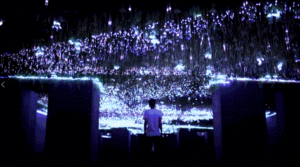
Aooooxixi. (2022, December 16).
3-2 Game Music, Film, and Other Sound Design:
In The Last of Us, the protagonist, Joel, experiences deep emotional trauma after losing his daughter. The game uses low, slow-paced music and environmental sound effects to create an atmosphere of oppression and solitude.
[Source link:https://api.xiaoheihe.cn/maxnews/app/share/detail/2695066]
In the Silent Hill series, deep, slow-paced melodies contribute to an oppressive atmosphere. Below is the official soundtrack:
[Source link:Silent Hill Original Soundtrack]
William Basinski’s The Disintegration Loops
Composed in 2001, The Disintegration Loops by William Basinski was created when he attempted to digitize old tape loops and discovered that they gradually deteriorated due to aging. He recorded this process, capturing a sense of slow decay and irreversible tragedy, while simultaneously evoking a meditative tranquility and transcendence.
[Source link: https://b23.tv/mrp3x6y]
3-3 Interactive Technology Case:
Voice Tunnel
Created by Mexican artist Rafael Lozano-Hemmer, Voice Tunnel is a large-scale interactive installation that allows participants to engage through sound. As visitors vocalize into the central sound system of the tunnel, the installation responds in real-time by adjusting the brightness and flickering patterns of lights based on the intensity and characteristics of the sound. This interplay between sound and light creates a unique and immersive sensory experience.
[Source link: https://www.urbanlight.cn/newsdetail/e3c8d402-0ab1-4963-af3c-ac12de995c48?utm_source=chatgpt.com]

China Lighting Network (2022)
4. Draft of Sound Design for the Five Stages of Denial
4-1. Denial
Sound Design
- Muffled Sounds:
Low-pass filtering to create a dull, suppressed auditory perception.
Out-of-focus ambient sounds, such as distant traffic noise or indistinct radio broadcasts.
- Deep Droning:
Infrasound (below 20Hz) to induce bodily resonance and discomfort.
Sustained low-frequency humming, resembling industrial low-frequency resonance.
- Hollow Echoes:
Long-tail reverb to create a vast and empty spatial impression.
Repetitive whispering, symbolizing stagnant thoughts and inner voices.
- Tinnitus and Silence:
Subtle high-frequency ringing, simulating auditory shutdown after shock (e.g., the “ringing effect” after an explosion).
Sudden silence, representing moments of psychological paralysis or cognitive void.
4-2. Anger
Sound Design:
- Sharp and Piercing Sounds:
Sounds of glass shattering, screaming, and metal scraping to create extreme discomfort.
Rapidly ascending Shepard tones to induce a never-ending sense of tension.
- Dissonant Melodies:
Use of augmented fourths and dissonant intervals, such as tritones or chromatic melodies, to evoke anxiety.
Sharp, high-pitched string stabs inspired by Psycho (1960) to enhance unease. Example: Psycho’s iconic string sound.
- Sudden Impact Sounds:
Abrupt volume bursts, such as industrial noise or electronic distortion, to create jump-scare moments.
Stuttering or “skipping” sounds, like a glitching vinyl record, mimicking the fractured nature of emotional outbursts.
4-3. Bargaining
Sound Design:
- Looping Familiar Sounds:
Childhood memories or dialogues, such as old radio broadcasts or repeated lullabies.
Old telephone recordings or home video clips with faint background noise.
- Ambient Noise:
White noise, rain sounds, or train motion sounds to provide a sense of security and aid in escapism.
Urban ambiance, such as café chatter or distant television sounds, to enhance a dreamlike immersion.
- Soft Whispers:
ASMR-like whispers to evoke intimacy but potentially become unsettling when endlessly repeated.
Layered whispers with slight phase shifts, creating an eerie “multiple consciousness” effect.
- Distorted and Unstable Sounds:
Tape degradation effects, making the audio gradually decay (inspired by The Disintegration Loops by William Basinski).
Example: William Basinski – The Disintegration Loops.
4-4. Depression
Sound Design
- Irregular Rhythms:
Fragmented percussion with unstable beats, resembling chaotic jazz improvisation.
Phasing effects (inspired by Steve Reich’s techniques) where melodies gradually shift out of sync, creating a sense of disarray.
Example: Steve Reich – Phasing Technique.
- Accelerating Heartbeat:
Low-frequency heartbeat simulation, starting faint and intensifying to induce breathlessness.
Sudden heartbeat cessation to create a peak moment of psychological tension.
- High-Frequency Noise:
Sharp electronic static noise, similar to TV white noise.
High-frequency pulses mimicking tinnitus effects triggered by anxiety.
- Breathing and Suffocation:
Heavy breathing in the background to reinforce panic and unease.
Gradually increasing reverb on breath sounds, making them feel distant and simulating a loss-of-control sensation.
4-5. False Acceptance
Sound Design :
- Stable Yet Slightly Distorted Tones:
Gentle piano or string melodies, slightly detuned to create a subtle sense of unease.
Off-key harmonies that induce subconscious discomfort.
- Low-Frequency Noise Beneath Laughter:
Layering low-frequency droning beneath an otherwise harmonious soundscape to create hidden anxiety.
Example: Black Swan soundtrack reference – Black Swan (2010).
- Looping Calm Melodies:
A serene melody that loops but gradually incorporates subtle noise or instability.
Extended melodic tails, making the sound feel like an intentional effort to maintain composure.
References
(Academic Sources)
Freud, A. (1936). The ego and the mechanisms of defence. International Universities Press.
HEAD acoustics. (n.d.). Making noise and sound impact visible. Retrieved from https://www.head-acoustics.cn/blog/data/making-noise-and-sound-impact-visible
Huang, C.-F., & Wu, S.-W. (2007). 大學生音樂選曲與情緒反應之相關研究 [A study on the relationship between college students’ music selection and emotional responses]. 國際藝術教育學刊 [International Journal of Arts Education], 5(1), 54–70. Retrieved from https://ed.arte.gov.tw/uploadfile/periodical/1657_arts_education51_054070.pdf
Kübler-Ross, E. (1969). On death and dying. Macmillan.
Pankovski, P. (2023). Psychological connotations of harmonic musical intervals. Physics Letters Review, 46, 69. Retrieved from https://ui.adsabs.harvard.edu/abs/2023PhLRv..46…69P/abstract
Sun, Y., Liu, Y., & Nan, Y. (2009). The impact of music on emotion and its neural mechanisms. Progress in Natural Science, 19(1), 1–10. Retrieved from https://www.nsfc.gov.cn/csc/20345/22468/pdf/2009/音乐对情绪的影响及其脑机制的相关研究.pdf
Wemore8888. (n.d.). 聲音頻率與情緒反應:從低頻到高頻的心理影響 [Sound frequency and emotional response: The psychological impact from low to high frequencies]. Retrieved from https://wemore8888.com/%E8%81%B2%E9%9F%B3%E9%A0%BB%E7%8E%87%E8%88%87%E6%83%85%E7%B7%92%E5%8F%8D%E6%87%89%EF%BC%9A%E5%BE%9E%E4%BD%8E%E9%A0%BB%E5%88%B0%E9%AB%98%E9%A0%BB%E7%9A%84%E5%BF%83%E7%90%86%E5%BD%B1%E9%9F%BF/
(Video & Sound & PDF Sources)
Aooooxixi. (2022, December 16). THE DAY LEFT FIELD installation [Video]. Bilibili. BV1CM411B7Ls
China Lighting Network (2022), “Review | Eight Interactive Sound and Light Installations,” URBANLIGHT.CN. Retrieved from https://www.urbanlight.cn/newsdetail/e3c8d402-0ab1-4963-af3c-ac12de995c48.
Guqi Cultural Tourism Performing Arts. (2022). TeamLab: The Immersive Experience Creation of Art Exhibitions in the New Media Environment. URBANLIGHT.CN. https://www.urbanlight.cn/newsdetail/6bb52e34-5c2b-4f2a-8d4a-a69735df0cd0
himSeize. (2022, April 26). William Basinski – The Disintegration Loops [Video]. Bilibili. https://b23.tv/mrp3x6y
teamLab. (2016, March 12). teamLab at ArtScience Museum [Video]. Instagram. https://www.teamlab.art/zh-hans/e/artsciencemuseum
Movieclips. (2011, May 27). The Shower – Psycho (1960) [Video]. YouTube. https://www.youtube.com/watch?v=0WtDmbr9xyY
Searchlight Pictures. (2010, August 17). Black Swan | Official Trailer [Video]. YouTube. https://www.youtube.com/watch?v=5jaI1XOB-bs
musicue, B. (2012, April 11). Steve Reich – Different Trains (Part 1).mp4 [Video]. YouTube. Steve Reich – Phasing Technique
TheSilentHillFan. (2012, May 22). Silent Hill Original Soundtrack [Video]. YouTube.
UrbanLight. (2022, December 9). 盘点 | 八个交互式声光装置 [Review of eight interactive sound and light installations]. UrbanLight. https://www.urbanlight.cn/newsdetail/e3c8d402-0ab1-4963-af3c-ac12de995c48