We focus on the five stages of grief, exploring the “presence within sadness”, inviting the audience into a fully immersive experience of grief. At the same time, we pose a thought-provoking question: “How do you see yourself in it?” This encourages the audience to look inward and confront the grief they may have unconsciously ignored or suppressed.
Grief is an extremely universal emotion, yet we often choose to repress, overlook, or conceal it. Among the five stages, “anger” stands out as one of the most common and visually powerful emotional expressions. Therefore, I decided to start with this stage as the entry point for this exploration.
Step 1: Brainstorming

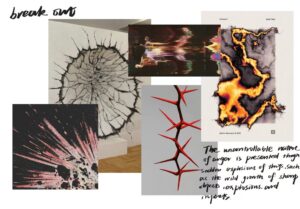
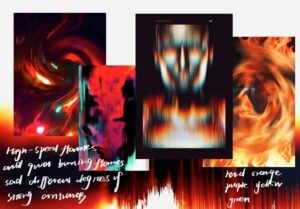
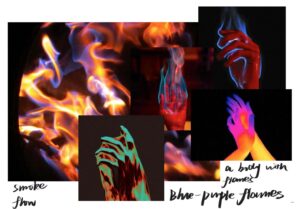
Image source:
- https://pin.it/3yGT9QwmD
- https://pin.it/32MxQO3eF
- https://pin.it/gQ65KZ7uy
- https://pin.it/5ycmtktoe
- https://pin.it/7qkzKyduC
- https://pin.it/q3eqQStHy
- https://pin.it/3HU6oQDO9
- https://pin.it/3pd1nipQ6
- https://pin.it/18tLP3exa
- https://pin.it/41Gwmyml5
- https://pin.it/LC65sPEDE
- https://pin.it/2KisD4i57
- https://pin.it/tAT1FiN6u
- https://www.behance.net/gallery/116096239/BLOCKCHAINS-ARE-BEAUTIFUL
- https://chirnside.studio/Frequencies
- https://pin.it/7EsmVNmRv
Anger is an intense, chaotic, and hard-to-control emotion. Smoke, with its shapeless and uncontrollable dynamic flow, perfectly aligns with the visual representation of anger. It can manifest as turbulent surges, sudden eruptions, or continuous diffusion. Each person enters this experience in their own way, and their emotional reactions are beyond our control. This sense of unpredictability is a defining characteristic of both flames and smoke.
Step 2: First Attempt
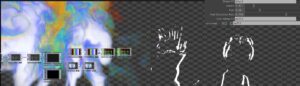
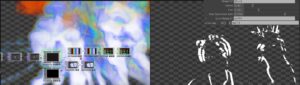
I experimented with TouchDesigner for visual presentation, as its dynamic adjustment capabilities allow for a more accurate representation of the diversity and fluidity of emotions.
I primarily used the Nvidia Flow Emitter to visualize smoke. By adjusting parameters such as smoke, fuel correction rate, and fuel values, I was able to manipulate the volume of the smoke. The human silhouette gradually deconstructs into a constantly shifting cloud of smoke, retaining its original shape while embodying a sense of fluidity and transformation.
Step 3: Further Effect Enhancement
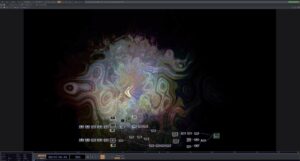
Adding multiple noise types for layering—could it enhance the complexity and visual appeal of the smoke effect?
Step 4: Real-Time Interaction Optimization and Hardware Output
1. Attempt to connect Kinect to capture 3D body data and enhance spatial perception.
2. Heart rate sensor: Dynamically adjust the intensity of the smoke effect based on the audience’s physiological data, reflecting emotional fluctuations.
Reference: