Technical Realization
For the technical realization of the project, it currently divided into three parts:
- Leap motion and Unity connection
- Multiplayer in Wwise
Leap motion and Unity connection
As the controller in the game, leap motion captures players’ gestures and transfers them to trigger events in Unity. In this case, I am searching for instruction about leap motion and Unity connection and here are my results:
Leap Motion official instruction: https://docs.ultraleap.com/xr-and-tabletop/xr/unity/getting-started/index.html
Some settings that are good to know before started
- Tracking Camera
- Ultraleap Hand Tracking Software
- Unity XR Plugin Management Package
- OpenXR
Leap Motion & Unity project blog: https://felcjo-ringo.medium.com/leap-motion-unity3d-playing-with-virtual-blocks-using-my-real-hands-2329be3a07d6
Multiplayer in Wwise
Since our project includes two players, there are some special settings and technical issues in Wwise requiring further research. Links below are references about multiplayer audio.
Audiokinetic Instruction: https://www.audiokinetic.com/fr/library/edge/?source=WwiseFundamentalApproach&id=listeners
Audiokinetic Blog: https://www.audiokinetic.com/en/blog/implementing-two-audio-devices-to-your-ue-game-using-wwise/
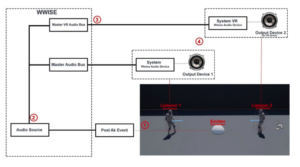
Based on the game mechanism, most of the modulation for sound and even sound source vary between two players for their different perspectives. This means there are two listener in Wwise and emitters have to send to two output devices in different modulation simultaneously.
A plugin (AkComponent) mentioned in the Blog link worth further research. Some programming (plugin) needs to be done if we want two players to have their own sound / two sound devices. My further learning will focus on realization and selecting the best solution for our project.
Game Mechanism
The basic aim of the game mechanism is creating information difference for two players in to perspectives in order to make them cooperate. According to my learning and experience, in most of the recent multiplayer game, players shares equal information or have different information in one perspective (mostly visual). But we can learn from their logic in designing game levels and obstacles.
Two examples below are from It Takes Two.
https://www.youtube.com/watch?v=yZ2VB6nbsUI
Time Point:
-
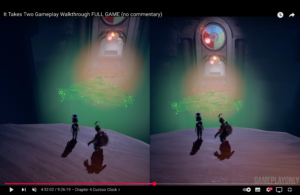
Chapter 4, 4:51:55 Providing visual / aural information with timing challenge -
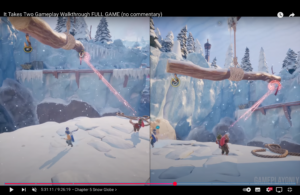
Chapter 5, 5:31:38: Replace the magnet with visual / aural ability (change colour / pitch)
I defined some logic of game level design here: timing which has some information provided by certain objects as standard to adjust players’ movement, rare power which only owned by one player and another player needs to help in some way.
For our project, instead of sharing information, it is always provided for one player due to two perspective. Timing can be a crucial part in our game level design,
Issue: Two players share the same information on screen. In our project, we may want some information difference based on sound and vision. We need a set of clear and easy communication between the players who receives different perspective from each other.