Zixuan:
🐶 Dog Head Microphone – Making Process Log
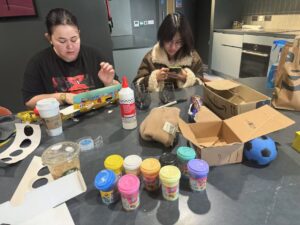
Today we completed the first round of making our dog head microphone. In terms of materials and structural design, we did a bit of experimentation in order to simulate the physical shape and auditory perspective of a real dog’s head using simple materials. This will help us more accurately capture sound from a “dog’s point of hearing” for our project.
📐 Dog Head Sizes and Breed Categories
Based on the three types of dogs featured in our project, we created head models of different sizes:
– Chihuahua (small breed): The actual head diameter is about 6–8 cm. We chose 8 cm as our reference.
– Labrador Retriever (medium breed): Scaled up to a 20 cm head diameter.
– Irish Wolfhound (large breed): For the greatest contrast, we made the head about 35 cm in diameter.
By creating models with these size differences, we aim to simulate how dogs of different breeds and sizes might experience sound spatially. This gives us a physical foundation for our sound design.
🔧 Materials and Construction Approach
We used three main materials to build the dog heads:
– Cardboard: Served as the skeletal framework—lightweight, easy to cut and shape, yet strong enough for structure.
– Plasticine: Simulated the “muscle layer” and soft tissue of a dog’s head, giving weight and flexibility to the shape.
– White glue (PVA): Brushed on the outside as a sealing layer to strengthen the structure, prevent deformation, and add texture.
An unexpected bonus of this combination is the tactile and acoustic feedback—when you tap the completed dog head, it produces a sound somewhere between soft flesh and solid form, very similar to striking actual animal tissue. This quality gave us ideas for using these models not only for microphone placement but potentially as physical sound sources for future sampling.
🛠 Challenges and Solutions During Construction
During the process, we ran into a shortage of cardboard. To make the most of what we had, we carefully selected the best pieces and **patched them together using transparent tape** to form the frame.
Initially, we were concerned about whether the taped structure would hold, but once the clay was added over it, the overall form became much more solid and stable, more than we expected.
In terms of practical functionality, we also designed the heads with recording in mind. We left microphone slots on both sides of the head, aligning roughly with where a dog’s ears would be, and created openings at the bottom and side for cable routing. This setup allows us to mount mics easily and connect them to recording devices, achieving a binaural recording experience that closely mimics a dog’s hearing position.
Despite the simplicity of the materials, this handmade process gave us valuable insights into structural design, texture, and acoustic response. It also laid a solid foundation for the next phase of our work—testing how the different-sized dog heads affect recorded sound in the same environment, and further exploring the relationship between body structure and auditory space.
Ruiqi:
I hate to say this, but… I’ll never forget how embarrassing it was, running into every single shop on South Clerk Street asking for cardboard.
Carly:
It was a shock to discover that the plasticine here is different from the one in Spain. I think one of the biggest problems we encountered was how long the heads took compared to how long we actually planned them to take. We started at 10 am, thinking we would finish around 2 pm or 3 pm. We didn’t even finish that day…