To increase the variety of interactions and make them not just focused on the main mushroom, I proposed adding an ultrasonic sensor part.
In terms of technology, I specifically utilized the Arduino platform, ultrasonic sensors, and LED bulbs.
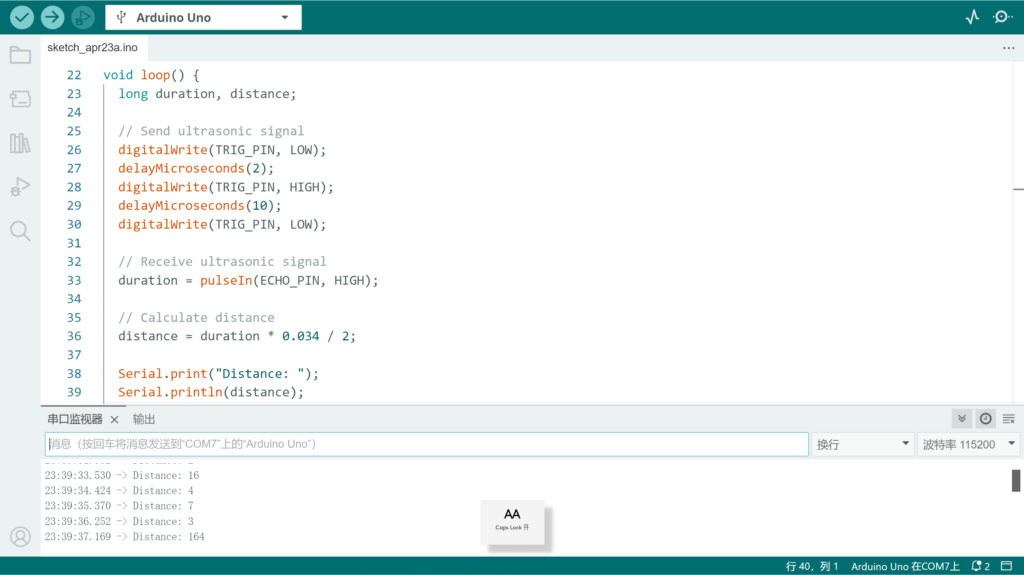
The code runs sequentially, first reading data from the ultrasonic sensor. This type of sensor can measure the distance of objects in a single direction (not limited to objects with biological characteristics). Then, based on the user experience designed by our group, usable distance ranges were determined.
Regarding the participant experience, our group’s creative intent was to express how human activities impact the routine biological activities and living environment of mycorrhizal communities. We personified this concept by attributing a notion of “safe social distance” to mushrooms: they remain unaffected beyond a certain social distance, and they coexist peacefully within the safe social distance, but crossing this threshold triggers alertness and discomfort in the mushrooms.
Therefore, in the program, I used 50 centimetres and 20 centimetres as critical values to divide the distances into three intervals: the “no social interaction” range (50,+∞), the “safe social distance” range (20,50], and the “alert/discomfort/danger” range [20,0]. Then, I employed if statements to correspond to the lighting conditions within each distance interval: no light (no social range), pulsating blue light (safe social range), and flashing red light (alert/discomfort/danger range). Through this approach, when participants interact with the art installation, we convey the concept of mushroom social activity distance using the visual effects of the lights more effectively.
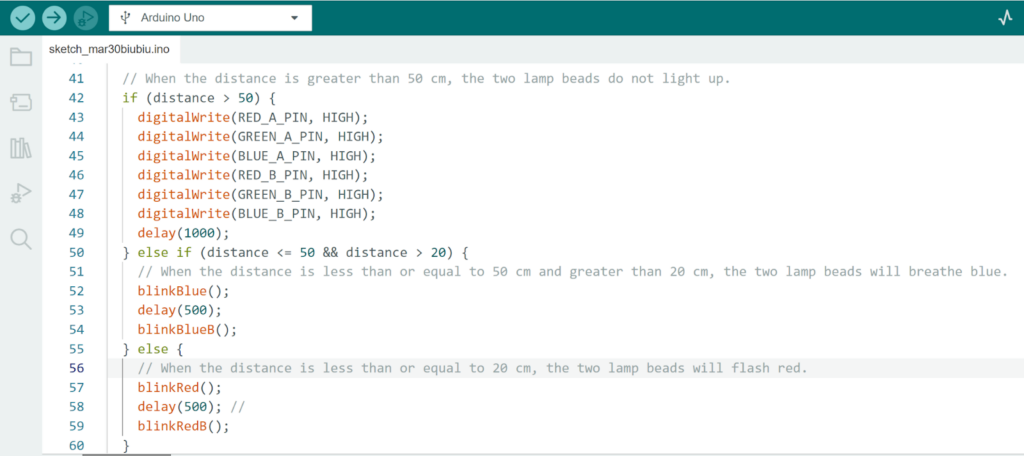
I first did the experiment with a single LED, and after success, I changed it to two LEDs for linkage control.