For nearly two weeks, Shirin and I tried to find different ways to style the mushrooms in our project.
We tried making it by hand, using crepe paper and wire. We also asked ECA’s wood workshop about the possibility of using cut wooden boards to create the main structure. And asked the metal workshop about the difficulty of welding the theme structure with wire.
We also considered 3D printing, but this method does take a long time. However, there is no need for continuous manual operation during this period, so I think it is feasible.
I’m trying to build a mushroom model in C4D. There are three key issues:
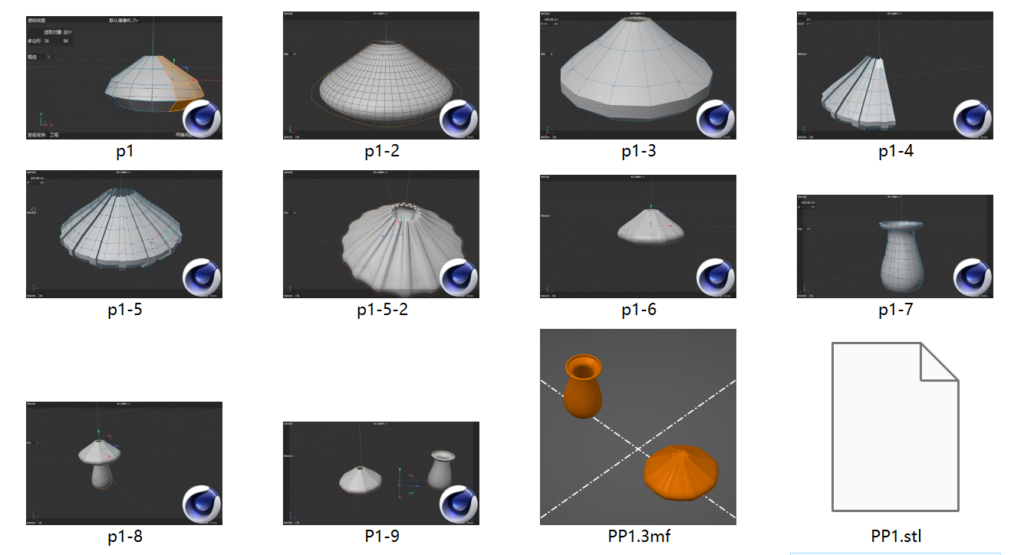
1. The size of the model. The maximum printable size of the 3D printer in the main library is 18cm*18cm*18cm. So I considered dividing the model into upper and lower parts, printing them separately and then splicing them together to expand the size of the mushroom.
2. Transparency of the model. The filament for the 3D printer in the main library is coloured PLA. Considering that in our project design, each mushroom will have different colours of luminous changes, in order to avoid interference, white PLA can be used. But this material itself is not very transparent. So I left a hole in the top of the model to let the light shine through.
3. The thickness of the model. At first, I wanted it to be as thin as possible so that some light could shine through. Later I realized that this would require higher printing accuracy, and was not conducive to later polishing. It may be more time-consuming. Finally, I increased the thickness.
I retained the internal hollow structure to facilitate the placement of sensors, lamp beads and wires in the physical model later.