
Our Grandmother, Our Heritage
Arkotong Longkumer
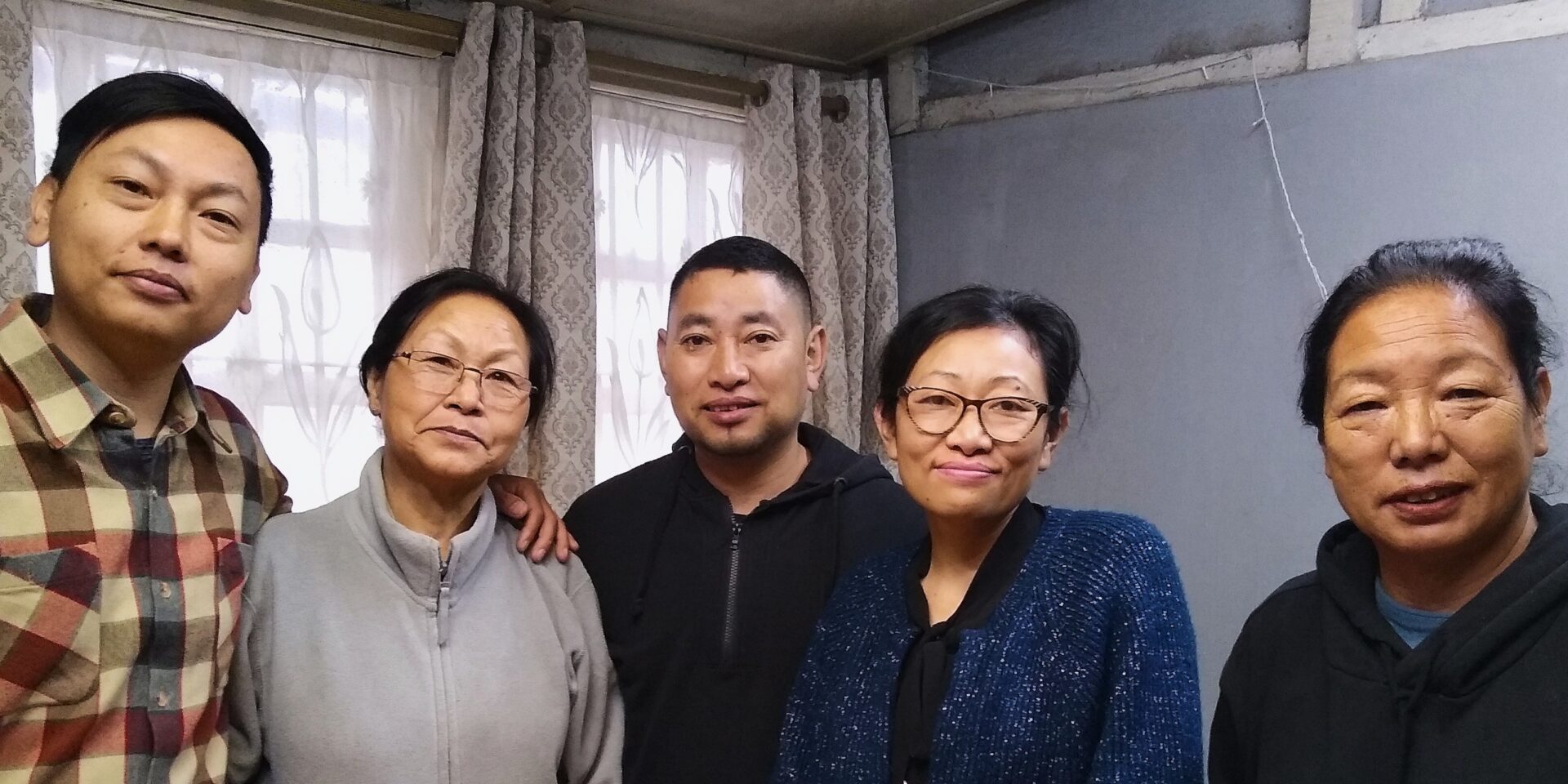
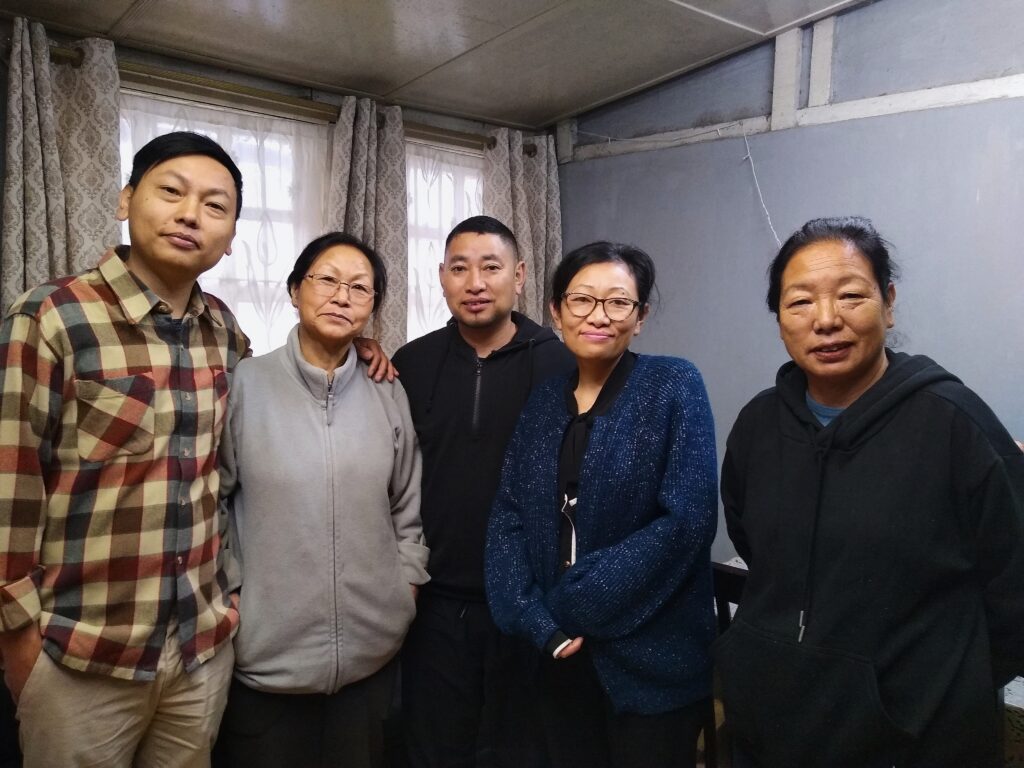
A/F 69 in Upper Agri Colony in Kohima, Nagaland, has a close association with Rani Gaidinliu. Her house, given to her by the Government of Nagaland around 1966, was her home for many years, and it was also the place where the grandchildren were born, where family stayed and where extended kin and friends would gather to chat, have meals and celebrate various important occasions. It is a house of memories, memories that are still held and remembered. Gaidinliu was unmarried but her younger brother, Khuisinang, has seven children, with Gaikhanglung being the second oldest. Gaikhanglung has seven children with Arai the oldest, followed by Kailem and Alila, who is the fourth, alongside four other siblings. Gaikhanglung and his wife still live there with Alila, their daughter, and together with her family. The women, Gaidinliu’s grandnieces, are now in their 40s and 50s and who were quite young when Gaidinliu died. I sit down with them over Zoom – Kailem and Alila joining from the house in A/F 69, and Arai from Delhi – to talk about their recollection of their Apai (grandmother in Rongmei) and what the Gaidinliu collection means to them.


‘We heard that her spectacles are in some museum in the UK’, they tell me. ‘You mean the dark glasses she wore?’, I ask. Kailem chips in to say that ‘Apai was so stylish, and she always travelled with her dark glasses’, an accessory that became iconic. This is why, Arai tells me, that there was a rumour the glasses went to a museum. I ask them about some of their enduring memories of her clothes and if they were curious about her style. ‘She always had a particular mekhla (wrap around body cloth), a black cloth with fringes draped around her upper body, a head scarf, and her comfortable brown canvas boots’, Arai says. Alila remembers that she had a black head scarf, which she always wore when going out. I ask if there was a reason she always wore it, Alila chuckles and says, ‘perhaps it was to cover her grey hair’. All three of them laugh out loud, as recognition perhaps of a story that they have told each other many times over.
These warm memories of their Apai are endearing and they remember their time with her with fondness. They are incredibly proud of her. While Gaidinliu was just an ordinary grandmother like any grandmother, Alila emphasises, she was also famous, and many people would come to visit her. As she grew up, Alila would hear stories about her bravery and her time avoiding capture from the British soldiers. So it was only later that Alila started to see her Apai in a different light, leading her to start researching into Gaidinliu’s life herself. The women’s memory of Gaidinliu while growing up, though, was associated very much with the domestic sphere.
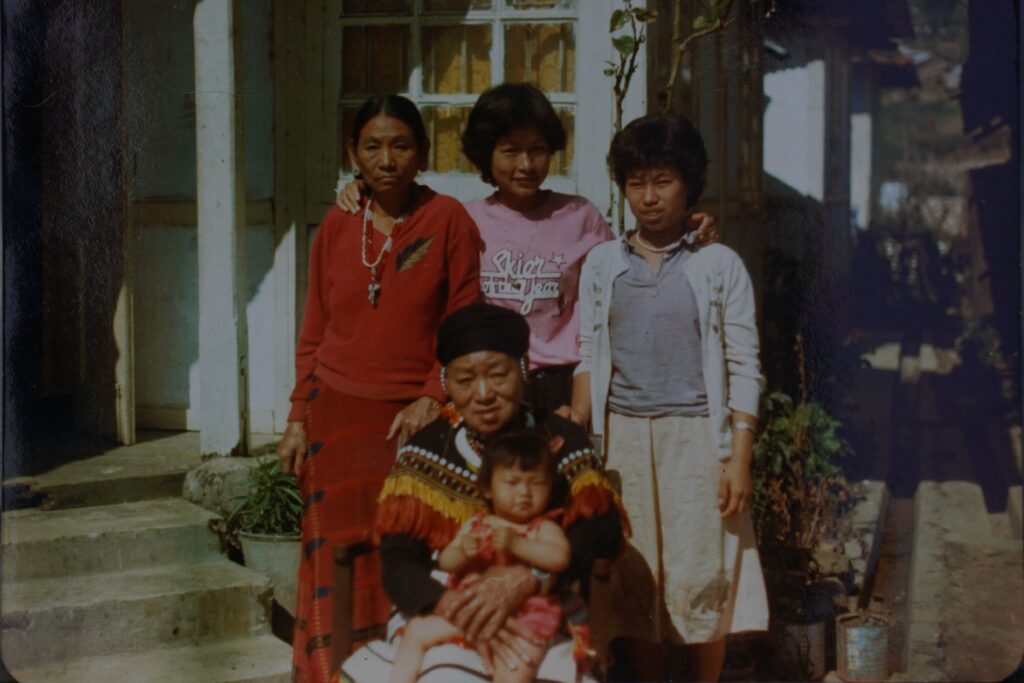
The women were born in A/F 69 and Apai was often around to help with childcare; Kailem remembers her time with her as she and Arai (who were the older siblings) also slept in the same bed together with Apai, which in Naga families is quite common. She would give the children sweets, Vicks (a menthol flavoured lozenges) was a popular one, Kailem remarks, but her favourite was Nova sweets, a type of sweets common in India at the time. She always carried some with her and she would distribute them to her grandnieces and nephews. Sometimes when she was about to travel to Imphal (a neighbouring city in the state of Manipur), she would give them 2 rupees, which in those days was an incredibly generous amount. It is obvious in the way they speak that all three women enjoy recalling these events and memories.
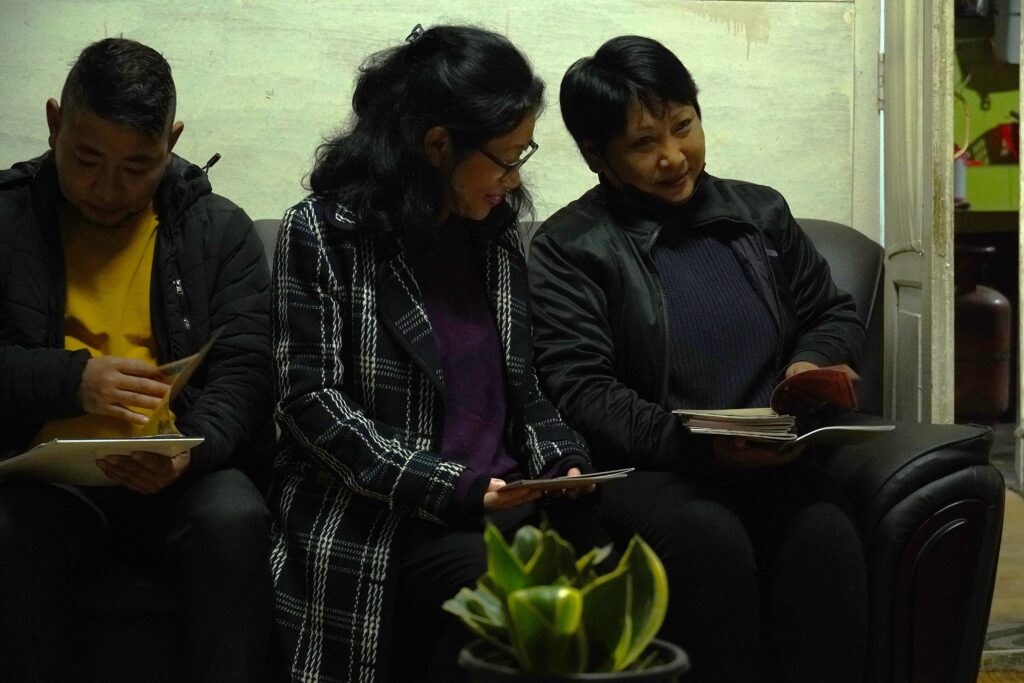
The research team first met the family in December 2023 in their house in Forest Colony. ‘We were really surprised’, Alila remarks. They had heard that Gaidinliu’s things were in a museum somewhere in the UK but thought it might only be rumours and left it at that. But when Clare Harris (a member of the team) showed them the script and all the other personal items of Gaidinliu, they realised that it was not rumours at all. During the meeting, the team provided them with all the digitised copies of the collection, including a replica of the notebooks for their keep. Now, two years later, I am having a follow up conversation to discuss their memories of their grandmother and of the collection.
Seven object lessons and their memories
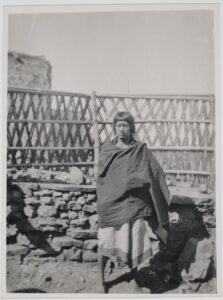
I begin by showing a portrait of Gaidinliu, shot in Puilwa village (present day Nagaland), on 17 October 1932, which was probably taken at the time of Gaidinliu’s arrest by Captain MacDonald (From the Hutton Collection, Museum of Archaeology and Anthropology, Cambridge). After a few moments of silence while they examine the picture, Arai is the first to reply. ‘She looks so different, and nothing like the way we knew her to be when she was older’. Kailem agrees and says, ‘she looks angry to me, and perhaps also defiant’. ‘She also looks lonely’, Alila adds. I explain that she was probably around 16 at that time, has a bounty on her head for evading capture and is being hounded by the British military. ‘What must have been going through her mind, I wonder?’, asks Arai. Alila then asks if photographs of this kind were procedure when someone is captured by the British? And if she was made to stand like that? ‘It is a sad picture’, Alila reflects, saying ‘why did she even have to take up this movement, right, to go through all these struggles? That’s a question that comes to our mind when we see her standing there like that’. ‘And you know’, Alila continues, ‘she had her brother with her. It’s not just her, when this photograph was taken’.
It didn’t occur to me that her brother, Khuisinang, was with her during this time. I ask the women how old their grandfather, Gaidinliu’s brother, would have been around that time. If she was 16, then, he was around 9 years old, they reply. Khuisinang apparently travelled with Gaidinliu, and the sisters believe Gaidinliu’s expression in the photo conveys the fear and uncertainty of an older sibling thinking about her younger brother. The photo gives only a partial glimpse of the situation. Alila says, ‘our grandfather [Gaidinliu’s brother] must have been terrified right? He was just a young boy’.
The mood is melancholic and sombre as we look at the photograph. After a moment, I puncture the silence by asking them what they make of her clothes. Arai makes the point that her clothes are worn out, and Alila notices that on the left side of her body, she seems to be carrying something. Could it be her basket, which is in the collection? I ask. Kailem notices that the basket would have been too large, and maybe it is a smaller item? We wonder what the smaller item might have been, or could it be just her hands protruding from the cloth making it look like she was holding something? The relationship between what we see and what we know is never settled, John Berger reminds us, when looking at images.
I start to show them the next portrait of Gaidinliu taken in Yimrup village (Chang region in eastern Nagaland), upon her release from prison in 1947. Yimrup village is where she spent around 9 years of her life with her brother. The photo was taken by the anthropologist Charles Robert Stonor in January 1948 and donated to the Pitt Rivers Museum in 1969.
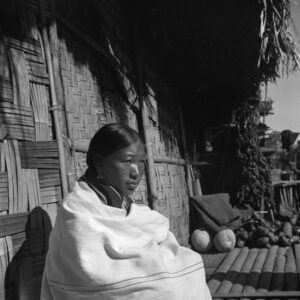
Alila is the first to comment. ‘She seems more relaxed here, and she doesn’t even look like she’s camera conscious, as if she’s in her own world and staring somewhere, like she is deep in thought. She looks very different over here, too. And very dark [referring to her skin colour] also. She was fair, right? She’s fair. She was fair’. They then notice her earrings. Kailem detects the small earrings and says that she usually wore bigger ones with white and red mix of colours. But here there are only the small hanging ones. Alila makes a more general point about her clothes and fashion sense, which changed after she was release from jail. She normally wore only Rongmei and Zeliangrong cloth patterns and in this photo, although black and white, they think the colours are predominately white, with red and black on the edges. ‘Did she wear any Chang cloths?’, I ask. This question prompts a conversation about their identities – a mix of Rongmei/Chang/Ao – and the many languages they were exposed to. They tell me that Gaidinliu spoke Chang fluently, as her brother married a Chang woman, and she also spoke Ao with the daughter-in-law, who is Ao. She spoke other related Naga languages such as Sangtam, Sümi, Lotha and Rengma. She was also fluent in Bengali, probably picked up during her travels in Silchar (South Assam). This multilingual universe, a linguistic cosmos, suggests her traversing the many places of the region, and her intelligence (and need!) in picking up languages in the places she inhabited. This linguistic landscape is reflected throughout the family. Arai mentions that they speak Chang and Ao at home, because their mother is Ao. But their father speaks in Rongmei, and Ao and Chang. In fact, in my first conversation with Gaikhanglung (also known as Along, their father), we spoke in Ao. This was interesting to me primarily because Gaidinliu is associated mainly with the Zeliangrong people, which has the Zeme, Liangmai, Rongmei and Inpui languages. But it is evident that this is a Naga family of multiple languages and intermarriages (Ao, Chang, Lotha, Chakhesang), which also provides a glimpse of their territorial expanse and heritage that is capacious.[1]
I then move on to show an image of a shawl that was in Gaidinliu’s possession when she was captured by the British. Arai remarks
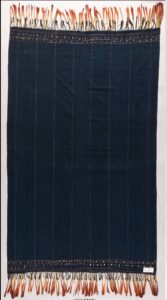
that she has not seen this shawl before. Alila joins in to say it’s a beautiful shawl. They look closely at the shawl and remark that the design on the edges look like stars. They struggle to recognise this shawl, but then Arai makes the point that, the fringe of the shawl does remind her of Apai’s iconic shoulder wrap (like a coat they say), she used to wear. They recall that Gaidinliu often had a weaver who would weave her coats, and it was always done inside her room and never outside.
I then magnify the image and ask if they are talking about the border, which has a fringe with extended thread wrapped with animal hair and orchid stems. Arai returns to the image and queries if the threads are held together by some kind of hair, with some orange thread dye? Unable to make out the design, Alila suddenly moves into the centre of the screen exclaiming: ‘I know. My mum was saying it’s lotus stem’! Her sisters agree in unison and nod their heads. Alila continues, ‘my mother was telling me yesterday that she has a yarn of that lotus that Apai used, which was used for weaving’. ‘I’ve seen it’, Keilam says, making the sign of a spinning wheel. They then switch to Nagamese and discuss amongst themselves, recalling that the spinning wheel was like the one used by Mahatma Gandhi. They are probably referring to lotus yarn, which is native to Southeast Asia. It is an aquatic plant which is a rare and luxurious fibre derived from the stems of the lotus plant. I then ask what kind of hair the fringe would be made of? Arai wonders if it could be pig’s hair, as that was commonly used, and she continues to note that this is shiny and not dull, so while weaving they might have used some special dye.
Part of my information comes from the Pitt Rivers Museum catalogue description that describe this shawl as ‘Dark blue woman’s body cloth made from two panels of woven indigo-dyed cotton, with two fringes of faded red-dyed goat hair tassels bound with yellow orchid stem’. When I mention this, they agree that it could be goat or pig’s hair, but they seemed certain about their memory of the lotus stems. This illustrates a significant point that the research team noticed during the project – ‘memories’ are not only recalled through language; but also through various forms of embodied, material practice that have been handed down across generations.
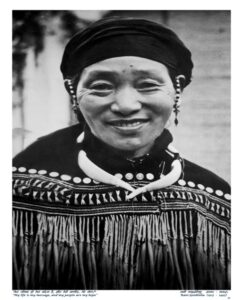
I show them the next image on the screen. They concur that this is worn around the waist. They tell me that the one their Apai used was similar in colour but she had two or three flower designs made of wool along the borders of the cloth with the various threads and lotus stems, which this one doesn’t have. In fact, the lotus stem is her signature accessory that she used on all her cloths, Arai explains. Moreover, ‘the waist cloth that you’re showing us is incomplete’, they say. By this they mean that their memory of seeing their Apai wear the waist cloth with the flower design is the one that is fixed in their imagination, which to them makes it more complete. This was tied around the mekhla (like a belt) to keep it up, but also as part of her style. Kailem interjects by saying that ‘it’s fashionable, isn’t it?’ The sisters nod in agreement, and remark that it was worn primarily during festivals, special occasions, and usually when she left the house for official events. The grandnieces think that this cloth was Apai’s invention. I ask them if they own such a cloth, and they note that nowadays this is worn only during cultural shows or on special occasions. It provides a glimpse of how sartorial choices – now dominated by clothes on the market like jeans, t-shirt, and sweaters – have also shifted, compared to the days of their Apai when most of the clothes and body cloths were stitched or woven at home.
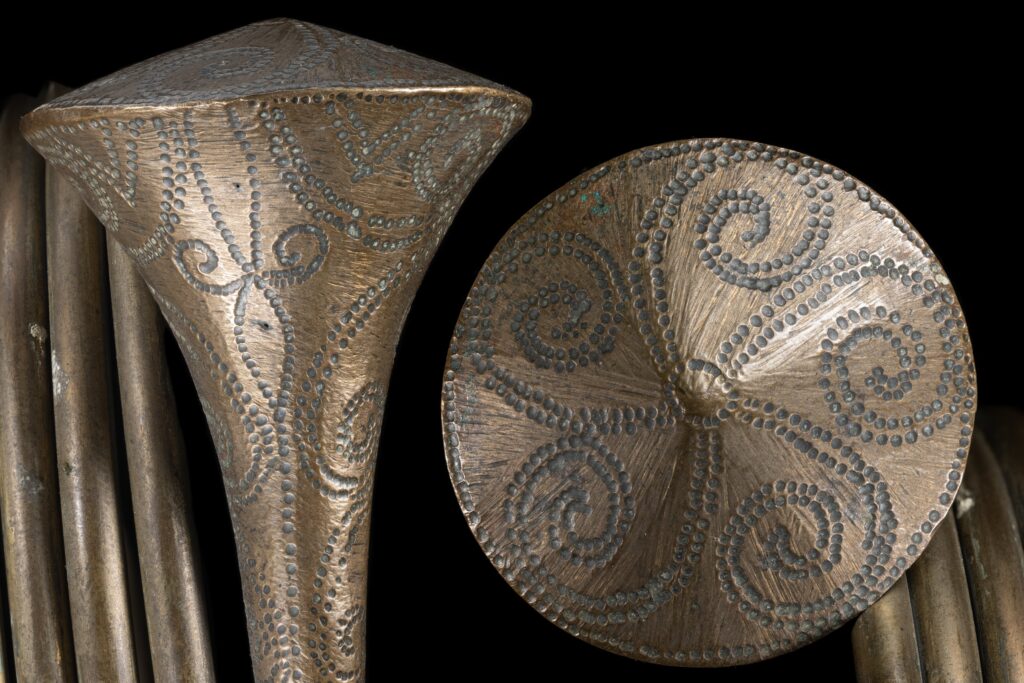
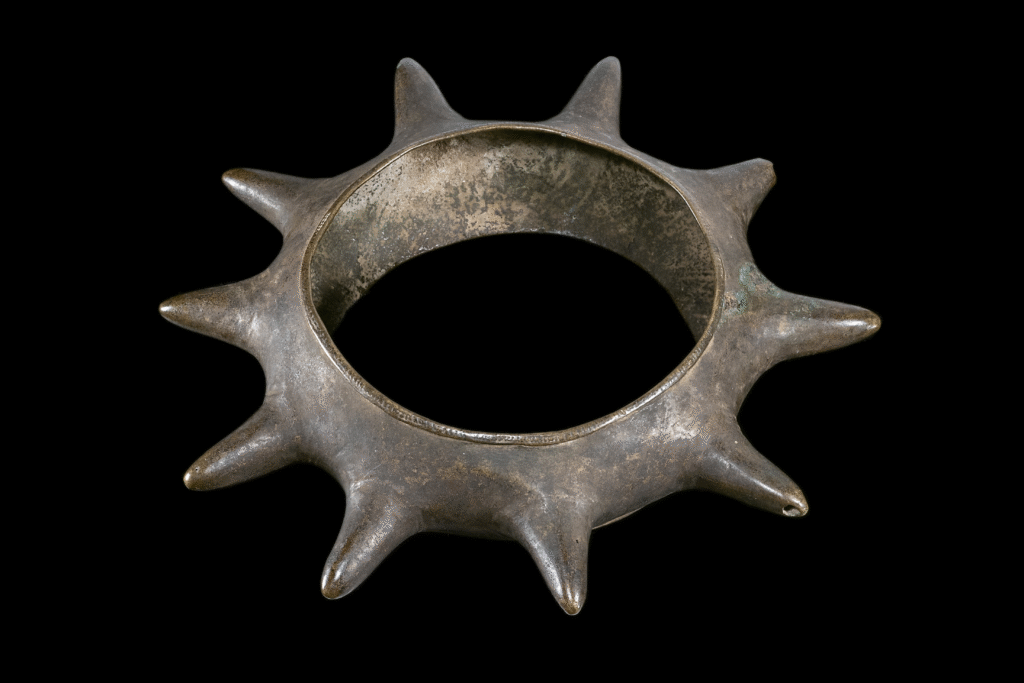
The next item that I show is the pair of spiral brass armlets that were in Gaidinliu’s possession. These the sisters had not seen before. They admire the unique design with the dotted circular patterns in the armlet. Could it be, they ask, this was created especially for her? The next object of the spiked arm bracelet had a similar response from the sisters. They were unsure and wondered if this was a gift that she received from someone else? They all remark that they have never seen their Apai wearing this, and unlike something she would have owned for her personal use.
Next, I begin to show an image of Gaidinliu’s basket, which they recognise. Arai makes the point that she had a larger basket at her home where
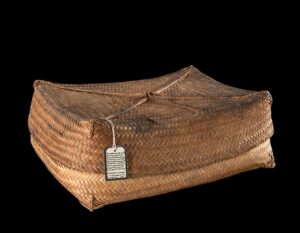
she put her clothes, ornaments and manuscripts of her writing. It was used as storage but also something she carried when travelling – like a suitcase. Kailem tells me how her basket was taken to her native village of Lungkao upon her death, where it is kept. Like the basket at the Pitt Rivers Museum, her personal basket is now part of a network where objects become history and act as a reminder of the past whether in a museum or in a village home. The basket in the museum is not the exception just because it is ‘preserved’ and ‘catalogued’ but the everyday material culture that people engage with has significance.
I read out the inscription on the basket by the political officer, J.P. Mills, which says ‘Basket of note-books belonging to the sorceress Gaidinliu’. Arai recognises the name J.P. Mills which her grandmother (her father’s mother – Gaidinliu’s sister-in-law) used to utter when telling them stories about their Apai – J.P Mills said this, or that. Arai cannot remember the exact stories, but the name ‘J.P Mills’ has stuck in her memory. When I ask them what they think of this basket, Kailem remembers a similar basket, a smaller one, that Gaidinliu used to have where she carried ‘our sweets’. There’s laughter all around as they cherish the memory.
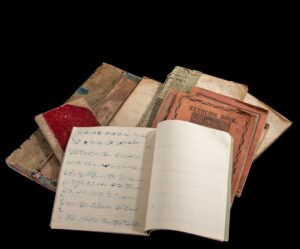
‘I’ve seen her writing multiple times, but I don’t know exactly what she’s writing. Looks like Arabic language type, no?’ This is how Kailem responds when she sees the Gaidinliu notebooks. These notebooks are largely viewed as untranslatable, but contain important knowledge drawn from local language, telling us about Gaidinliu’s world. I then ask if they witnessed her writing anything down and whether the writings are familiar to them. Kailem tells me that she did see her Apai writing down something, but now she thinks that it was the songs. She loved singing and composing songs and they would be written down. I ask if Kailem could be more specific – were these songs written using the alphabets in the notebook? ‘Yes, yes’, Kailem replies and suggests that possibly the script she wrote was like musical notations? She’s not entirely sure but ‘I can still recall the songs, as I remember them from my childhood’. ‘There was also a lot of dancing, particularly groups of people would come at night, and they’d dance’. So the singing and the dancing were part of their experiences growing up. When I ask Kailem if she still remembered the songs, her sisters playfully chide her to sing, as they’d also like to hear them again. She sings a tune that is recognisable; a song that is familiar in the various Naga regions where Gaidinliu is revered. ‘It’s a Zeliang [a Naga tribe associated with Gaidinliu in Nagaland] song’, Kailem clarifies. Another explanation of the script, Alila says, could be that ‘maybe she was writing a diary, and, you know, maybe since she was not educated, she was just… she just created her own script and started writing what was in her mind, it could be that also, right?’
After looking at collection on the screen, the sisters tell me that many of Gaidinliu’s things are also in their possession. While the curation session provoked many recollections and memories of their Apai, they talked about how her things are kept in Lungkao, her native village, and in their home in Kohima. All these possessions were supposed to be kept at Gaidinliu’s museum in Kohima – an initiative started by the Indian government but only half-complete due to various objections from the public and civil society in Nagaland. The sisters then begin discussing where her things could go? Alila suggests perhaps they should go to the Indian government, as she feels that ‘she fought for the country, so she… whatever she did, she didn’t just do it for the family, right? She did it for the whole country’. What is the right way to honour her story and her personal things? There is no one right answer, they say, but maybe they should go to the museum, like they originally planned to.
The place of the museum as an institution to preserve and to sustain a conversation around Gaidinliu is important for the family. In the intimate setting of the home, Alila tells me, while the memory of their Apai is in their minds, and ‘will be like that forever in our hearts’, they also want the world to know of her story. That is why they feel that it should go to the museum, and for others to know that she gave her life for the country. I then ask what role do museums play in the preservation of Gaidinliu’s things, including the collection at the Pitt Rivers Museum?
They say that it is important that Gaidinliu’s things are preserved. ‘It’s safe there and it’s breathing’, Alila says, ‘because here, we do not have that capacity to preserve it for another 100, or even a 1000 years’. ‘Only when we don’t have it, we know the value of it, right?’ She continues, ‘for us because sometimes we are so lost in our own world, we forget the importance of such unique and such important things. This is very valuable. But at the same time, we also wonder if it is displayed in the museum for the right reason’. For example, one thing that unnerved Alila, she says, is the label in the basket describing her Apai as a ‘sorcerer’. It brought up a lot of painful memories growing up in Kohima and the rumours that circulated about Gaidinliu as a ‘sorcerer’. Being her grandchildren, it wasn’t always easy. This is what the project is attempting to do, I explain – we are trying to revise these unhelpful descriptions by changing the narrative and telling Gaidinliu’s story from the eyes of those who knew her, like we are doing now.
Memory and the practice of remembering is often difficult, they tell me. Over these two hours, a lot of old memories have surfaced, Alila says, ‘even when we were talking, my memory went that far. Yeah, to think about her, and all that, even the brown canvas and all that’. Their abiding memory of their Apai, of a woman at home – the sweets she gave them, the dark glasses she wore, and the ever-present brown canvas boots – provides another glimpse that can be seen as ordinary or even unimportant. The dominant narrative portrays her in a national and international light, which removes her from the everyday routines of home that families all over live through. As we conclude our discussion, Alila speaks about the collection at the Pitt Rivers Museum, with her sisters nodding in agreement: ‘I think for now, it’s in the right place for the time being’.
‘But there is also another sense in which seeing comes before words. It is seeing which establishes our place in the surrounding world; we explain that world with words, but words can never undo the fact that we are surrounded by it’. This eloquent reminder comes from John Berger as he discusses the way we see things. My conversation with Arai, Kailem and Alila demonstrates in some sense memories seen through the prism of their experiences; the presence of Gaidinliu is inescapable. The images that I showed illuminate stories that are certainly difficult to remember, yet even as fragmentary traces they are lodged in the recesses of their minds, unforgotten. These memories are embodied in the house they still call home, a home that they have inhabited through the years, some of which they shared with their Apai. The digital collection creates a space for them to reflect on Gaidinliu’s life and possessions, events that may seem far removed from their day to day lives, yet the collection asks of them to remember, not because this offers information that can be classified or contained, but because it enables memories to live on.
[1] There are also inter-marriages with Punjabi from northern India, Malayali from Kerala, and Nepali from Nepal.
(Image courtesy: https://pibindia.wordpress.com/2015/09/30/rani-gaidinliu-daughter-of-the-hills/)



Thank you so much for the valuable information of Apai Rani Gaidinliu. We are collecting documents, book etc on apai Rani Gaidinliu. We want to promote and developed her legacy.
Thank you very much for your kind comments. If you are interested in any of the material, please feel free to contact us at thedimuseproject@gmail.com to discuss further.