

Projects
This is a small selection of recent projects by centre members
Experiencing the Past
Centre Members Involved: Dr Bryony Coombs, Dr Hope Doherty-Harrison and Dr Aaron Allen
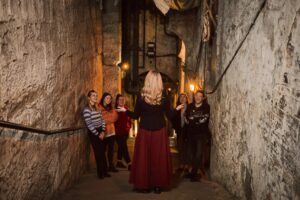 Experiencing the Past is an interdisciplinary heritage‑learning initiative that invites students to engage directly with history — not just through reading, but through immersive, hands‑on encounters. Through a series of extracurricular workshops, students explore real heritage sites, archival documents, and material culture. Recent activities have included visits to historic landmarks such as Mary King’s Close and the 1722 Waggonway Heritage Centre, as well as workshops on manuscript‑making, salt‑making, and historical transcription.
By combining scholarly research, sensory experience, and creative practice, Experiencing the Past offers a richer, more tangible connection to Scotland’s heritage and helps students develop practical research skills through direct engagement with historical spaces and materials.
Hearing Historic Scotland
Centre Member Involved: Dr James Cook
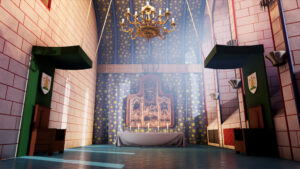 In a world where historic spaces are often experienced only visually, these two linked AHRC-funded projects offered a unique journey into the aural past (Hearing History: Bringing to life the sounds of the past through Virtual Reality and Space, Place, Sound, and Memory: Immersive Experiences of the Past). This pioneering research combined archaeology, architectural reconstruction, and digital acoustics to recreate how music would have sounded in the chapel as it stood in the early sixteenth century.
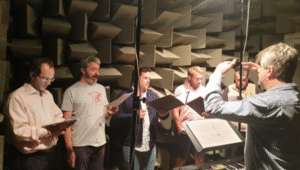
Using detailed 3D scans of the surviving ruins and archival research, researchers reconstructed the chapel’s structure and historic interior finishes. Advanced acoustic modeling then simulated how sound would have behaved within this space, capturing the intimacy, clarity, and resonance of a performance in its original setting. Vocal music recorded in an anechoic chamber (a special environment with no natural resonance) was processed through this virtual acoustic, producing the first complete recording to reflect the sound of this historic Scottish chapel authentically .
The project demonstrates how modern technology can illuminate lost dimensions of heritage, offering scholars, performers, and the public a new way to experience the past — not just as a place to see, but a space to hear. Visitors to Linlithgow Palace can now experience the VR reconstruction on-site, and you can listen to the music, recorded and produced in the virtually reconstructed acoustic in this CD recording.
Renaissance Goo: Sixteenth-Century Cosmetics Recipes and Soft Matter Science
Centre Members involved: Prof. Jill Burke and Prof. Wilson Poon
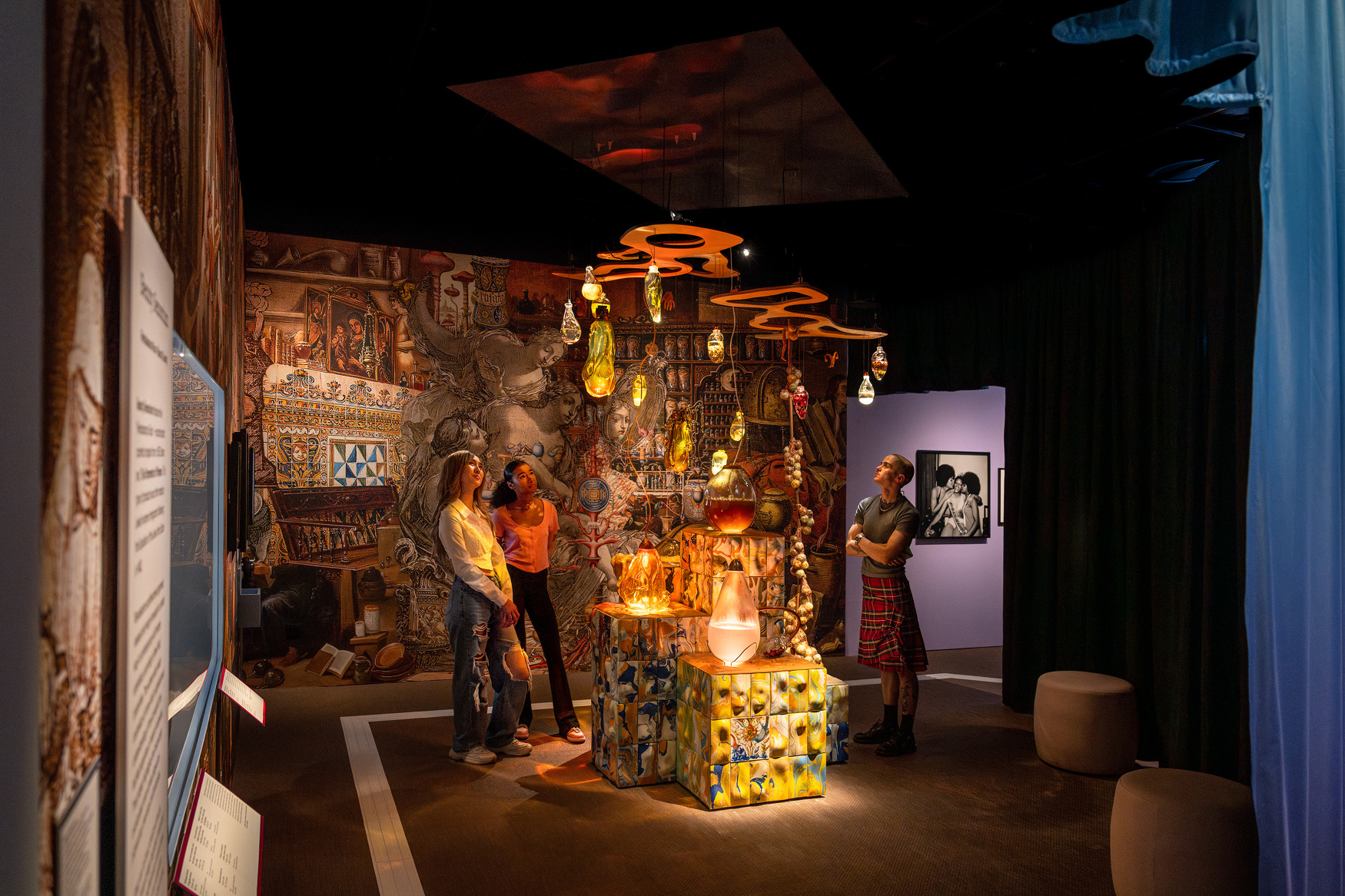 This project. funded by the Royal Societ,y brought together a cultural historian (Jill Burke) and a soft matter physicist (Wilson Poon) to investigate Renaissance cosmetic recipes. Stereotyped as poisonous or unpalatable, we showed how sophisticated Renaissance cosmetics could be, and how the women who made them had an impressive understanding of the material properties of everyday substances that they used to make all manner of cosmetics – from hair conditioner to anti-wrinkle cream. As well as publishing two articles and a book that we BBC Radio 4 Book of the Week, a major outcome of the project was our installation ‘The Beauty Sensorium’ (left) created with artist team Baum and Leahy, which was shown in exhibitions in the Wellcome Collection in London and the Centre for Contemporary Culture in Barcelona.
Within the Frame
Centre Member Involved: Dr Jess Bailey
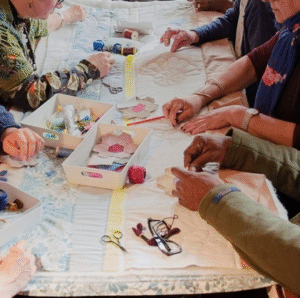 Within The Frame combines academic research with active practice and preservation, honouring the intergenerational exchange of technical, artistic, and embodied knowledge inherent to working at a quilt frame. Bridging the past, present, and future of this unique heritage craft, our project is committed to connecting the next generation of hand quilters with the nuanced historical contours of the artform. Our virtual library of resources and ongoing research connects quilters, academics, and museum professionals with archives, collections, and living practitioners. Within The Frame refocuses how we tell stories of quilting communities in the British Isles, while encouraging the creative evolution of frame hand quilting in the present.
GRASS ROOTS: past, presence, future
Centre Member involved: Dr Tanja Romankiewicz
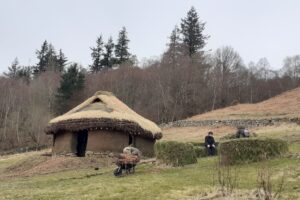 A team of local volunteers, professional builders, heritage managers, local enterprises and researchers are investigating the sustainability of turf as a building material, past, presence and future. Turf has been used in northern climates for thousands of years to build homes, field walls, shelters and defenses. In Scotland, turf structures have been recognised as UNESCO World Heritage, from the humble Cleits of St Kilda to the Roman rampart of the Antonine Wall. But how sustainable was the use of turf – and can it offer a zero-carbon alternative for natural building in the future?
We have tested this by creating a turf-walled bench – and thus learning about modern and ancient turf building by doing it ourselves – trained by professional turf builder Daniel Postma of Archaeo Build. The bench is a modern design, but based on Tanja Romankiewicz’s prehistoric roundhouse research and modelled on an excavated roundhouses nearby. We then expanded by constructing a full-scale modern eco-hut, that links people today with people of the past and of the future, thanks to funding from the UKRI and match-funding by Historic Environment Scotland.
The structures we created are not replicas or reconstructions, but translations into our modern context from the circular building economies that our ancestors practiced for thousands of years. The project taught participant traditional building skills and expanded their knowledge about circular concepts of construction from the prehistoric past to the present day. Together, we took positive climate action and participants can now act as multiplier of the skills they learned, the knowledge they acquired, and the experiences they gained – contributing to a more sustainably built future.
SoundSpace: How Processions Moves
Centre Member Involved: Dr James Cook
 Processions were quintessentially performative acts that infused a sense of social collectivity while at the same time creating and communicating awareness of the aura cultivated by civic and religious authorities to justify and maintain existing social structures and practices. The premise of the Soundspace project is that hermeneutic study of the procession as performance affords enhanced insight into the workings of society and the experience of everyday urban life. It aims to go beyond this to assess the impact of urban ritual on participants and spectators through analysis of the social and cultural processes that lay behind that experience, and of the perceptual discourses that gave it meaning and significance for all those present. Anthropological studies suggest that the aim of processions was to move the urban community, but how did this work in practice in the historical past? How can the historian enter into the performative moment? Understanding of the complex, multi-faceted relationship between sound, space, meaning and society must attempt to identify and evaluate the interstices between collective experience, social expectations and memory, as in present-day sound studies.
The project aims to develop historical sound studies as an umbrella term for an innovative and experimental combination of disciplines—ritual and urban studies, sensory history and history of the emotions—and digital humanities tools, including Virtual Reality, digital cartography and semantic discourse analysis. It aims to forge a new theoretical and analytical framework to understand the social and cultural processes involved in the preparation, performance and reception of processions and thus the underlying social mechanisms that trigger the need for processional expression. The objective is to open up new ways to explore the impact of intangible but key features of processions such as acoustic space, soundscape competence, density of sensory experience and emotional response.
A key reconstructive aspect of the project is to reconstruct the rogation processions of early modern Valencia, in virtual reality. This involves reconstructing several buildings, streets, squares, and markets – their acoustics and their broader soundscapes.

Comments are closed
Comments to this thread have been closed by the post author or by an administrator.