Any views expressed within media held on this service are those of the contributors, should not be taken as approved or endorsed by the University, and do not necessarily reflect the views of the University in respect of any particular issue.
Skip to content

White lettering on a green background which reads: Come in, we're open.
Image by Geralt via Pixabay

Did you know that Academic Support Librarians (ASLs) work year round, even while most students are on their summer break? Here at UoE we have courses starting at different times throughout the year so some members of our team have already been hard at work helping students get settled in and familiar with Library Services right at the beginning of their university journey in Edinburgh.

For example, we have a lot of students who arrive for pre-sessional courses such as the 'Essentials of English for Academic Purposes’ who began in July in order to complete some language courses before their PG study begins. We like to meet these students and make sure they're familiar with which resources will be relevant for them, and how to ask for help in the very early part of their course so the information stays with them no matter what they go on to study.
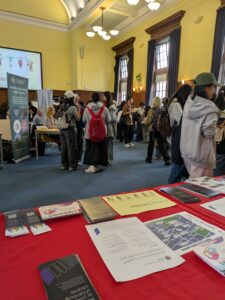
A leaflet display on a table, with other stands around the room and small groups of students stood in between them.
ASLs had a stall at the Community Fairs organised by The Centre for Open Learning (COL) in July

We've been providing library introductions for new and returning students in the College of Medicine and Veterinary Medicine, and we’ll soon be welcoming the latest cohort of Professional Graduate Diploma in Education (PGDE) students who will be arriving on the Holyrood campus on Monday 18th August. This group of students traditionally start before other cohorts and spend limited time on-campus as they go out on school placements at the start of the academic year.

To facilitate early arrival on-campus, Ishbel (ASL for Moray House School of Education and Sport) has liaised with Programme Directors for PGDE Primary & Secondary to find out how many new students are expected to arrive for the 2025-26 session (PGDE Primary: 100 approx. & PGDE Secondary: 145-160 approx.) She has liaised with the Moray House Library EdHelp Team and with Pam Wells at the Main Library to arrange for student ID cards to be sent to Moray House Library in advance, which allows PGDE students to collect cards before ‘official’ card collection events take place during Welcome Week. This year, we’ve also had assistance from Jade Fenton (Graduate Library Trainee) and Tim Gray to arrange for Library tote bags to be delivered to Moray House Library in time for PGDE student arrivals.

We'll also welcome Access students in August. Access courses are designed for adults who are returning to learning after a break and will go on to Undergraduate work in the future - they begin almost a full month before welcome week and continue on for two semesters.

We often talk about how there's no one-size-fits-all scenario for our students and that's because there's so many different courses, circumstances and timetables to account for in our planning. This is just one example of how we're trying to make sure everyone has a valuable and meaningful library experience no matter when they join us!


 

At the University Library you have access to a huge range of material for your research and learning including over 2 million books, archives, instruments and artworks, over 2 million e-books and 330,000 e-journals, as well as 1000s of streaming videos, digital scans, databases, and more.

Text: How To Library

But when you are doing your own research there will be times you come across items or material that our Library does not have in its collections. Don't panic! There are options available to help you get what you need. ...continue reading "What to do when the Library doesn’t have what you need?"

One of the most important things you will need to know how to do when starting out at university is understanding academic references. Here’s a simple guide to help you decode book and journal (periodical) references.

Text: How To LibraryHow to interpret a reference for a book

Example book reference:

Olusoga, D. (2017) Black and British: a forgotten history. London: Pan Books.

  1. Author(s): The first part of the reference is the author’s name. In this case, “Olusoga, D.” indicates the author is David Olusoga. If there are multiple authors, they will be listed in the order they appear on the book itself.
  2. Year of Publication: The year the book was published is in brackets. Here, it’s “2017”.
  3. Title of the Book: The title of the book is italicized. In this example, it’s “Black and British: a forgotten history”. Only the first word of the title and any proper nouns are capitalized.
  4. Place of Publication: This is the city where the publisher is located. In this case, London.
  5. Publisher: The name of the publishing company. Here, it’s “Pan Books”.

...continue reading "How to interpret a reference for a book or journal article"

css.php

Report this page

To report inappropriate content on this page, please use the form below. Upon receiving your report, we will be in touch as per the Take Down Policy of the service.

Please note that personal data collected through this form is used and stored for the purposes of processing this report and communication with you.

If you are unable to report a concern about content via this form please contact the Service Owner.

Please enter an email address you wish to be contacted on. Please describe the unacceptable content in sufficient detail to allow us to locate it, and why you consider it to be unacceptable.
By submitting this report, you accept that it is accurate and that fraudulent or nuisance complaints may result in action by the University.

  Cancel