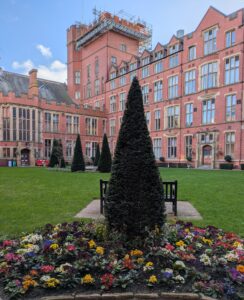
This year's LILAC information literacy conference was held from 30 March - 1 April 2026 at the University of Sheffield with two members of the Library Academic Support Team in attendance, Jade Fenton (Graduate Library Trainee) and Ishbel Leggat (Academic Support Librarian).
Jade and Ishbel have put together a summary of their reflections and picked out some highlights from the conference below.
Jade's report:
One keynote I found particularly interesting was by Matteo Bergamini, who discussed his organisation Shout Out UK (SOUK) and the increasing impact of AI deepfakes and algorithms on the spread of misinformation, disinformation, and malinformation. He explored the concept of 'prebunking', which aims to prevent the spread of harmful information by educating learners about common topics of misinformation, as well as highlighting efforts to promote media literacy within global education systems.
I also attended several other talks that caught my attention, including "Winning the one-shot: the growth and success of a game-based approach to library instruction." This interactive session involved a card game that required participants to search databases, develop search strings, and utilise Boolean operators, which was really fun. Another notable talk was "'All mushrooms are edible but some only once': Exploring conceptualisations of information literacy in risky leisure contexts through hobbyist mycology". This talk used mushroom foraging as a unique lens to study information literacy in leisure activities, highlighting the importance of risk-informed information practices in everyday life. I found both talks to be engaging and enjoyable, offering fresh perspectives on learning library instruction and information literacy.
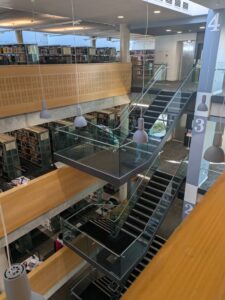
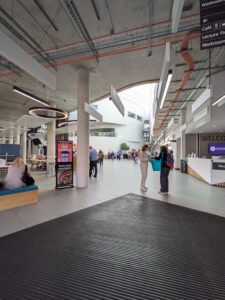
My final highlight of the conference was the tour of the Information Commons, one of the libraries at the University of Sheffield. Although it shared similarities with our Edinburgh libraries, such as Makerspaces, study hubs, and book collections, the Information Commons presented these facilities in its own distinct way, such as having it’s own sewing room and using large dry-erase boards on the walls of group study areas. The Garden Room was a particularly lovely space, filled with nature-themed decor, jigsaw puzzles, and wellbeing books, designed for students to relax. Although perhaps the most exciting thing was the fact you could borrow picnic blankets, deck chairs and weighted stuffed animals at the Library Help desk!
Ishbel's report:
Three separate keynotes were delivered on each day of the conference and although each dealt with quite different topics, all were concerned with how change affects us and how we as information professionals might adapt. The keynote that resonated for me was Sue Lacey Bryant's ("Under the radar: Poor health literacy as a predictor of ill-health").
Sue, who chairs the national Health and Digital Literacy Partnership and previously Chief Knowledge Officer for the NHS in England, spoke about poor health-literacy as a predictor of ill-health, something I had not previously considered, but which makes perfect sense. There is a need to tackle a lack of basic literacy skills (1-6 adults in England struggle with literacy) which excludes access to appropriate information about health care and means people are more likely to believe dis/misinformation. This can also be applied to a lack of digital/media/information/critical literacies in general - information professionals can help tackle issues with literacy and improve many outcomes for our patrons.
Parallel sessions were delivered throughout the conference, and whilst not themed as such, resulted in a wide variety of interpretations on 'information literacy'. Inevitably, artificial intelligence and its impact on libraries and critical/literacy skills (as well as impacting on society more broadly) became a theme across many presentations.
One session I attended was a talk by Madelene Logren, a doctoral student from Umeå University in Sweden. Madelene's presentation ("Critical thinking, disillusion and dissent: Information literacy in a refused knowledge landscape") focused on her research into social media posts made by a group of Swedish nurses during the Covid-19 pandemic. Information literacy is often framed as a solution to the belief-in and spread of misinformation, but Madelene's findings indicate that information literacy doesn't necessarily take place in a shared way, particularly when information is contested. The session concluded with a suggestion that attendees "consider the limitations of information literacy as a solution for belief in misinformation, and to reflect on how information literacy practices may themselves be part of the formation and circulation of such beliefs".
Another session which was a highlight for me was an interactive workshop ("Teaching philosophy unpacked: making your information literacy instruction intentional") delivered by Darren Flynn, Alison Hicks, Arielle Ben-Itzhak and Madeleine Williams, tutors teaching on the Information Literacy module on the MA Library and Information Studies programme at University College London (UCL). The presenters shared experiences in developing their own teaching philosophies, then invited attendees to think about their experience of teaching and write down or reflect in some way what works or doesn't work in their practice. This was a valuable experience for me, allowing me to consider how my approach to teaching has developed and what I might want to change or review to enhance my professional practice. The presenters concluded the workshop by suggesting some applications for personal teaching philosophies (PTPs), some of which I intend to investigate further for my own professional development:
- Process or product?
- Guiding, developing and evaluating teaching practice
- Academic liaison and collaboration
- Developing teacher-librarian identity
- Reflective practice
- Recruitment
- Continuing professional development (CPD)
- Research instrument and/or output.
A few more stand out sessions included Charlotte Dunn and Hakan Gunduz's presentation on their work in re-designing online information literacy modules at Glasgow School of Art ("InfoSMART: a collaborative approach to information literacy"). Their approach was to ensure ongoing collaboration between librarians and learning developers "to create a more engaging and active learning experience". I also enjoyed Kathleen Phillips, Joel Burkholder and Russell Hall's (Penn State University) approach to tackling the rise of malinformation created by right-wing populist groups through the teaching of information evaluation and critical literacy skills. Their presentation was memorably titled: "Weaponizing authority: teaching information literacy in the era of evidence-based othering".
Overall, LILAC provided a welcome opportunity to meet librarians and information professionals from a wide variety of sectors and countries, to share ideas and consider how best to approach our commitment to supporting information literate library users.
More information, including reports and presentation slides from LILAC 2026 and from previous years' conferences can be found on the LILAC Archive.
Jade Fenton and Ishbel Leggat (Library Academic Support).
(Image credit: Jade Fenton)
(Image credit: Jade Fenton)
(Image credit: Jade Fenton)
(Image credit: Jade Fenton)