I arrived in Berlin on Monday 16 March as one of the twelve University of Edinburgh
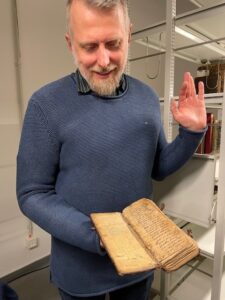
Library colleagues participating in an international exchange visit with the Freie Universitat Berlin. We were blessed with glorious weather and a very warm welcome from colleagues at the FUB, who joined us on the first evening for a welcome meal at the Schwartzes Café. On Tuesday morning, I was greeted at the FUB by Dr Helen Younansardaroud, subject specialist for Ancient history, Orient and Religions, who I had previously met at UK and European theological library conferences. I was also welcomed by Dr Peter Smolak, who recently visited the UoE Library on a two week placement where he gave us the benefit of his Hebrew skills as a Jewish Studies specialist to catalogue some of the New College Library book collections.
The day kicked off with presentations, including an introduction to the library structures and networks of Germany, particularly how the German states shape library provision in tandem with national provision. This was followed by a session on the FUB’s digital interview collection, which includes both a collection of their own recordings and subscribed interview collections. These audio and video recordings often take the form of life stories, or oral history testimonies, and are useful to answer the question of ‘why’ something happened. Next, Sina Menzel presented on her role leading on user experience research in library practice. Sina’s exclusive role for library research supports evidenced based decision making and library innovation. This has included gathering information on ideas and innovations, compiling them into a database to prioritise ideas. Sina also worked with learning spaces services to analyse the feedback from ‘dear Library’ letters. Sina emphasised that, as well as new information, ‘stock’ findings matter too, as we can use this data to justify decision making. Liaison librarians Cosima and Andreas spoke on their relatively new roles, shaped by a concept of liaison librarians as our “library sales force” and “ambassadors of change”. They have a specific brief to support research data management, but are also working on establishing a liaison librarians network from all staff who ‘do liaison’.
Cosima and Andreas described their roles as springing from a strategic shift in focus from “what librarians do” to “what users do” – and this same focus has informed the development of Sina Menzel’s library research officer post. Hearing these presentations shone light onto how the staffing roles at FUB may have similarities, but are not the same as ours. ‘Subject librarians’ are numerous and handle the majority of acquisitions and cataloguing at a faculty library level, as well as the enquiries and teaching embedded in their subject area. The Main Library at FUB provides digital resources and fills gaps in print library provision not covered by faculty libraries. The Faculties themselves retain a high degree of control over library budgets.
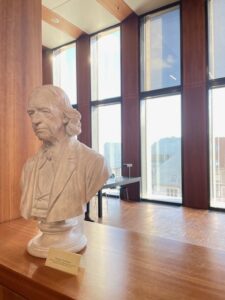
On Tuesday afternoon we made our way to the Grimm Library at Humboldt University, the older University in Berlin, where we were kindly hosted by Dr Yong Mi Rauch from Historical Collections. Yong Mi gave an introduction to the history of the collections, and then focused on a project to reassemble the Library of the Brothers Grimm. About 700 books used as reference tools by the brothers to write their works are being digitised, including the underlining and annotations in different writers’ hands that trace the research undertaken with these books. A Berlin University Alliance has developed, connecting 100 university collections located across Berlin and creating an infrastructure for digitisation - Berlin-university-collections-de
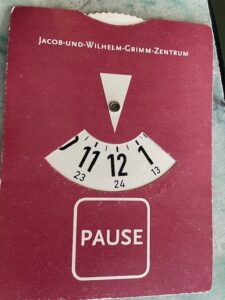
Walking around the Grimm Library at Humboldt University it’s sometimes the small things that spark ideas – for instance the timer clocks used for leaving on desks to indicate a study pause.
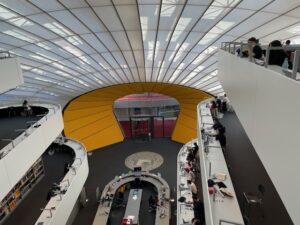
On Wednesday, we visited the libraries at Freie Universitat Berlin. The Philological library, known as the Brain due to its striking architectural design by Sir Norman Foster, contains 80,000 books on languages and literatures. These have been merged together from multiple small faculty libraries and are still in multiple different legacy classification schemes.
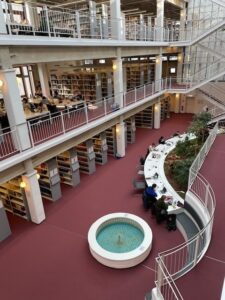
Next, the Campus library, containing a range of collections including Education, sciences and religion, amounting to approx. 90,000 books. As with other German libraries, it’s required for library users to leave their belongings in lockers at the entrance to the library, but the librarians lamented that while there were 950 reader spaces there were only 500 lockers. Notable were problematic collections, including a North Korean collection and collections of Nazi materials which had to be carefully managed. A reparation scheme for older collections is also offered, where books can be returned to pre-war owners. Torah scrolls have been returned to the Jewish community through this scheme.
Wednesday and Thursday were dedicated to our ‘World Café’ workshop sessions, where we spent considerable time in presenting, discussing and capturing key issues including AI, inclusion and widening participation, and developing and potential touchpoints for shared practice. This trip wasn't just an exchange; it was a deep dive into the evolving world of academic libraries. We hope we can bring back some of these ideas and make them work for us.