Event Details:
Monday 18th May, 2026
13:00 – 18:30 GMT
Hunter Lecture Theatre, Hunter Building, Lauriston Place
Agenda:
13:00: Keynote: Stephen Pyne
15:00: Panel Presentations: Melissa Sterry, Adam Bobbette, Liam Ross
17:00: Keynote: Luis Fernández-Galiano
Fire is there at the beginning of the beginning of architectures history and theory. For Vitruvius the Origin of Building and the discovery of fire occurred in the same moment: fire the first focus of social gathering, the first construction technology, the first thing in need of shelter. In the Roman architect’s origin story, building, society, language, the technical arts – Civilisation as such – all spread from that first spark. Since Vitruvius other many theorists – from Semper and Banham to Rykwert and Fernández-Galiano – have returned to the same point of origin to theorise alternative trajectories of development.
Today fire is more often associated with endings. The spark Vitruvius recounts has burned out of control; anthropogenic burning, supported by new technologies of combustion, have led to higher levels of atmospheric carbon and rising global temperatures, triggering runaway climate-change exemplified by the prevalence and intensity of wildfire, creating existential threats for humans and the wider web of life. Civilisation appears autocatalytic. The key technical challenges for built environment disciplines today concern limitations to burning; reductions in embodied and operational carbon, and improvements in building fire-safety, particularly at the wildland interface.
Between these images of beginnings and ends is the period Environmental Historian Stephen Pyne calls the ‘Pyrocene’. Fire is humanity’s ecological signature. Our capacity to modify the world around us can be told through a series of pyrhic trasitions, from the earliest opportunistic use of lightning fire, through to the development of swidden agrilculture and broadcast burning of biomass, to the controlled combustion of lithic fuels. Fire is our fundamental to our ecological agency, but also the means through which we experiences limits to that agency; releasing millennia of stored solar-fire we have breached planetary boundaries, changing the patterns of free-burning fire on earth in ways we cannot control.
Pyne’s work originates from the practice of wildfire management and its intersection with fire-ecology. He is associated with popularising awareness of the wildfire-paradox – whereby fire-suppression exacerbates resultant intensity and spread. His work has defined a field of ‘fire history’ which traces the close relationship between human and non-human fire-regimes. The concept of the Pyrocene has already generated strong responses within the field of Landscape Architecture.
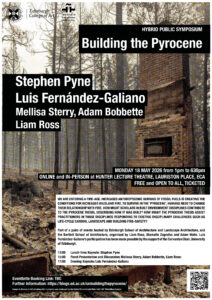
This first symposia, Building the Pyrocene, introduces the Pyrocene thesis to an architectural audience, as well as exploring the range of ways in which fire has shaped the built environment, including:
-
Long histories of the place of fire within buildings, cities and landscapes.
-
Principles of landscape and urban design that work with, and against, naturally occurring fire-cycles.
-
The role of fire as a construction technology, and its relationship to processes of extraction.
-
The relationship between urban fire-safety and life-cycle carbon cost of the built environment.
