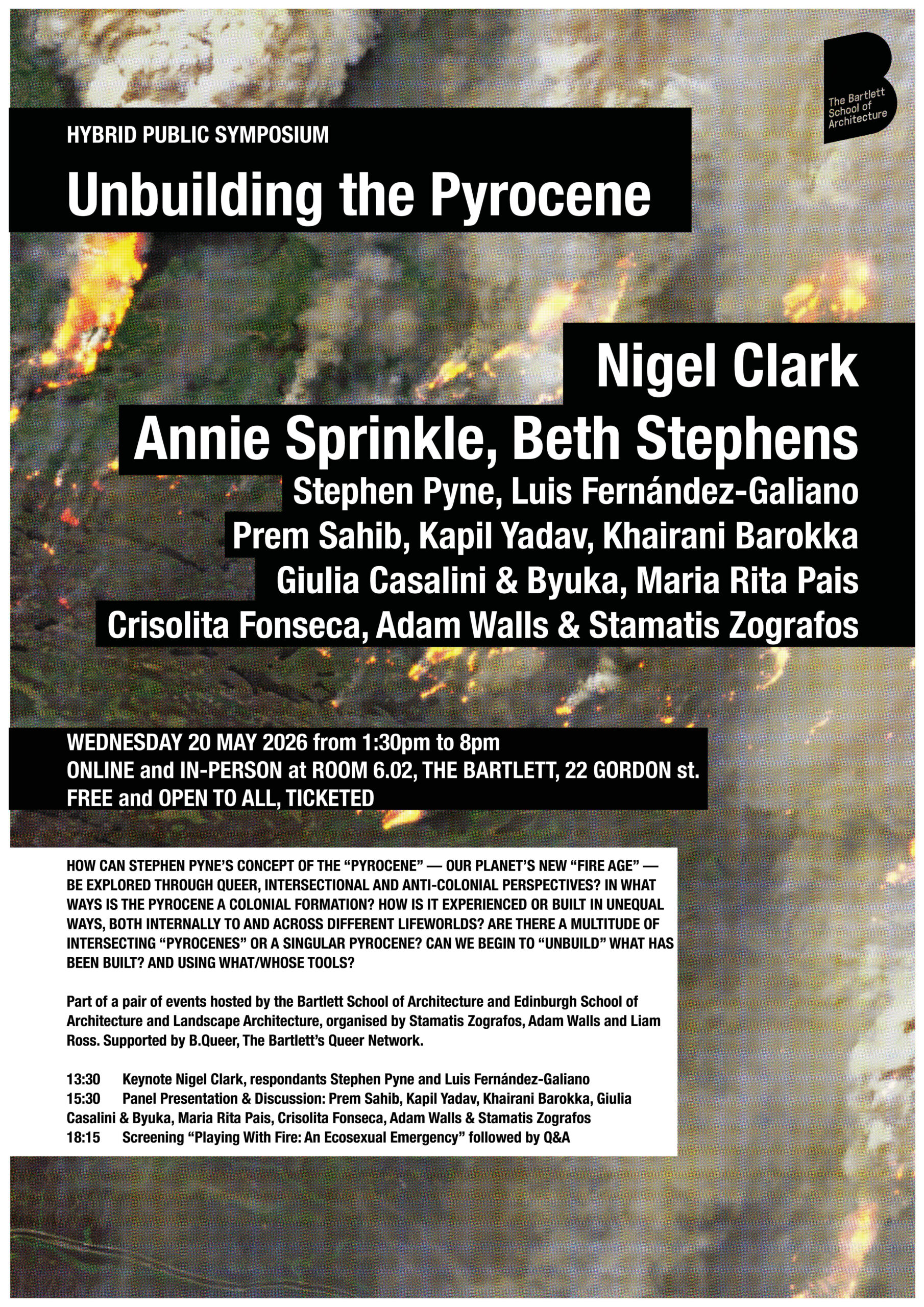
Online and in-person, free. Click here for tickets.
Event Details:
Wednesday 20th May 2026
13:30 – 20:00 BST
University College London, Bartlett School of Architecture, Rm 2.06, 22 Gordon Street
Agenda:
13:30 Keynote: Nigel Clark, with responses from Stephen Pyne and Luis Fernández-Galiano
15:30 Panel Presentation: Prem Sahib, Kapil Yadav, Khairani Barokka, Giulia Casalini & Byuka, Maria Rita Pais, Crisolita Fonseca, Adam Walls & Stamatis Zografos
18:00 Screening: Playing With Fire: An Ecosexual Emergency followed by Q&A with Annie Sprinkle & Beth Stephens
The earth is trembling. Systems of thought have been demolished, and there are no more straight paths. There are endless floods, eruptions, earthquakes, fires. Today, the world is unpredictable and in such a world, utopia is necessary. But utopia needs trembling thinking: we cannot discuss utopia with fixed ideas.
Édouard Glissant, in conversation with Hans Ulrich Orbist (2021)
Within the context of the climate crisis, thinking utopia and the planetary have become urgent tasks. But how do we think the Earth’s totality without dissolving and homogenising its infinite differences? And when we speak of utopia, whose utopia are we speaking of? How do we decide which futures become liveable and which become unliveable?
Thinking with the Antillean poet and philosopher Édouard Glissant, this process must not be a zero-sum game: we need to embrace the Earth’s diversity and need a proliferation of concepts to do so. Stephen Pyne’s ‘Pyrocene’ – his term for our new ‘Fire Age’ (2021) – is now one of upwards of 80 alternatives for the Anthropocene (Chwałczyk 2020). Each is a different tool for thinking the Earth’s totality – and for making the Anthropocene narrative tremble, diffract and multiply. As Pyne argues, each has their own value, and the great strength of the Pyrocene lies in its non-anthropocentrism: instead of universalising the human or assigning blame to one or other group or system, it foregrounds ‘humanity’s primary ecological signature’ and the defining element of our times – analogously to the way that ‘Ice Ages’ have been foregrounded previously (Pyne 2021, 3-4). There is no sense of human mastery over nature here – Pyne’s favoured term is ‘alliance’ – and there is a deep engagement with diverse fossil-fuelled and Indigenous lifeways. Yet in centring an element, do we lose something of the criticality of terms like ‘Capitalocene’ or ‘Plantationocene’? And in what ways does the Pyrocene still function as a ‘charismatic mega-category’, one rooted within the western academy which ‘sweeps many competing narratives under its roof’ (Todd 2014, 246)? In other words, how can we make the Pyrocene tremble further? Do we need, as Kathryn Yusoff might suggest, a Billion Black Pyrocenes?
Where the first symposium asks how we build the Pyrocene, this second event asks how we might ‘unbuild’ it. It will ask:
-
How can the Pyrocene be further explored through intersectional, non-western and anti-colonial perspectives? How do we make the Pyrocene tremble?
-
How is the Pyrocene experienced or ‘built’ in unequal ways – both internally to and across different lifeworlds?
-
How do diverse media or aesthetics construct and give access to the Pyrocene in differing ways?
-
Are we talking about a multitude of intersecting ‘Pyrocenes’ or a singular Pyrocene?
-
Can humans begin to “unbuild” what has been built? And using what/whose tools?
