
Knowledge Mobilisation is an active process of shaping and tailoring knowledge (e.g. research insights) so that it reaches the right people and can be applied effectively (e.g. in policy or practice). Knowledge Mobilisation is not a bolt-on; it’s not a “phase” or a targeted “push” of information after a project finishes. Rather it should be and active two-way process that is integrated throughout a project.
So what does that mean for evaluations? How can you practically integrate knowledge mobilisation throughout an evaluation timeline?
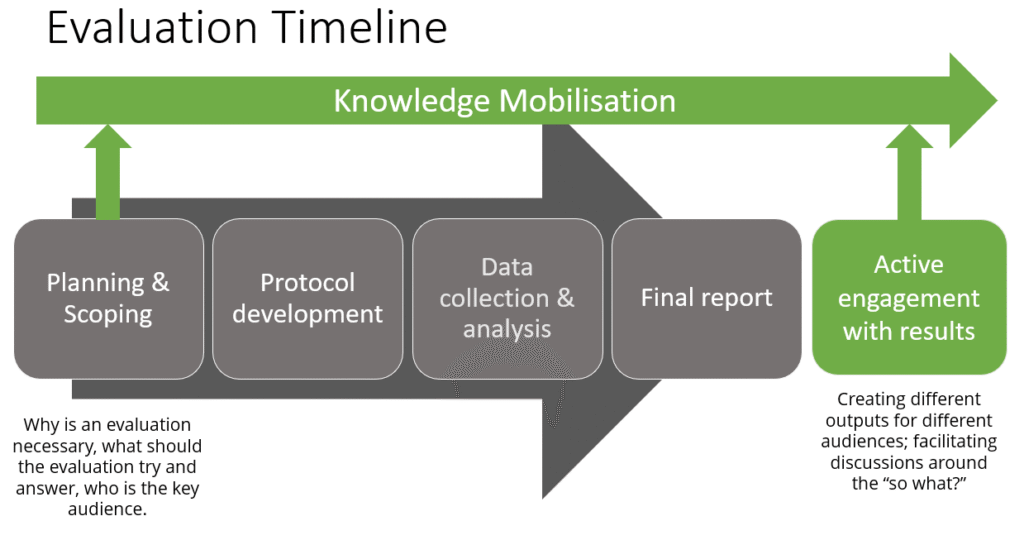
Start of the evaluation:
The start of the evaluation is crucial for defining and involving the primary audience/evaluation users. This can be through an evaluability assessment or similar scoping phases. Other blog posts cover Step 1 and Step 2 of untangling evaluation aims and knowledge mobilisation goals. Involving the primary audience early is key in shaping meaningful evaluation questions, feasible evaluation methods and understanding local impact goals. It is also a good opportunity to work with the primary audience to understand what outputs could be most useful to support their impact goals, and who else might be or should be interested in the evaluation (wider impact opportunity).
Middle of the evaluation:
The evaluation is now underway. This is a great time for planning which actions can support local impact goals. This is also a good time for identifying audiences who might be or should be interested in the findings, and how to reach them for wider impact. Ideally you can summarise all this in a knowledge mobilisation plan, which can be revisited throughout the evaluations.
As a prompt, here is a list of activities we did for one of our evaluations to support both local and wider impact. As a local government was delivering the intervention, this list of activities is focused on local government settings.
1. Dedicated knowledge mobilisation meetings with the intervention delivery team or strategic team – this helps plan activities to align with local impact goals, and identify wider audiences
2. Independently mapping local and national interest groups, including teams that run similar interventions or evaluations.
3. Engaging decision-makers e.g. through 1:1 meetings, local board meetings or steering groups. This could be to deliver interim updates or offer Q&A sessions.
4. Working with relevant Comms & Marketing within the local government – these can help with internal communications (newsletters etc), local press contacts, pathways to engage local residents etc
5. Briefing local councillors about the evaluation timeline, what impact the results may have – this could also extend to local MPs.
6. Identifying knowledge brokering organisations (i.e. organisations connecting research with policymakers/practitioners). These can help act as an intermediary to reach key audiences. For instance, here is a list of local knowledge brokering organisations in Yorkshire and Humber.
7. Involving members of the public to understand how to frame messages for the community, and what outputs would be most useful. There is of course the opportunity to co-produce evaluation outputs for the community with local residents. Read more about involving members of the public in evaluations.
8. Planning the report format and other outputs – will additional expertise be needed e.g. graphic designer or animation company? Quotes will likely be required.
9. Organise an early networking or knowledge sharing event – although you won’t have evaluation results yet, such an event can be helpful to bring key interest groups together and discuss the challenges in running similar interventions and evaluating them.
10. Review evaluation findings as they emerge. Anything surprising? How do they align with your impact goals? In some cases, evaluation results may be unexpected and require a pivot from the original impact plan. Keeping the main audience up to date with any interim results or high level themes/insights is crucial here.
11. Involve the evaluation users and/or other key interest groups in formulating recommendations, especially if they have local expertise in policy and practice. That way, it is more likely the report includes recommendations that are realistic and actionable for the local context.
End of the evaluation
The evaluation results and recommendations are being finalised. This is a great time to revisit the knowledge mobilisation plan, the impact goals and the bridges/relationships you have been building.
Engage with the key contacts and interest groups you have build during the evaluations. Send them the most appropriate output you have developed – whether that’s the report or accompanying infographic, slide deck, video etc. Ask for opportunities to go through results 1:1 or in key meetings/groups to discuss the “so what” (e.g. what does the evaluation mean for policy and practice?).
Knowledge brokering organisations or local/national interest groups may have newsletters or can help organise a webinar/seminar. You can tailor the webinar to foster active engagement with the information.
There is no one way to do knowledge mobilisation for evaluations, but hopefully this helps demystify the process and spark some ideas by giving practical examples. As always – feedback much appreciated.