

Week 9: Workshops & Access Practice
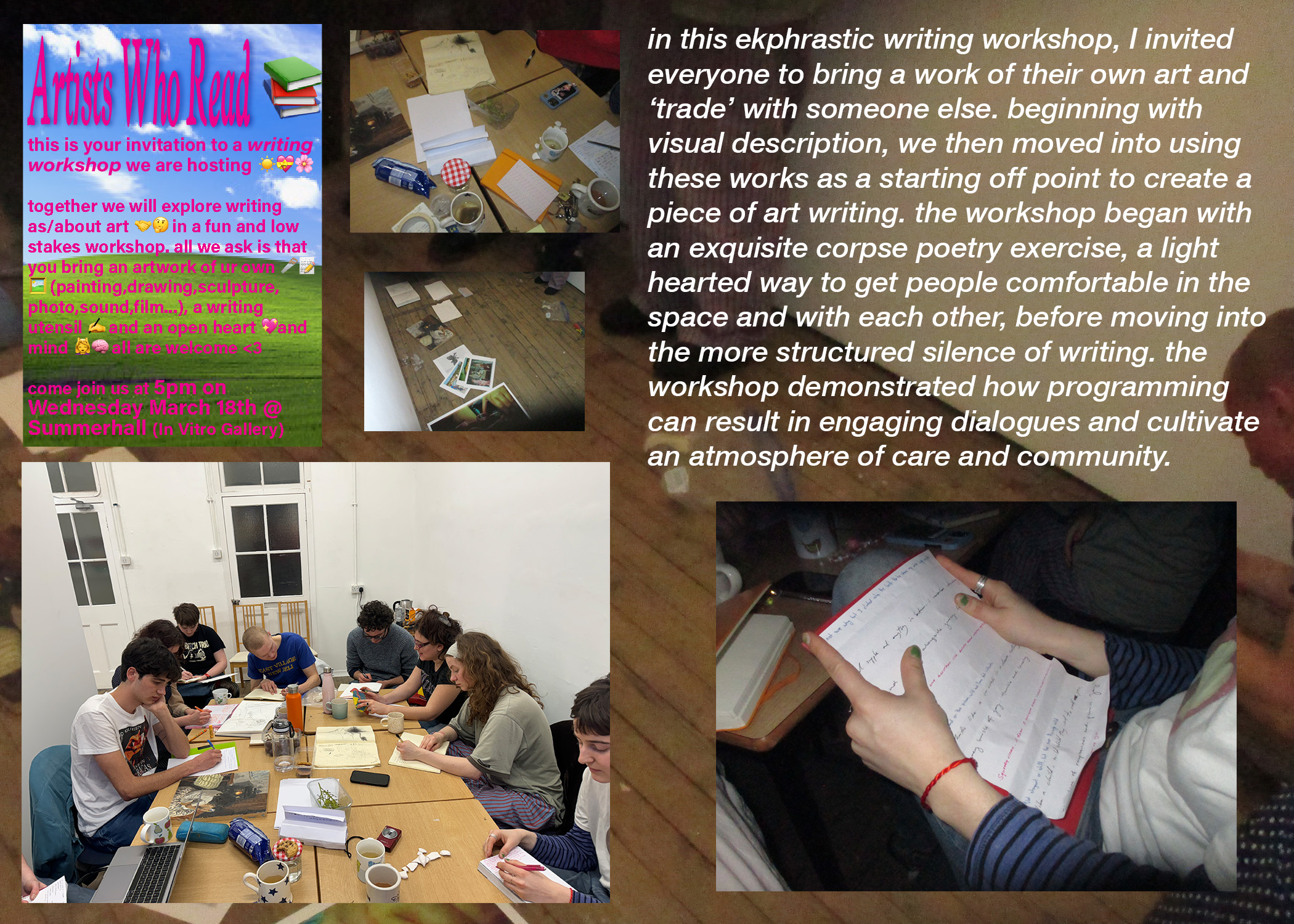
artists who read Workshop in Summerhall
This week I led an art writing workshop for the artists who read club in the collective space, extending my own personal practice through leading a workshop while also exploring the role of workshops as part of the programming for my ISCP. Whilst the workshop was focused on ekphrastic writing and its participants were primarily artists, I began reflecting upon this aspect of programming as making a way to make exhibitions more accessible for non-art audiences and young people. As the fostering of inter- & cross-cultural dialogues is central to my exhibition, programming opportunities such as writing workshops or reading groups can bring literal dialogues into the exhibition space.
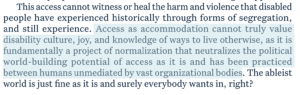
Screenshot of Taraneh Fazeli and Cannach MacBride, pp 136.
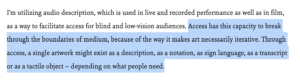
Screenshot of Lazard, Carolyn. “Carolyn Lazard on Illness, Intimacy and the Aesthetics of Access”
Access practice
dis_place gallery demonstrates how the exhibition can change forms to avoid access practice as “a project of normalization”, and function as a generative practice that avoids ableist tendencies and centers disabled people’s experiences and needs(Fazeli & MacBride, 136). As such, I intend to explore digital and alternative formats as more than facsimile of the exhibition, but as iterative and generative responses that are tailored for the audience’s needs, including easy-read documents, audio description, and exploring different digital mediums and layouts for presenting the exhibition.
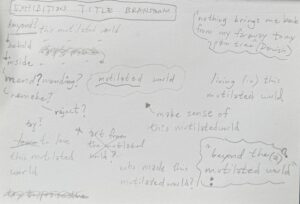
Photograph of notebook, exhibition title brainstorming
Title workshopping
Workshopping the title has proven to be a difficult process, and I have yet to arrive at a title that successfully incorporates Adam Zagajewski’s expressive notion of the “mutilated world” from his poem “Try to Praise the Mutilated World.” I enjoy the evocative nature of the phrase, though I struggle with whether it provides a necessary clarity in what the exhibition seeks to communicate. That being said, I do not want to employ the colon for fear of explication or the title becoming didactic; after all, as writer/curator Tom Morton humorously states, the colon “is not intellectual super-glue” (Morton 2026).
Jí Jū Collective
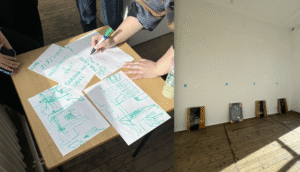
Collage of photos of Jí Jū Collective exhibition planning
Whilst our collective’s plans for how to use the space have oscillated over the past few weeks, we have arrived at an event in which certain members of the collective will bring in personal artworks that reflect/are about home, and install this exhibition as an adopted ‘shell’ alongside a mini pamphlet and installation including pairs of images of our home towns and adopted homes (in Edinburgh).
Reflecting upon my participation in the collective over the past two weeks, I have taken less of a leadership role as I have been quite busy with the CAP exhibition planning & artists who read workshop, and needed to take a step back. Whilst there have been instances of miscommunication and bumps in the road whilst planning this activity, members of the collective have begun to be more vocal and engaged, a great reminder that my communication style and personality have the potential to deter participation and not foster openness for people with varying communication styles.
References:
Taraneh Fazeli, and Cannach MacBride. “MEANS WITHOUT ENDS: LEARNING HOW TO LIVE OTHERWISE THROUGH ACCESS-CENTERED PRACTICE.” In As for Protocols, edited by Re’al Christian, Carin Kuoni, and Eriola Pira, pp. 120-145. Amherst College Press, 2025. https://doi.org/10.3998/mpub.14526504.12.
Lazard, Carolyn. “Carolyn Lazard on Illness, Intimacy and the Aesthetics of Access”, interview by Edna Bonhomme, Frieze 225 (March 2022), https://www.frieze.com/article/carolyn-lazard-edna-bonhomme-interview-2022.
Morton, Tom. “[Insert Title Here].” Frieze 139 (May 2011), https://www.frieze.com/article/insert-title-here.
Zagajewski, Adam. “Try to Praise the Mutilated World”, trans. Clare Cavanagh, from Without End: New and Selected Poems (Farrar, Straus and Giroux, 2002)