

Week 5: “Anti-shows,” the Public Park as Exhibition, and Site Research
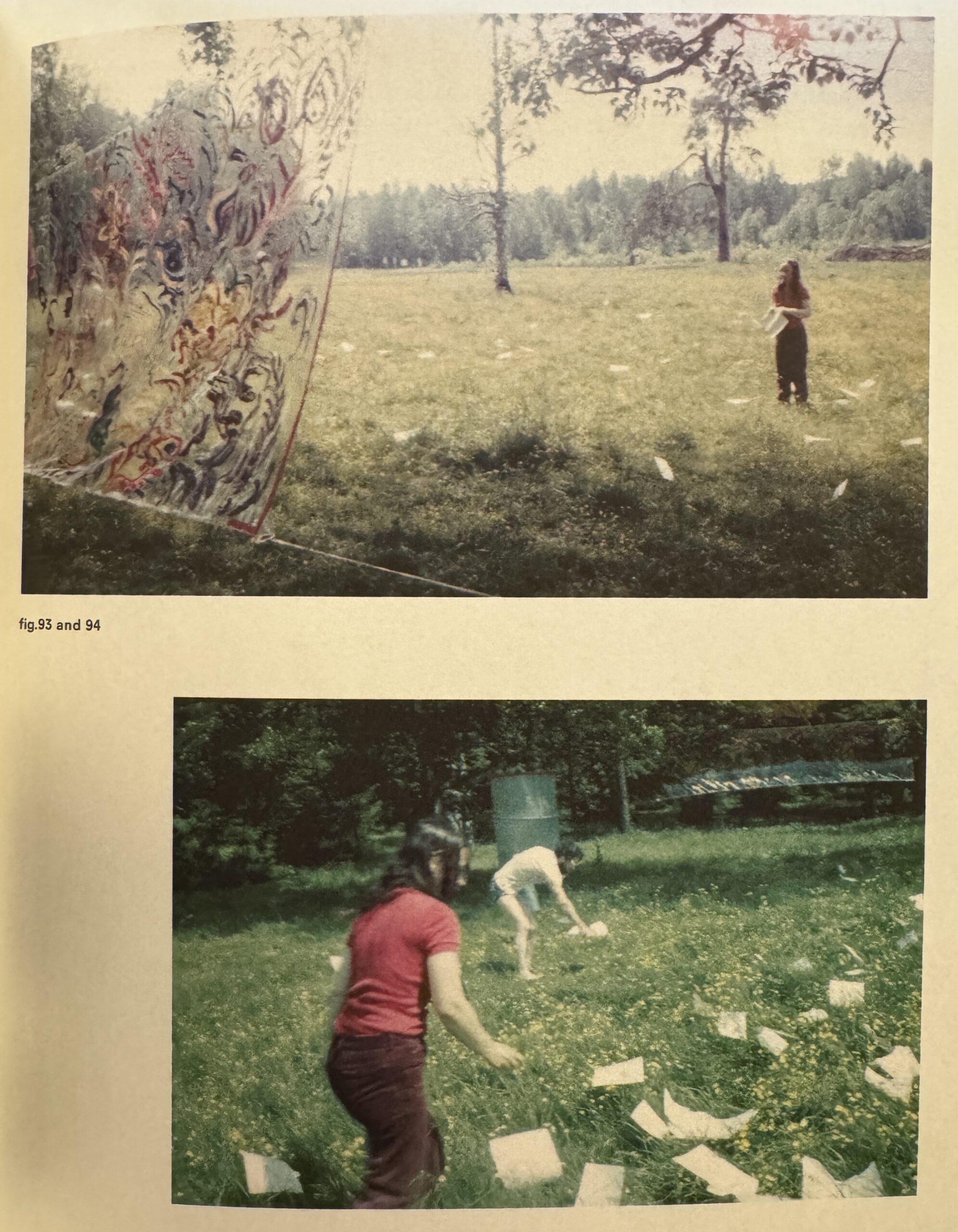
APTART
In further research into curatorial practices this week I came across the APTART “anti-shows” that were put on in the early 80s in Moscow.1
While these were in direct response to a political and art ecosystem that only provided exhibition opportunities for Social Realist works, this self-organizing group reflects the power of alternative exhibition formats and spaces to build community and spaces for dialogue (central to the ethos underpinning my curatorial practice):
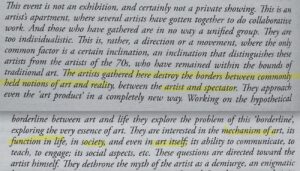
Image of text from Anti-Shows : APTART 1982-84, pp.
In particular, the ‘APTART en plein air’ and ‘APTART Behind the Fence’ shows in May and September ‘83, respectively, are highly influential as they use the natural landscape to situate their show. Engaging with installations, paintings, performances, and participatory works while traversing public grassy fields or wooded trees is a much different experience than the sterile white cube. As Mary Jane Jacob so aptly states when discussing the “new public art”, “for the meaning of this art to be conveyed, its presence in public is essential. It is not art for public spaces but art addressing public issues.”2
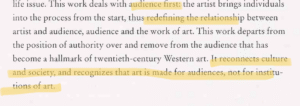
Screenshot of Mary Jane Jacob, “Mapping the Terrain: New Genre Public Art”, pp. 54.
Superflex/Public Park as Exhibition Site
My mind immediately goes to SUPERFLEX’s involvement in the Superkilen Park in Copenhagen, DK, in which the collective invited groups from the 50+ nationalities living in the immediate vicinity of the park to nominate objects relevant to their culture or national origins to be permanently installed in the park.3 This decision to open the curation of these installations unto publics to integrate their diaspora into the built environment reflects a positive participatory project relevant to my curatorial themes, though I question the project’s goal of an “urban version of a universal garden.”4 Does this conveniently instrumentalize the diversity of a neighborhood to publicly oppose the negative wide perception of a homogenous Denmark that wants to remain so?5 Regardless, the work emphasises the need of public programming to foster discourse and bring diverse publics into fruitful dialogues; while this cultural assemblage is visually striking, workshops, readings, performances, screenings, and other sites of gathering are needed to foster meaningful dialogue.
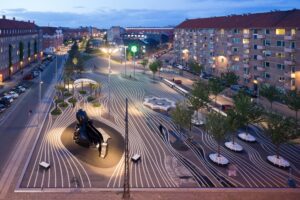
The black square. Superkilen, 2012. Photo: Iwan Baan
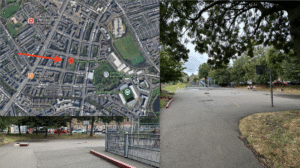
Collage of google maps screenshot and personal photos of Dalmeny Street Park
Ultimately, I have come to the conclusion that my project should exist in a public park. An initial public site that comes to mind is Dalmeny Street Park off of Leith Walk, for a few primary reasons:
- Diverse surrounding community
- Variety of users/uses (DIY skateboarding spot, football/basketball courts/kids playground/dog park adjacent)
- Well trafficked
Our workshop with the CAP students in our weekly planning session cemented my project themes — when discussing her practice, Alvi aptly summed up a key aspect of my interests in exploring diaspora’s relationship to adopted cultures — you “[learn] more about your own culture by engaging with others.” Both her and Kato’s practices seem perfectly suited for the project, and I intend on including their works in my speculative project.
Questions/research inquiries going into next week:
- While leaving the white cube increases social and physical accessibility, where does it limit access?
- How to display non-installative or sculptural work in public? (ie: film, painting…)
- What permissions are needed for public sites?
References
- See Tupitsyn, Margarita, Viktor Agamov-Tupit͡syn, David Morris, and sponsoring body Bard College. Center for Curatorial Studies. Anti-Shows : APTART 1982-84. Edited by Margarita Tupitsyn, Viktor Agamov-Tupit͡syn, and David Morris. London: Afterall, 2017.
- See Mary Jane Jacob, “Mapping the Terrain: New Genre Public Art, in Lacy, Suzanne. Mapping the Terrain : New Genre Public Art. Seattle, Wash: Bay Press, 1995, pp. 54.
- See BIG, Topotek 1, & Superflex. (2012). Superkilen [Park]. Copenhagen, Denmark.
- See Frearson, Amy. “Superkilen by Big, Topotek1 and Superflex.” Dezeen, September 9, 2014. https://www.dezeen.com/2012/10/24/superkilen-park-by-big-topotek1-and-superflex/.
- For more information regarding the Danish government’s contested classification and treatment of immigrant communities, particularly in Norrebrø (where Superkilen is located), see https://www.lowyinstitute.org/the-interpreter/eu-court-sets-back-denmark-s-ghetto-laws.