

Week 4: Contributing to the Collective & Kicking Off Artist Research
Ji Jū Collective
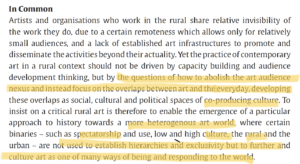
Screenshot of text from MyVillages, “Introduction” in MyVillages (eds.), The Rural (Whitechapel Gallery, 2019), pp. 12-19.
This week we met to draft a mission statement and outline our curatorial ethics manifesto, a practice that highlighted the rich opportunities and difficulties of working in a collective. When faced with differing opinions, such as how we feel about AI usage or artists’ pay, it was at times difficult to reach a consensus without certain voices silencing themselves given their opinion being in the minority. Whilst we arrived at a solid foundation for both tasks, next week I want to discuss with the collective ways of decision making that could be more democratic while encouraging dissenting opinions (splitting into smaller groups to deliberate vs. open forum).
One of our biggest issues is varying levels of participation, often resulting in my being the most vocal leader and decision maker, which innately introduces concerns over bias and the collective not functioning entirely democratically. How can I take a step back, while ensuring we still meet, discuss, and move our collective forward?
Independent Curatorial Project
The highlighted text from this week’s reading above (The Rural)1 reflects and expands upon my curatorial mission (stemming from my formative years in the rural), to break art out of the echochamber of art audiences and integrate art into the everyday, to “co-produc[e] culture.”2 That is not to say that I seek to instrumentalize the artworks — something I seek to remain conscious of. On this topic, I attended a reading group at Embassy Gallery this week in which we discussed two essays: Rubenstein’s “Provisional Painting” and Chris Sharp’s “Theory of the Minor.”3,4 Notably, Sharp discusses the idiosyncratic nature of “minor” painting as a rejection of the “major”’s usage of representation, allegory, and language (which all allow, if not encourage, instrumentalization or co-opting of the work). In my own curatorial work, I intend to pair the mission of the rural with the project5 of the minor.

Screenshot from Chris Sharp, “Theory of the Minor” in Mousse 57 (February 2017), pp. 224-231.
As J.L. offered a much-needed reminder in this week’s collective planning meeting to not over-conceptualize before researching artists, these texts (and conversation) have encouraged me to begin deeper research into artists who I would want to include in my ‘exhibition’ and wider programming, to ensure I do not treat artists like puzzle pieces to allegorize or instrumentalize the wider project. ihsan saad ihsan tahir’s WESTERN SUNRISE and Mengwei Chen’s Visitant have already begun shifting the wider project and I certainly hope to include these works in the curatorial project (more on these works & context in subsequent blogs).
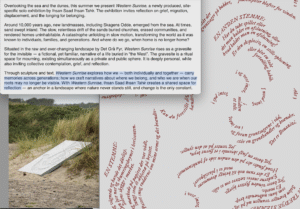
Collage of exhibition text and works, ihsan saad ihsan tahir, WESTERN SUNRISE, SKAL Contemporary, Skagen, Denmark, 2025
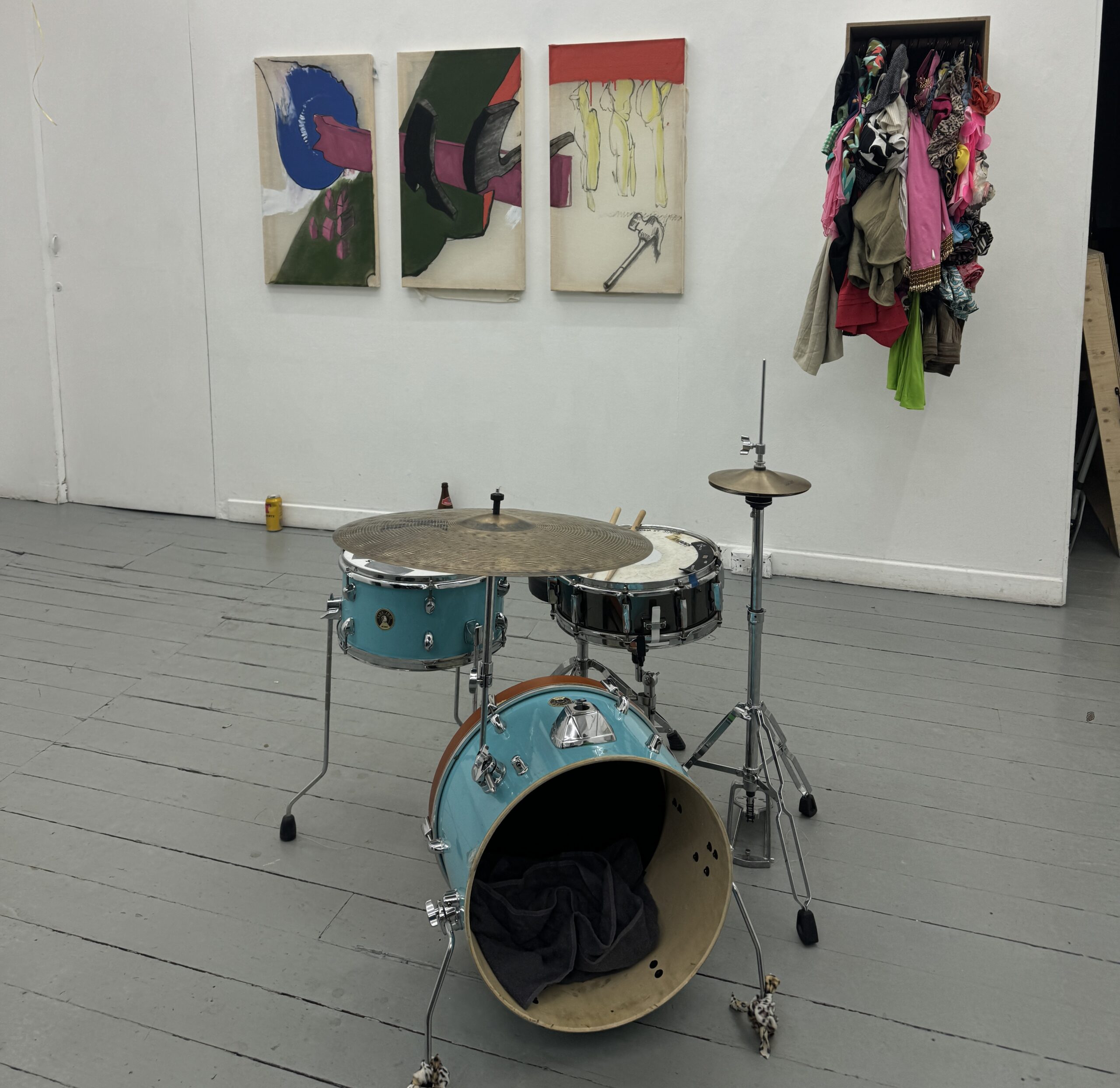
Attending an opening of the show “Band Members Wanted” at Whitespace this week emphasized the importance of performance/live events and cemented my decision to include public programming throughout my ‘exhibition’. As such, I have begun researching writers, musicians, and performance artists to include in an ongoing programme. An incredible discovery was the Leeds-based band Kinaara, who blend Celtic and Punjabi folk music, reflecting the lead singer Satnam Galsian’s Punjabi heritage and UK upbringing; their music serves as a dialogue between these two distinctly rich cultures.
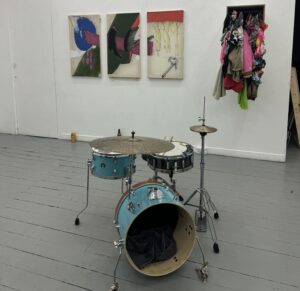
Image courtesy author, photo of Band Members Wanted, exhibition at Whitespace Gallery, Edinburgh, UK, 2025
Going into next week, I intend to explore sites in which my curatorial project could take place, continue researching artists, and work through texts on the subject of diaspora and displacement I have gathered (see Miro Board).
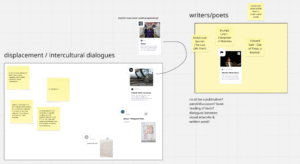
Screenshot of personal Miro Board, 2025
References
- Central to my curatorial ethics and vision for my independent project aligns with this prospect set forth in the text; to create a “more heterogenous art world” where “binaries… further and culture art as one of many ways of being and responding to the world.” Whilst I am keenly aware of my particular situatedness in the (art)world (ie: pursuing a Postgrad in Contemporary Art Theory, having levels of education, access, and privilege), I find myself actively critical of institutions, exhibitions, and artworks that do little to speak beyond the confines of an art world, dividing what “is” art from what “isn’t”… In that art is uniquely situated to offer perspective, dialogue, and context, it carries immense power to connect audiences across their ‘differences’: to offer spaces of dialogue and cultural intersection to inspire empathy and understanding. See MyVillages, “Introduction” in MyVillages (eds.), The Rural (Whitechapel Gallery, 2019), pp. 12-19.
- Idib.
- See Raphael Rubenstein, “Provisional Painting”, in Art in America, May 1, 2009.
- See Chris Sharp, “Theory of the Minor” in Mousse 57 (February 2017), pp. 224-231.
- Project here is meant to imply the wider mission of the minor, if one were to exist. This is not meant to be confused with an artist’s wider project guiding their practice and works. For more info, see Barry Schwabsky, “Object or Project? A Critic’s Reflections on the Ontology of Painting” in Petersen, Anne Ring, et al., editors. Contemporary Painting in Context. Museum Tusculanum Press, 2010.