

Week 3: Curatorial Ethics
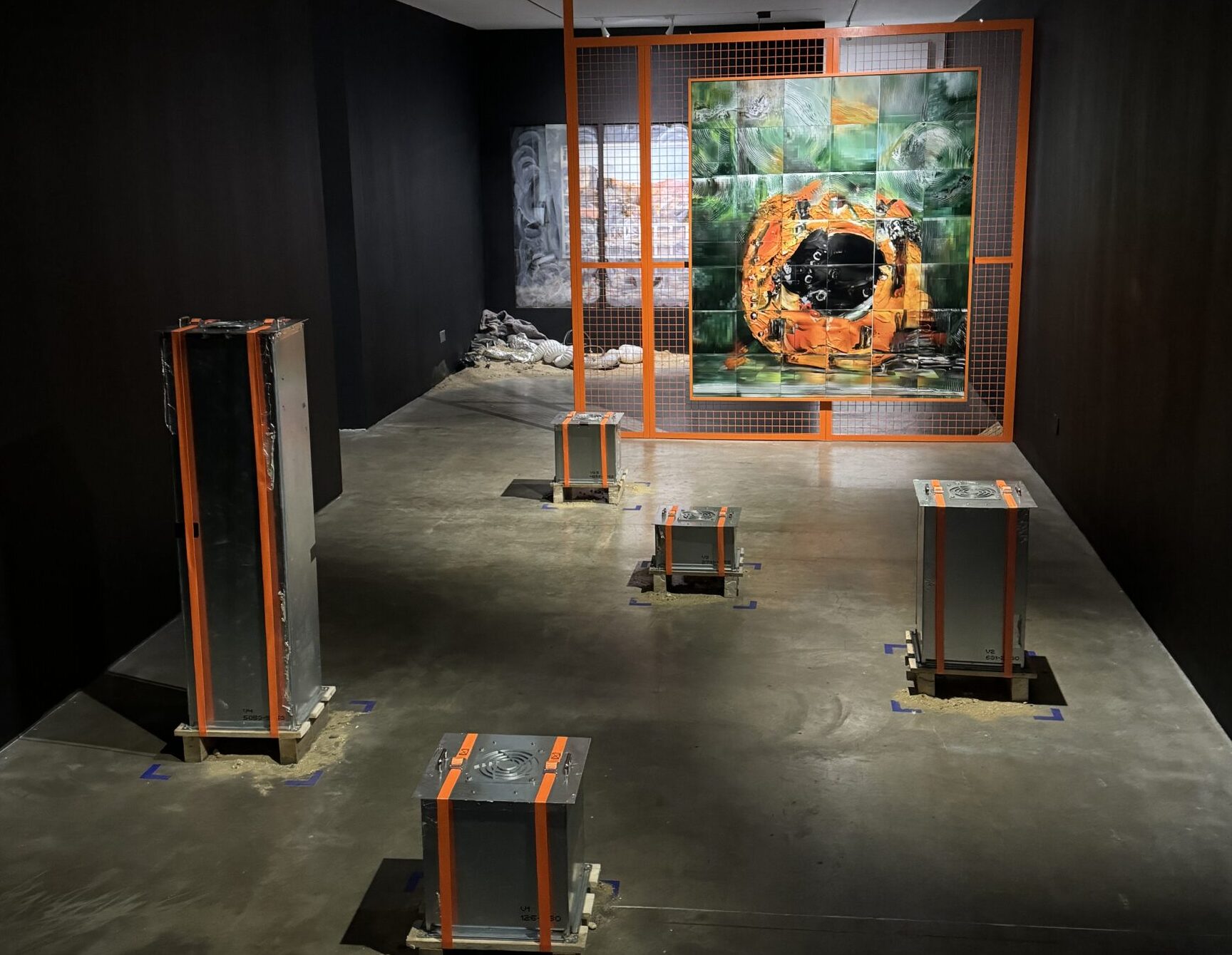
Following this week’s seminar, I have begun considering how I would define my curatorial ethics. I was really struck by Dr. Meng Shi-Chen’s conclusion in his essay “Ethics of Curating”, that the goal of an ethics of curating may be “to empathetically uncover the hidden knowledge swept under the carpet, making the invisible visible, without sacrificing the poetic potential of art.”1 In relation to Pratt’s notion of “contact zones”2, and particularly in a contemporary context defined by continually restricted immigration policies and political division spurring an ‘othering’ of any group that carries different social, political, or religious values than one’s own, my interest in alternative formats to the white cube reflects the need (and unique opportunity) for ‘art’ spaces to foster intercultural, intersocioeconomic, international, and translocal3 dialogues. Art has the incredible opportunity to spark dialogue and inspire empathy4, and as such, I seek to bring these dialogues ‘out’ into the community — physically and ephemerally.
I discovered an interesting intersection in the discussion of aesthetics in Reilly and Martinon’s texts, where the former defines the “Eurocentric standards of “taste” and “quality”” to be “ the code words of sexual/racial indifference and exclusion”5 and the latter prescribing aesthetics to be an “institutional narrative” of the “old-school curator”6. As Martinon discusses the widened scope of curating beyond art worlds, aesthetic taste has invariably been democratized through social media and the internet, yet auction houses, galleries, and major institutions continue to reflect Eurocentric standards of taste that need to be questioned and challenged. It is a reminder to actively question my own ‘tastes’ as I approach my own curatorial practice.
Ultimately, my curatorial ethics is defined by a few key pillars: to (1) continually question my own personal biases and interests, (2) defend and protect artists’ voices, practices, and work (and ensure they are not anesthetized by institutional concerns), (3) never speak for others, rather, to use curation to amplify or spark dialogue between voices, (4) not “renounce [my] responsibility… because of structural flaws”7, and (5) to continually return to these pillars, as an ethics of curating (as with anything in life) must be actively reconsidered and adapted.
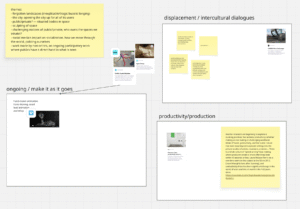
Screenshot of personal Miro Board.
Following James Clegg’s workshop, I was inspired to start my own Miro board to consolidate and organize my ideas for ‘exhibitions’ and begin building connections between curatorial concepts and artistic practices. A seemingly simple statement James made in the workshop really struck me: that an exhibition must always be able to visually and spatially “hold a room”. Must it?
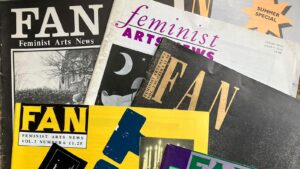
FAN Covers, Flyer for Victoria Horne’s lecture on “Feminist Arts News and the UK Women’s Art Press”, as part of the History of Art Research Seminar Series at the University of Edinburgh.
Attending Dr. Victoria Horne’s talk this week on FAN (Feminist Arts News) magazine has inspired research and a line of thought that will lead into next week; in particular, I found the structuring of the publishing collective as well as the notion that “feminine subjectivity emerg[ed] through work”8 to be highly influential. For each issue, a new editorial team volunteered to curate, produce, and organize the contents of that issue, which would be collated and distributed by a central ‘business collective.’ As a result, the overall curatorial mission was guided and sculpted by its participating members and publics; the publication serving not to make definitive statements about Feminist art & culture from a centralized group, rather to serve as a platform for the decentralized dissemination of the movement’s interests. How could a publication ‘extend’ an exhibition and bring it forward, being continually molded and reshaped by its involved members?
Notes
- See Chen, Meng-Shi. ‘Ethics of Curating.’ Curatography. The Study of Curatorial Culture 5 (2021). https://curatography.org/5-3-en/
- Pratt defines contact zones as “social spaces where cultures meet, clash, and grapple with each other, often in contexts of highly asymmetrical relations of power, such as colonialism, slavery, or their aftermaths as they are lived out in many parts of the world today.” See Mary Louise Pratt, “Arts of the Contact Zone,” in Ways of Reading, 5th edition, ed. David Bartholomae and Anthony Petroksky (Bedford/St. Martin’s, 1999). Accessed via: https://gato-docs.its.txst.edu/jcr:c0d3cfcd-961c-4c96-b759-93007e68e1f0/Arts+of+the+Contact+Zone.pdf.
- “The artists’ gatherings may have been transnational but their guiding ethos was translocal, an affirmative localism that did not limit their broader, international outlook, but on the contrary was an important footing of their cosmopolitanism” See CHIANG MAI. (44).
- I find Chismar’s discussion of empathy critical in relation to curating and curatorial care, particularly when engaging with subject matter/themes that fall outside of a curator’s direct lived experience. This also reflects the need for dialogue to spark empathy amidst widening social, political, & economic division: “In the case of empathy, familiarity with the recipient and his situation is the chief parameter, whereas for sympathy, agreement with the recipient, liking him and what he stands for—appear to be the important variables.” See Douglas Chismar, “Empathy and Sympathy: The Important Difference” in Journal of Value Inquiry 22(1988): 261-2.
- See Reilly, Maura. Curatorial Activism: Towards an Ethics of Curating. London: Thames & Hudson, 2018, pp.214-225.
- See Martinon, Jean-Paul. Curating as Ethics. Minneapolis and London: University of Minnesota Press, 2020, pp. vii.
- See Schuppert, M. (2021) ‘Learning to Say No, the Ethics of Artist-Curator Relationships’, Philosophies, 6(16), pp. 1.




Hi Preston, looking at your Blog so far…it is reading well, good work. There is good evidence of independent research (LO1) eg. David Teh’s book on the Chiang Mai Social Installation, Maria Linz. Throughout the Blog’s 3 posts, you are weaving course resources, your research, practices in the field, and your SICP development together, very good.
Minor but good practice: add the years, background of authors/people you reference, eg the mid-career curator, the sociologist…look to add useful framing info, taking minimal word count.
Week 1 “I have always had a bias” Give context of who you are. Qualify “tastes and prejudices”Could you give references for “storied institutions or blue chip galleries”. Qualify what you mean here : “objects that do not inherently involve publics”
Week 2: “how can curation build authentic relationships between publics and artworks that do not innately foster participation or engagement”: it’s not entirely clear what you mean here…show thinking on the idea of ‘authentic’, further research on participatory art (Claire Bishop is touchstone as a starting point)
Can you add images, always with captions, to show more visual research?. Good you reference Mierle Ladermen Ukeles’, make clear it was in the Lecture. Same for “Broken Globalization, the Capitalocene, and centre/periphery discourses” (the focus of Week 1 Lecture)
Good that you create flow, referencing what lies ahead in your posts, eg Week 2: “beyond my Week 1 focus on methods of engagement & curation”. Consider summaries of keywords at the opening or the end of a blog, or a list of actions? Just a suggestion, not essential.
Week 3: Following this week’s seminar (on x by y).
This post most clearly shows potential for subheadings in your posts: consider their use? It creates a journalistic feel appropriate to a portfolio.
A key gap: you need to reference the Collective in your Blog, I know Week 1, and maybe 2, things were warming up, but definitely by Week 3 there is movement to discuss.
Consider image size and the use of various types of figures, you have a 400 approx word limit, but can use images strategically to add visual communication.