

Week 1: from Chiang Mai Social Installation to Maintenance Art
This has been a fun week of jumping right into the world of curating.
One of the highlights of the readings for this week was Ana Bilbao’s essay on micro-curating and SVAOs. I have always had a bias towards the DIY and the freedom that being independent permits; while they admittedly appeal to my own tastes and prejudices, I firmly believe that SVAOs are much more powerful than storied institutions or blue chip galleries at engaging publics and supporting artists.
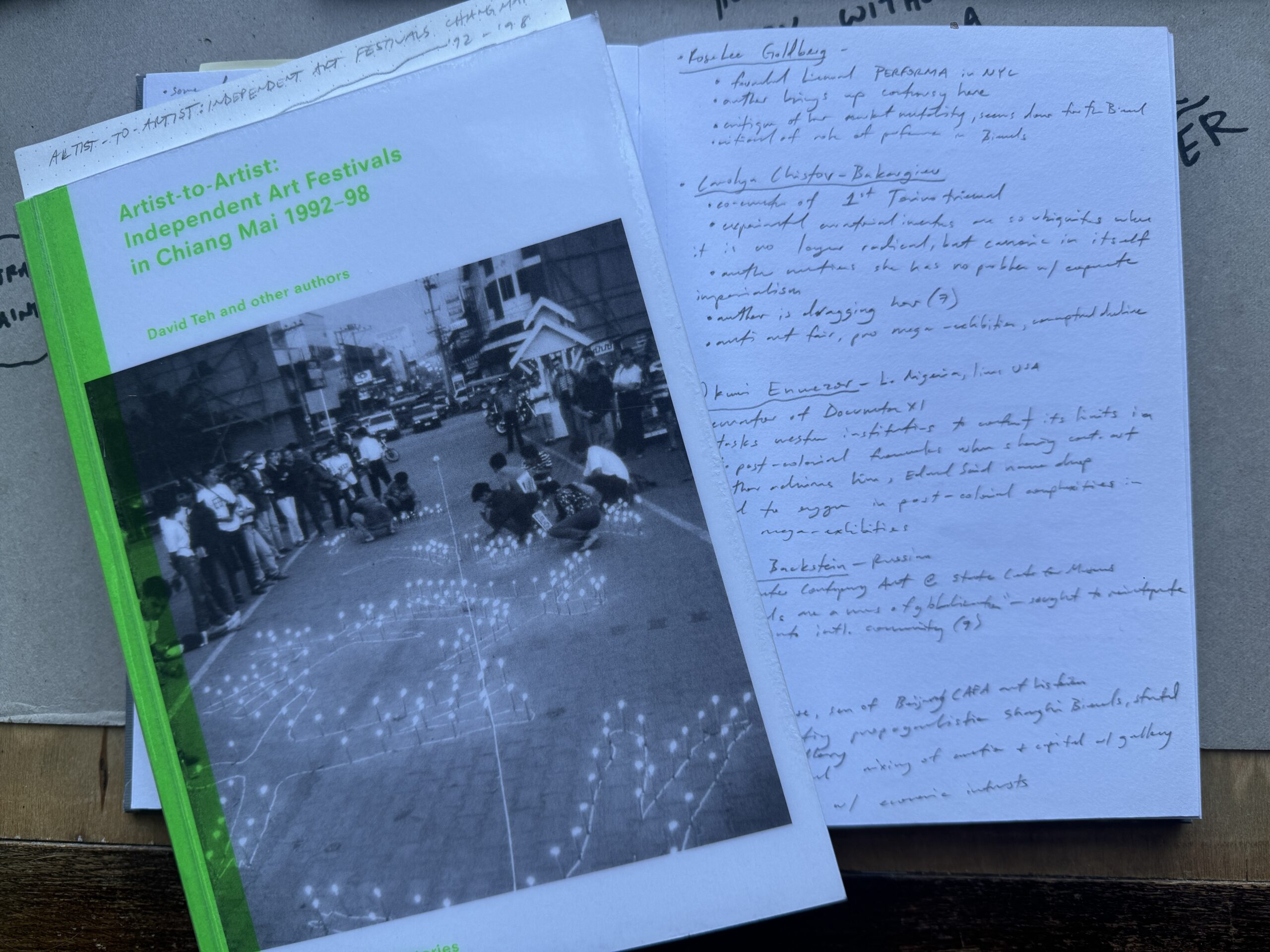
As it is referenced in Bilbao’s essay, I was inspired to pick up a copy of David Teh’s book on the Chiang Mai Social Installation (CMSI) festivals of the 90s to extend my interest in activating publics outside of the walls of the gallery. Teh states that “‘installative’ practices do not merely expand the framework of ‘exhibition’ but decenter and recenter it”, further asking the question “what is the encounter that really matters when artists share their work? Is it not the social more than any material exchange?” (Teh 10). Funny enough, this reflects my interests in the role of curation, while also challenging my background as an artist that primarily makes objects that do not inherently involve publics in the way that installation, conceptual, or participatory art practices do.
This raises a critical question I want to explore in my own curatorial practice: how can curation build authentic relationships between publics and artworks that do not innately foster participation or engagement? Performance invites participation through the relationship of performer/audience and performer/site… a painting on a white wall or film projection in a quiet back room of a gallery do not share that same sense of invitation and participation. What happens when you put paintings on free-standing walls in a public square? Or disseminate a film via USB – or airdrop?
On engaging publics, I also researched Mierle Ladermen Ukeles’ practice as I had somehow never heard of her. Her Maintenance Manifesto is incredibly inspiring, particularly the relationship between development and maintenance she proposes. In an interview, Ukules mentions that after becoming a mother she “fell out of a certain class and moved into another. And when I looked around, I saw that most of the people in the world were also in that class, that they were workers too”(Afterall Interview). Becoming a mother extradited her from the art world, and into the maintenance world. While much has changed since the ‘70s, Broken Globalization, the Capitalocene, and centre/periphery discourses highlight how the division between oppressor/oppressed and insider/outsider has only widened.
Curation can make visible these divisions — and potentially — work to collapse these gaps by bringing the periphery in, pushing the centre out, and seeking to build community, connections, and understanding rather than propagate division.
Notes
Afterall. n.d. “Mierle Laderman Ukeles in Conversation with Alexandra Schwartz.” Afterall. https://www.afterall.org/articles/mierle-laderman-ukeles-in-conversation-with-alexandra-schwartz/.
Bilbao, Ana. “Micro-Curating: The Role of SVAOs (Small Visual Arts Organisations) in the History of Exhibition-Making”, Notebook for Art, Theory and Related Zones, issue 25, 2018, pp. 118-138
Teh, David. Artist-to-Artist : Independent Art Festivals in Chiang Mai 1992-98. London: Afterall Books, 2018.
The Brooklyn Rail. “MIERLE LADERMAN UKELES with Maya Harakawa | the Brooklyn Rail.” Brooklynrail.org. The Brooklyn Rail. August 19, 2024. https://brooklynrail.org/2016/10/art/mierle-laderman-ukeles-with-maya-harakawa/.
Ukules, Mierle Laderman, “Maintenance Art Manifesto”, 1969, accessed via: https://queensmuseum.org/wp-content/uploads/2016/04/Ukeles-Manifesto-for-Maintenance-Art-1969.pdf