Any views expressed within media held on this service are those of the contributors, should not be taken as approved or endorsed by the University, and do not necessarily reflect the views of the University in respect of any particular issue.
After reading the Week 4 materials and discussing exhibition venues with my tutor, I developed a curatorial concept based on the Introduction//Rural Art is… framework. Although I later asked JL if the exhibition could be held outside Edinburgh, she confirmed this possibility. However, she noted that teachers would require more detailed explanations to understand China’s geo-cultural context. I later asked two classmates for their opinions, and they both agreed that my new curatorial concept would be more suitable for an exhibition in Edinburgh.
To determine the venue, I also visited four small exhibitions in Summer Hall’s four galleries after class. I believe Summer Hall’s Sciennes Gallery is well-suited for my exhibition as a first-time curator with a limited budget.
Therefore, I relocated the exhibition to the Summer Hall Sciennes Gallery in Edinburgh. My target audience shifted to the public of Edinburgh, including international students worldwide. Most of them come from urban backgrounds, so I redefined the exhibition’s purpose to reveal the truth about how cities exploit rural areas. Such an exhibition encourages city residents to reflect on urban exploitation of the countryside, preventing them from viewing rural areas solely as vacation destinations attached to cities[1].
In other words, I shifted the exhibition’s theme to critical rural art[2]. I hope to use a small village near Xiong‘an, China as a starting point, prompting viewers to consider through a microcosm: Has the plastic recycling industry in Hugezhuang Village impacted local agricultural development? Do these industries truly serve the local residents, or are they primarily serving the Xiong’an as the new political center? Do plastic recycling plants and sewage treatment facilities—which seem distant from the lives of locals—bring more benefits or drawbacks to the community[3]? Has the migration of young people to work in Xiongan led to a decline in Hugezhuang’s youth population, hindering labor supply and economic growth? In the era of modernization, are rural areas being drained by surrounding metropolises?
I also found some collective, artists and artworks that could be used for exhibition.
[1] Kathrin Bohm & Wapke Feenstra, “Introduction” in MyVillages (eds.), The Rural (Whitechapel Gallery, 2019), pp. 16.
An endless stream of images of the rural enters our imaginations through multiple screens and printed matter. This intense objectification of the rural is alarming and splits our roles into spectators and dwellers. The transition from an agricultural and mining economy to a service, and above all non-land-based, economy has fixed our view of the landscape. We see the rural environment as an image that serves us. We build the picture that we long for.
[2]Kathrin Bohm & Wapke Feenstra, “Introduction” in MyVillages (eds.), The Rural (Whitechapel Gallery, 2019), pp. 14.
……perhaps it's time to introduce the term critical rural art, as part of a collective ambition to emancipate art from its urban hegemony and to introduce a new dialectical dynamics into the current consideration of cultural production.
[3] Kathrin Bohm & Wapke Feenstra, “Introduction” in MyVillages (eds.), The Rural (Whitechapel Gallery, 2019), pp. 15.
The rural is equally shaped by industrial production both within the rural and the cities. Industrial and technological revolutions/infrastructures in urban areas offered overcrowded and economically weak rural communities a new home, causing depopulation and a new urban working class, while industries that rely on ground and soil resources dig up rural landscapes and spit them out as hubris and holes.
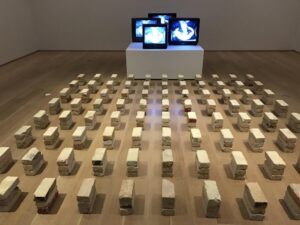
[4] Peili Zhang: Document on “Hygiene” No.3, single channel video, silent, color, 24’45”, PAL, (卫)字3号/Documenton“ Hygiene” No.3 — ZhangpeiliART
Recording the process of washing a chicken: a live chicken is placed in a basin, and constantly scrubbed with soap and water for 150 minutes, until the end of the cassette. The camera angle does not change for the duration of the video. The chicken was washed against the backdrop of a patriotic hygiene campaign. The reason a chicken was chosen for washing instead another animal is that it is considered strange to wash chickens. Chickens do not like water. That is the view of most people, something widely agreed as fact. But in reality, no one knows what a chicken feels when being washed in a basin, because chickens lack the ability to express themselves, or we believe that they cannot express themselves. Even so, why is our previous judgment correct? Zhuangzi presents the idea of “you are not a fish, so you cannot know what a fish enjoys.” Could we say “you are not a chicken?”
[5]UCCA×LEAP×CIFA THREE SISTERS SPECIAL SCREENING + Q&A WITH DIRECTOR WANG BING | UCCA Center for Contemporary Art
Three Sisters was filmed in a village in northeast Yunnan, and treats the lives of three sisters struggling to get by without parents or other support. The film won the Venice Horizons Awards at the Venice Film Festival in 2012.
[6]Myvillages
Myvillages is an international artist-led collective and non-profit cultural foundation, established in 2003 by Kathrin Böhm, Wapke Feenstra, and Antje Schiffers, that promotes cultural production in rural settings by linking local knowledge, communal practices, and artistic interventions across global village networks.[1] The founders, who hail from rural backgrounds in Germany and the Netherlands, leverage their insider-outsider viewpoints to initiate collaborative projects emphasizing shared spaces, utopian community forms, and the interplay between art, agriculture, and local economies, often resulting in ongoing series like the International Village Shop's collective products and Company Drinks' annual rural beverage ranges.
[7]Marjetica Potrč[8] The Resilience of Roots, 2024, ink on paper, 56 x 76 cm, 22 x 29 7/8 in
[9] The Rights of a River, 2021, ink on paper, group of 10 drawings, each 29.7 x 21 cm, framed 36.7 x 28 cm, 14 1/2 x 11 in, and The Life of the Lachlan River, 2022, ink on paper, group of 10 drawings, each 29.7 x 21 cm, framed 36.7 x 28 cm, 14 1/2 x 11 in, courtesy of Fragmentos, Espacio de Arte y Memoria, photo by Juan Velasco
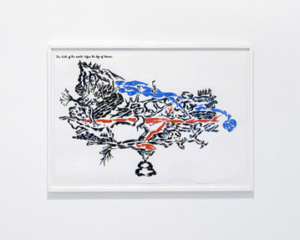
[10] The World in the Age of Stories (Part 1: The Birth Of The World Before The Age Of Stories), 2020, ink on paper, 76 x 112 cm, 29 7/8 x 44 1/8 in, framed 85 x 119 cm, 33 1/2 x 46 7/8 in
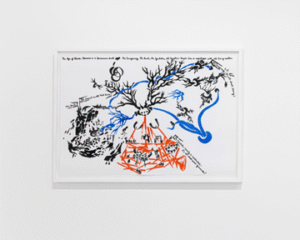
The World in the Age of Stories (Part 2: Humans in a Borromean Knot), 2020, ink on paper, 76 x 112 cm, 29 7/8 x 44 1/8 in, framed 85 x 119 cm, 33 1/2 x 46 7/8 in
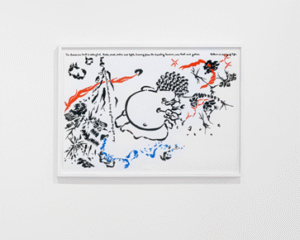
The World in the Age of Stories (Part 3: The World after the Borromean Knot Is Untangled), 2020, ink on paper, 76 x 112 cm, 29 7/8 x 44 1/8 in, framed 85 x 119 cm, 33 1/2 x 46 7/8 in
 [4]
[4]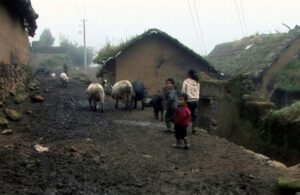 [5]
[5]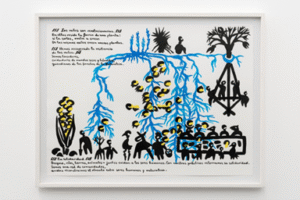 [8]
[8]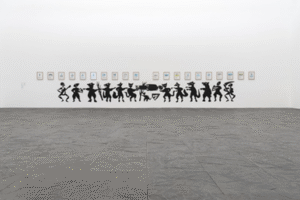 [9]
[9]