Any views expressed within media held on this service are those of the contributors, should not be taken as approved or endorsed by the University, and do not necessarily reflect the views of the University in respect of any particular issue.
Before the third week’s lecture, I read Curating as Ethics and gained an understanding of ethical issues within curatorial practice[1]. A crucial component highlighted was the application of cultural elements[2]. Meanwhile, A Call To Arms: Strategies For Change detailed curators’ practical actions against the straight white male-dominated mainstream art world and their motivations[3]. This article focused more on the treatment and opportunities afforded to non-white, male, heterosexual artists. A classmate shared his concern about whether exhibited artworks might contain explicit misogynistic or racist content, even if displayed for oppositional or satirical purposes. This prompted me to consider issues largely overlooked in these texts[4].
During the group discussion in class, I exchanged views with that student. Ultimately, the discussion returned to the constraints imposed by practical conditions, such as artist’s security and the policy permissions. In Talbot Rice Gallery curator’s presentation, he mentioned that curators must consider the artist’s feelings, as controversial exhibitions risk directing the audience’s attention solely towards the controversy rather than the artwork itself.
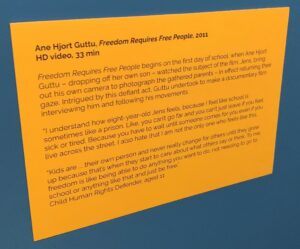
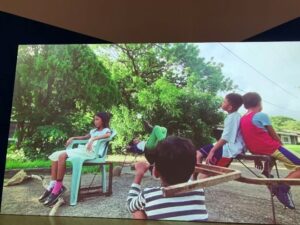
However, after class, I visited the Talbot Rice Gallery to view this teacher’s exhibition, The Children are Now. Yet I discovered that one artworks had uttered racially discriminatory words about Chinese people[5].
The film depicts a boy who uses discriminatory language, but portrays him as a character who yearns for freedom and is unwilling to be constrained by school. He hit teachers and disturbed other pupils’… I noticed the label framed children and adults as opposites, overlooking how rule-breaking children can also affect their peers. The label reflected the artist’s accommodating boy’s behaviour, which I feel uncomfortable.
Curators must strengthen their vetting of artworks. The repeated use of discriminatory language within such pieces, coupled with the artist’s ambiguous lack of explicit opposition, creates a profound sense of disconnection from the exhibition’s theme (group exhibition) . I have learnt that I must more meticulously review the content of every artwork in my own exhibitions.
I believe the exhibition’s anti-colonial content was not sufficiently thorough, and I need to improve this in my own exhibition. I consider multilingual subtitles essential for artworks, requiring at least the language spoken by the actors and English subtitles. As this film is anti-colonial and contains strong satire of Eurocentrism, For instance, textbooks labelled ‘English Changes the World’ are burned in flames, yet the subtitles remain solely in English.
[1] Martinon, Jean-Paul. Curating as Ethics. Minneapolis and London: University of Minnesota Press, 2020, x.
The most common example of this kind of ethics with regards to curating is, as mentioned earlier, museum and curators’ codes of ethics: short texts that put forward sets of supposedly rational principles that museums and/or curators should follow.
[2] Martinon, Jean-Paul. Curating as Ethics. Minneapolis and London: University of Minnesota Press, 2020, xxii.
On the other hand, it takes the cultural elements explored here equally seriously, not as illustrations for philosophical arguments but for their intrinsic cultural characteristics (as demonstrated, for example, in “Images”).
[3] Reilly, Maura. Curatorial Activism: Towards an Ethics of Curating. London: Thames & Hudson, 2018, 215.
As is evident in the preceding pages, many curators are working tirelessly to develop strategies to counter the persistent under-representation, silencing, and erasure of numerous artists throughout the world. Theirs is not affirmative-action curating, it is smart curating. Theirs is a practice rooted in ethics, and, as such, their exhibitions function as curatorial correctives to the exclusion of Other artists from the master narratives of art history and the contemporary art scene itself. These curators have taken immense strides forward in challenging hierarchies and assumptions, initiating debate, and circulating new knowledge.
[4] Reilly, Maura. Curatorial Activism: Towards an Ethics of Curating. London: Thames & Hudson, 2018, 220.
Publishers should be more self-aware and curb overt declarations of sexism/racism in their pages.
[5]The Children are Now | Talbot Rice Gallery
Ane Hjort Guttu (b. 1971, Norway) will present two films. Freedom Requires Free People (2011), follows eight-year-old Jens Flakstad Vold through his everyday life at school and his reflections on his experiences as a pupil. The result is an insight into an astute, critical mind, questioning what it means to achieve freedom within institutional settings. Conversation (2021) follows up with Jens ten years later, to reflect on his early quest for autonomy as well as his memory and experience of the making of the first film.