

Week 2 |Mapping Curatorial Infrastructures and Collective Agency
1.From Scale to Infrastructure
Building on Week 1’s attention to institutional scale, this week I reframed “scale” as an infrastructural condition rather than a purely spatial or visual attribute. Terry Smith’s account of the Visual Arts Exhibitionary Complex (VAEC) is helpful because it maps contemporary curating across interrelated contexts and platforms, where exhibitions circulate through institutions, networks, and publics rather than being contained within a single site.This led me to shift my question from “the difference in size” to: how curatorial authority and publicness are distributed and constructed at different nodes in the exhibition ecosystem.
2.Field Note: Visiting RSA200 at The Mound
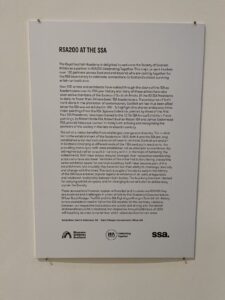
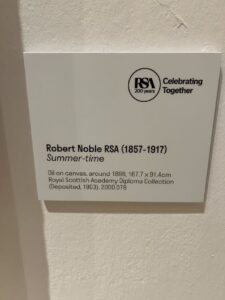
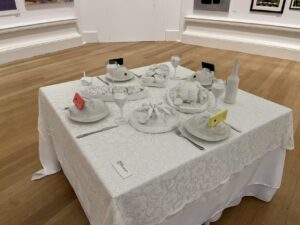
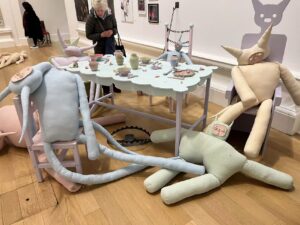
On Saturday, I visited the SSA 127th Annual Exhibition with my classmates at The Mound, within the National Galleries of Scotland and Royal Scottish Academy (RSA) complex. In the RSA Upper Galleries, the exhibition is explicitly positioned as part of RSA200: Celebrating Together and is framed as a “historic partnership.”A wall text titled “RSA200 at the SSA” foregrounds institutional longevity and collaboration, and the SSA webpage similarly emphasises shared history by referencing works from the RSA collection and an accompanying commissioned essay. Experiencing this framing on site made “publicness” feel less like a neutral attribute of a national cultural location and more like a curated claim produced through institutional partnership, heritage narratives, and the governance of shared space.
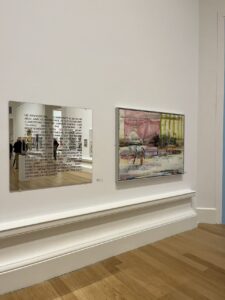
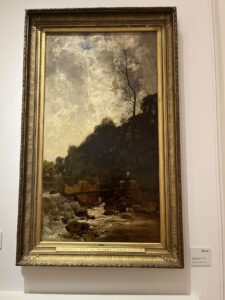
All photographs reproduced in this text are author’s photographs, taken during exhibition visits on January 24, 2026.
3. Collective Action as Method
This visit connected directly to the week’s reading on collective action, which outlines how collective formations recur as operational responses to institutional norms of authorship and to political urgency. In this context, “artist-run” can be read not only as an identity descriptor but as a working method thlics are addressed, how resources circulate, and how agency is distributed across institutional frameworks.
Notes
1. “Mapping the Contexts of Contemporary Curating: The Visual Arts Exhibitionary Complex,” Terry Smith,accessed January 25, 2026,https://discovered.ed.ac.uk/permalink/44UOE_INST/1viuo5v/cdi_crossref_citationtrail_10_1386_jcs_6_2_170_1
2.https://elephant.art/brief-history-collective-action/ ,accessed January 25, 2026