Corporate ed-tech narratives often present a future of online higher education dominated by automation, surveillance, and platformatization. However, our team’s work resists this deterministic trajectory by envisioning preferable futures grounded in human values, institutional agency, and a commitment to equity. We focused on online higher education in the UK and U.S., two regions whose systems share significant similarities, including pressures from market-driven models, datafication trends, and the challenge of maintaining quality in increasingly digital learning environments. We argue that universities must not only adapt to these challenges but actively redefine the narrative of online education, championing inclusive, community-oriented, and sustainable approaches. As Bayne and Gallagher (2021) emphasize, universities must “articulate confident, alternative imaginaries for the future of teaching… which re-introduce the values we want to teach and live by” if they are going to serve students for generations to come (p. 608).
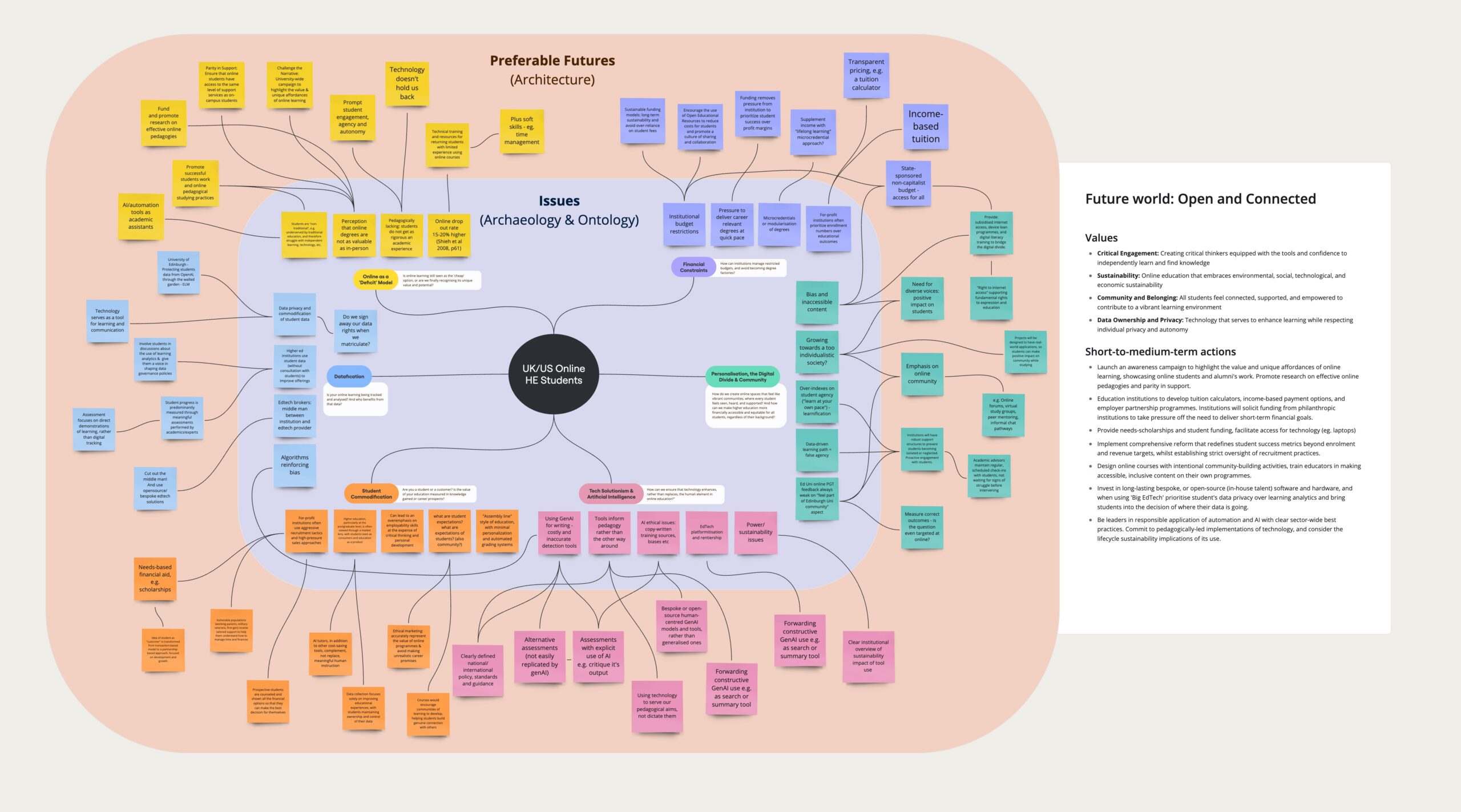
Mapping the Present: Issues and Challenges
Through collaborative mapping, we identified critical issues and assumptions shaping perceptions of online higher education in the UK and U.S. today:
- Student commodification: The framing of students as consumers and education as a product often distorts higher education’s broader purpose, cultivating transactional rather than transformative relationships.
- Technological solutionism: Over-reliance on technology as a quick fix for complex educational challenges risks sidelining human-centered pedagogical aims.
- Datafication and privacy concerns: Student data is increasingly treated as a commodity, often collected without sufficient transparency or authentic consent.
- Building community: Genuine connection in digital spaces remains an ongoing challenge, particularly for marginalized and non-traditional students.
These themes resonate with critiques of market-driven models in the UK and US, where the rise of “Big EdTech” often prioritizes scalability and profitability over educational quality. Bayne and Gallagher (2021) describe how the commodification of student data and the delegation of teaching responsibilities to algorithms threaten to erode the civic and social purposes of higher education. Similarly, Nash (2015) highlights concerns about grade inflation, diluted academic standards, and the lack of meaningful student-faculty interaction in online courses as institutions push for rapid adoption of cost-efficient models.
Garrett (2019) observes that while online education in the US and UK is celebrated for its scalability and convenience, it often emphasizes economic imperatives over pedagogical depth, leading to superficial course designs and limited opportunities for collaborative learning. Zhu (2021) warns that the uncritical adoption of technological solutions can deepen systemic inequities, necessitating urgent reforms in course design and institutional priorities.
This convergence of critiques calls for a reimagining of online higher education that moves beyond market imperatives and prioritizes values such as equity, critical engagement, and the restoration of academic community. By addressing these systemic issues, universities can resist the deterministic trajectories of technological and economic forces, reclaiming their role as spaces of transformation and innovation.
The Necessity of Traditional Universities
A pivotal question from our mapping process emerged: Do we still need traditional universities in the face of proliferating digital platforms? Arguably, while online learning offers flexibility and access, it cannot wholly replicate the multifaceted role of universities. This is because institutions are more than content delivery systems: they are spaces for socialization, community building, and critical engagement.
Bayne and Gallagher (2021) caution against the “hollowing-out” of campuses and the delegation of teaching responsibilities to algorithms. Mitchell’s (2003) concept of “preferable futures” further underscores the need for collective, rather than individualistic, approaches to online education. Our analysis suggests that universities are uniquely positioned to balance the imperatives of individual development with the cultivation of collective agency, offering a counterpoint to the atomization seen in corporate models.
Articulating Preferable Futures: The “Open and Connected” Vision
Our preferable future, “Open and Connected,” is anchored in four core values identified through our mapping process:
- Critical engagement: Empowering students as independent learners and thinkers.
- Sustainability: Addressing environmental, social, and economic challenges in online education design.
- Community and belonging: Ensuring students feel connected, supported, and valued.
- Data ownership and privacy: Using technology to enhance learning while safeguarding individual autonomy.
These values challenge the “neoliberal utopian blueprint” critiqued by Van Dermijnsbrugge and Chatelier (2022), instead promoting equity and human dignity.
Translating Values into Action
To realize these futures, we propose actionable strategies:
- Promoting online learning’s unique value: Awareness campaigns can challenge the perception of online education as inferior by highlighting its distinct strengths and benefits.
- Reforming metrics of success: Shift from revenue and enrollment metrics to holistic assessments of student development and community impact.
- Supporting vulnerable populations: Tailored interventions—such as scholarships, technology access, and digital literacy training—can bridge the digital divide.
- Advancing ethical data practices: Students should have a voice in data governance policies, ensuring transparency and control over their information.
- Community-driven course design: Intentional activities like peer mentoring, virtual study groups, and collaborative projects can help build vibrant online communities.
Universities as Catalysts for Ethical Innovation
Universities have a critical role in addressing technological and ethical challenges in online education. As our team discussed, institutions must lead in the responsible application of AI and automation, using these tools to complement human instruction rather than replace it. The emphasis on pedagogically informed technology use aligns with Bayne’s (2024) vision of education as a site of reinvention, where technology serves human aspirations rather than dictating them.
Addressing Financial Sustainability
The financial pressures on institutions cannot be ignored. Sustainable funding models, including state sponsorship and philanthropic partnerships, can reduce reliance on student fees while ensuring access for all. Lifelong learning initiatives, such as microcredentialing, could offer additional revenue streams without compromising educational integrity.
Conclusion: Reclaiming Agency in Educational Futures
As Bayne and Gallagher (2021) remind us, “by defining and articulating a future we find desirable, we begin to build it” (p. 622). Our vision, grounded in human values and institutional agency, seeks to reclaim agency in shaping the future of online education. Through collective imagination and sustained action, universities can resist deterministic trajectories and create inclusive, equitable learning environments.
By addressing systemic inequities, fostering community, and prioritizing sustainability, we affirm the indispensable role of universities. Far from being rendered obsolete, these institutions can act as beacons of innovation and equity in an increasingly digital world. Meaningful alternatives to corporate-driven futures are not only possible—they are essential.
References
Bayne, S. and Gallagher, M., 2021. The Manifesto for Teaching Online. Cambridge, MA: MIT Press.
Bayne, S., 2024. Digital education utopia. Learning, Media and Technology, 49(3), pp.506-521. Available at: https://doi.org/10.1080/17439884.2023.2262382.
Van Dermijnsbrugge, E. and Chatelier, S., 2022. Utopia as method: A response to education in crisis? Asia Pacific Journal of Education, 42(sup1), pp.6-19. Available at: https://doi.org/10.1080/02188791.2022.2031870.
Facer, K. and Sandford, R., 2010. The next 25 years? Future scenarios and future directions for education and technology. Journal of Computer Assisted Learning, 26(1), pp.74-93. Available at: https://doi.org/10.1111/j.1365-2729.2009.00337.x.
Gallagher, M. and Breines, M., 2023. Unpacking the hidden curricula in educational automation: A methodology for ethical praxis. Postdigital Science and Education, 5(1), pp.56–76. Available at: https://doi.org/10.1007/s42438-022-00342-z.
Garrett, R., 2019. Whatever happened to the promise of online learning? International Higher Education, 97, pp.2–4.
Hicks, D., 1996. Retrieving the dream: How students envision their preferable futures. Futures, 28(8), pp.741–749.
Inayatullah, S., 1996. What futurists think: Stories, methods, and visions of the future. Futures, 28(6), pp.509–520.
Mitchell, M.M., 2003. Possible, probable, and preferable futures of the digital divide. Informing Science InSITE – “Where Parallels Intersect”, pp.610–620.
Nash, J.A., 2015. Future of online education in crisis: A call to action. Turkish Online Journal of Educational Technology, 14(2), pp.80–85.
Zhu, Q., 2021. The future of higher education online learning. Global Journal of Engineering Sciences, 7(3), pp.1–10. Available at: https://doi.org/10.33552/GJES.2021.07.000664.