Any views expressed within media held on this service are those of the contributors, should not be taken as approved or endorsed by the University, and do not necessarily reflect the views of the University in respect of any particular issue.
We want to share our exciting news featuring the Sir Charles Lyell notebooks! Curious? Read on....
We are very happy to advise that the fuller project to digitise Lyell’s notebooks will start in September 2021. This means that we will soon be able to add yet more digital images of Lyell's notebooks to those currently available to view online.
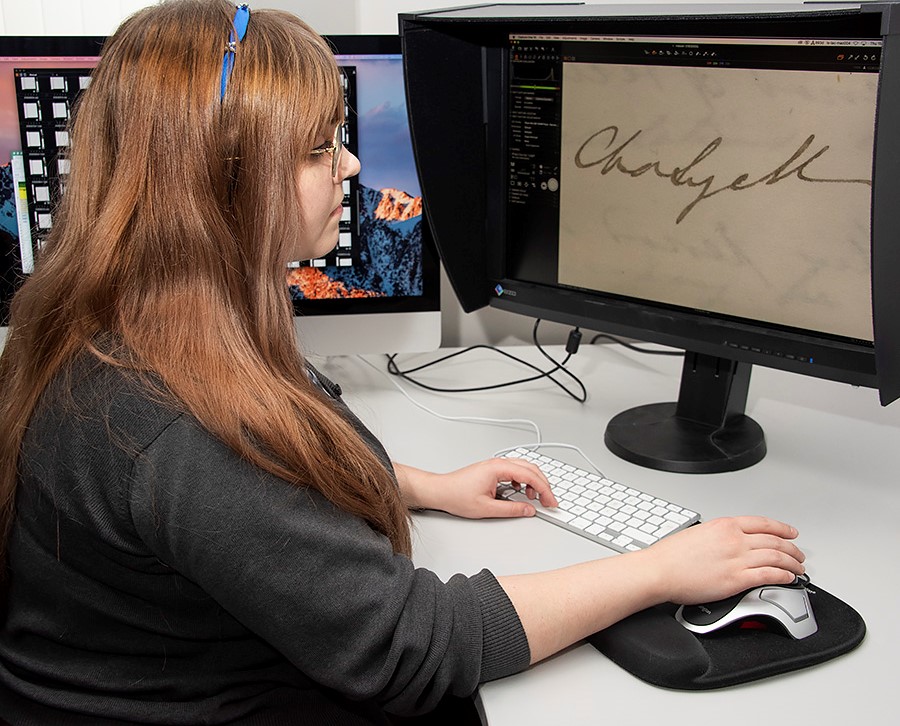
This important work is possible thanks to our generous supporters, who, in responding to our funding appeal, have donated over £40,000. That's enough to fund two specialist photography staff for 12 months. The work will take place in a newly fitted out digital imaging studio, kitted out with new equipment.
Thank you to all the individual donors and bodies who have supported us so far. In addition to our anonymous supporters, we would also like to acknowledge the ongoing support of the Murray family, Jim Hunter, the History of Geology Group and the Geologists’ Association Curry Fund. If you are interested in helping us complete the digitisation project’s funding target that would be wonderful. Individual gifts may be made online at: https://donate.ed.ac.uk/portal/public/donate/donate.aspx?destination=LyellAccess
Or please contact David McClay directly to discuss: 07815903725 or david.mcclay@ed.ac.uk
This month we learn that Erin, one of our Lyell project volunteers, has had her eyes opened to the present-day natural world - thanks to inspiration from our Sir Charles Lyell Collection.
We have all caught the Lyell / Geology bug here at the Sir Charles Lyell Collection Project HQ. Each of us has developed a preoccupation with spotting and identifying pebbles, fossils, gneiss, and schist and so on. Our work and personal libraries groaning with the additional weight of multiple biographies of Lyell, and an almost absurd array of spotters guides to rocks, minerals and fossils. Even our twitter feeds are increasingly populated with evidence of geological time lines (mostly pebbles with veins). No return from a trip to the beach complete without a pocketful of geological specimens; pebbles of grey granite, ovoid pebbles of slate with quartz vein running through it, fragments of whitish chert, and things we used to know, simply, as shells.
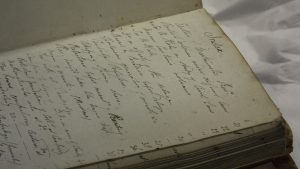
A list of shells sent to Bedford Place, dated 5 February 1840, from Sir Charles Lyell's Notebook, No. 80, 5 February 1840 – 25 June, 1840, (Ref: Coll-203/A1/80)
On my desk, as I type, are an assortment of granite, quartzite, and possibly metamorphic mud - a recent haul from Point beach on the Isle of Lismore. It is one of the great privileges of working so intimately with historical collections: we are repeatedly offered a unique opportunity to develop knowledge and interest in a person, subject, or era that, most likely, would have eluded us had we chosen a different line of work. Earlier this week I read, in the New York Times, Dennis Overbye's review of the renovated hall of gems and minerals at the American Museum of Natural History. He suggests that 'Geology Is Our Destiny'.1 For all of us working together to interpret, catalogue and make accessible the Sir Charles Lyell Collection, it would certainly seem so.
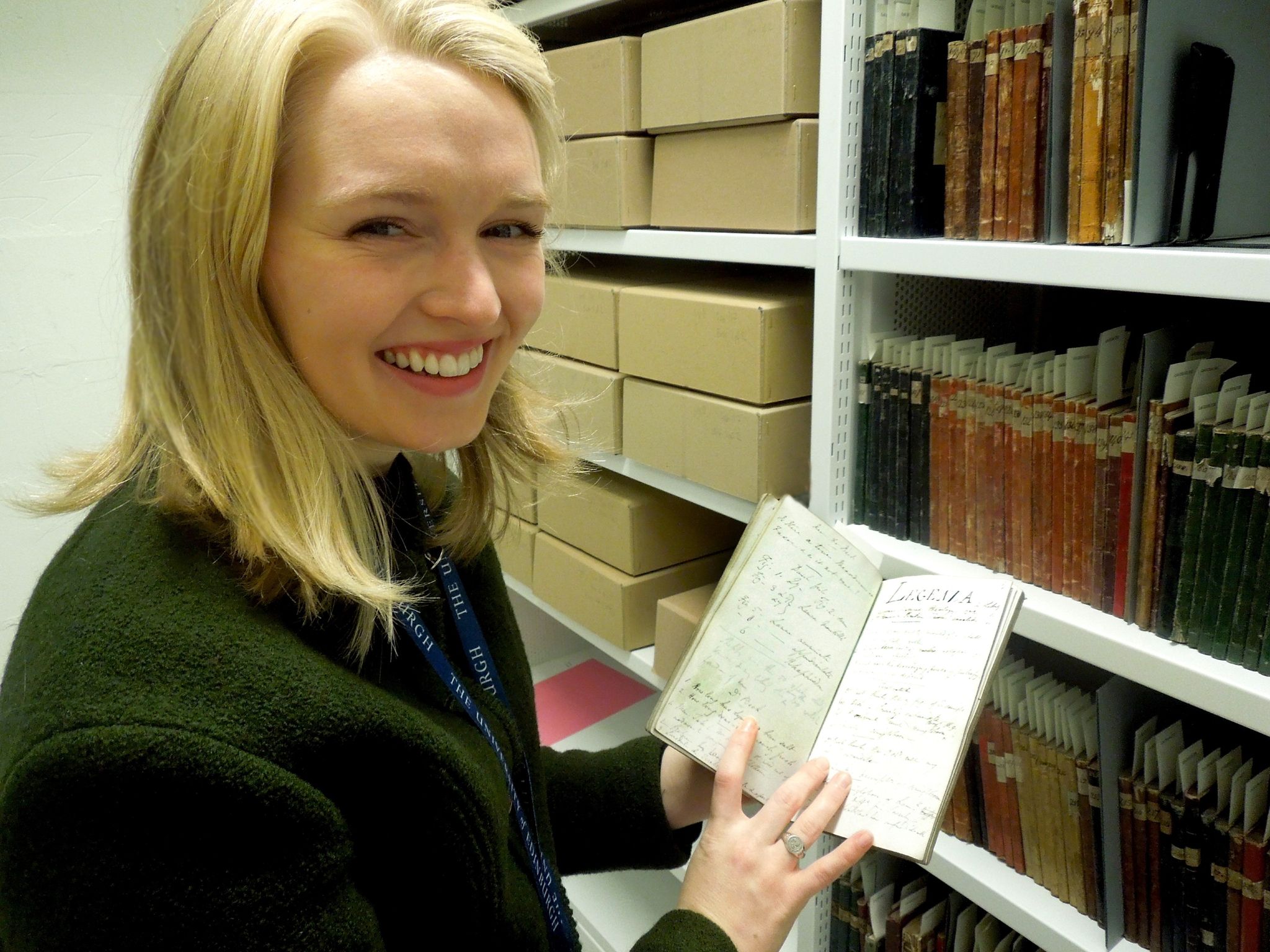
Project volunteer, Erin, has developed only a little infatuation with molluscs (to the extent that her new found knowledge required the creation of its very own data-set - Erin is a qualified archivist after all). In working with the Lyell notebooks, Erin has begun to see the world through Lyell's nineteenth-century geological wisdom. The present-day natural world has opened up to Erin in a way she had never imagined possible. Here, Erin tells us more about her work transcribing Lyell's notebook indexes and how it has fuelled her growing obsession.
"Transcribing Sir Charles Lyell’s scientific notebook indexes has been a sometimes ruffling but always captivating journey. The one thing I never expected was that like Lyell, I found myself becoming fascinated with molluscs. The Mollusca phylum is:
“one of the most diverse groups of animals on the planet, with at least 50,000 living species (and more likely around 200,000) [and it] includes such familiar organisms as snails, octopuses, squid, clams, scallops, oysters, and chitons”.2
Lyell often took note of the different genera and species he found during his travels. In notebook 80, for instance, I found a list of shells belonging to various molluscs which Lyell had identified and had sent to his home in London.
I felt like both an amateur detective and biologist as I hunted for these bivalves and gastropods on the World Register of Marine Species and MolluscaBase (a global species database, covering all marine, freshwater and terrestrial molluscs, both recent and fossil). As I transcribed, I felt compelled to document them and my new found knowledge about them in an Excel data-set. Some of them proved very elusive and some others are still a mystery. The excitement I felt each time I was able to find a mollusc Lyell had listed was extremely gratifying, particularly when the name he had recorded had fallen out of accepted or general use.
What I have loved most about transcribing Lyell’s notebook indexes is how much I am able to learn from only one index entry; nineteen molluscs in a single page that I had the pleasure of trying to find and learn about! This is what I feel is the most rewarding part of being an archivist. Through this amazing collection we are given the opportunity to explore the life and times of Sir Charles Lyell while presenting his knowledge, research, ideas and wondrous curiosity to a wider audience.
Now, each time I go to Yellowcraigs or North Berwick for a wild swim, I can’t help but stop and examine the rocks, the shells, the crab skeletons, the little pools full of marine life and of course the molluscs. I never would have stopped to explore in this way had I not first discovered so much through the eyes of Sir Charles Lyell."
We hope you enjoyed reading about how the Sir Charles Lyell Collection has inspired our project volunteer, Erin, to observe and learn about her natural surroundings with new-found enthusiasm. Erin's story is just one example of the power of historical collections to enable, support and enhance the acquisition of new knowledge, learning and understanding. We would love to know how you might use the collection to aid learning, teaching and research. Please share your thoughts in the comments.
Thanks to Dr. Gillian McCay, assistant curator at the Cockburn Geological Museum, for her help in identifying the Point beach pebbles. Look out for our next blog post, (coming very soon), when we will be taking a bit of a deep-dive into Lyell's indexes and hearing from another of our project volunteers, Michael. Thanks for reading!
We are very happy to introduce our Sir Charles Lyell Collection Advisory Board.
Sir Charles Lyell's Notebook, No. 141, 15-25 April 1846 (Ref: Coll-203/A1/141)
The Sir Charles Lyell Collection team is made up of cohort of professional curatorial, conservation, photography, public access and engagement staff. Our work is enhanced by the support of volunteers and student interns. Together, we work collaboratively to preserve, conserve, interpret, catalogue, digitise, transcribe and provide access to and engagement with the Sir Charles Lyell Collection. In doing this work we aim to make this internationally significant and unique collection accessible to all, further enabling its position as a vital resource for teaching, research and public engagement.
We are very grateful to be supported and guided by a very knowledgeable and experienced advisory board. Our advisory board meets every quarter and is made up of a range of internal and external academics, as well as a number of directors of Earth Science and related collections from across the United Kingdom.
"The Advisory Board is pleased to volunteer its assistance in helping the University of Edinburgh make available for research and public engagement this globally important historical archive and geological collection."
Board Statement by Professor Charles W.J. Withers FBA FRSE - Chair
Details of our current advisory board membership will always be published on the Sir Charles Lyell Collection webpages and we provide them here for your information. Thank you to all of our advisory board members for contributing their time and expertise in support of all of our work with the Sir Charles Lyell Collection.
Chair
Professor Charles W. J. Withers FBA FRSE
Emeritus Professor of Historical Geography, University of Edinburgh
Geographer Royal for Scotland
Board members
Dr Sam Alberti PhD FRSSA
Keeper of Science & Technology, National Museums Scotland
Dr Hermione Cockburn FRSE FRSGS
Scientific Director, Dynamic Earth
Professor Richard Fortey FRS FRSL
Natural History Museum London - Emeritus
Professor Aileen Fyfe FRHistS FHEA
Professor of Modern History, University of St Andrews
Professor Richard Herrington
Head of Earth Sciences, Natural History Museum London
Ms Eliza Howlett
Head of Earth Collections, Oxford University Museum of Natural History
Professor Sandra Kemp
Director, The Ruskin-Library, Museum and Research Centre
Professor James A. Secord FBA FRHistS
Director, Darwin Correspondence Project
Emeritus Professor, Department of History and Philosophy of Science, University of Cambridge
Ms Maggie Simmons FGS
Director of Publishing, The Geological Society of London
Professor John Underhill FGS FRSE
Professor of Exploration Geoscience, Heriot-Watt University
Advisor
Mr Daryl Green FSA
Head of Special Collections, Centre for Research Collections
Secretary
Mr David McClay
Philanthropy Manager, Library & University Collections
This month we hear from Lyell Project Archivist Elise Ramsay and Project Volunteer Erin McRae. Elise and Erin each reflect on their recent progress transcribing the Sir Charles Lyell notebooks using ground-breaking AI and machine learning, and their work together to develop this incredible AI tool for further use with the Lyell collections.
Elise Ramsay Lyell Project Archivist
For me, the written word is the most captivating and characterful element of the Sir Charles Lyell collections. When reading Lyell's own words on the page in graphite and ink, I can tell when he is writing from a desk, or in the field. In decoding his idiosyncrasies, I have come to understand a bit of the man himself. Understanding Lyell's handwriting is the key to opening up this internationally significant collection. But it is also the first barrier. Lyell's handwriting is of his time; often liberally abbreviated, topic specific, and faded. Complete transcription of the collection is paramount to accessibility, and recently, we have made some exciting progress towards this goal.
In early March 2021, the Charles Lyell Project team took part in hosting the EDITOR Transcription virtual workshop. In preparation for the workshop, two digitised notebooks from the Lyell collections (MSVII and Notebook No 4) were selected to be trialled with the Transkribus platform. Over 8 weeks, EDITOR project interns Evie Salter and Nicky Monroe transcribed these notebooks word for word. With this data, an algorithmic model of Lyell's handwriting was created, effectively teaching Transkribus to recognise Lyell’s words on the page, and to decipher them automatically. This innovative work by the EDITOR Team, has revolutionised our systems and methods of cataloguing. Already we can see this balance of machine learning and human input has introduced new efficiency (and enjoyment!) to the task of transcription.
To build on this momentum, we were delighted to offer a remote volunteer opportunity aimed at trialling the newly created Transkribus model and testing the many features Transkribus offers. In this capacity, Erin McRae joined us in March,contributing to key cataloguing efforts and scoping the features of Transkribus for further use with the collections. Erin is a recent graduate from the MSc in History programme at the University of Edinburgh and holds an MA in Archives and Records Management from University College Dublin in Ireland. In only two months, Erin has produced tremendous material, and we are indebted to her. Here, Erin reflects on her first impressions of the Sir Charles Lyell collections and using Transkribus:
Erin MacRae Lyell Project Volunteer
When I think of Sir Charles Lyell, I see a man in constant motion and possessing a thirst for knowledge that knew no boundaries. I can picture him observing the volatile Mount Etna, or immersed in the identification of mollusc species, or exploring geologic formations and petrified fossils millions of years old. I imagine him pausing to scribble down his observations in notebooks in his own inimitable style (a combination of English, French, Italian and Latin), so he wouldn’t miss any detail.
The detail of the collection is of untold value to researchers and presents interesting challenges as we describe the collection.In addressing these challenges, theTranskribus platform is an invaluable tool.
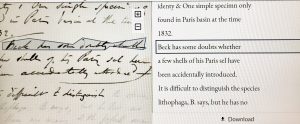
Transkribus is "a comprehensive platform for the digitisation, AI-powered text recognition, transcription and searching of historical documents – from any place, any time, and in any language.”1 Using the algorithmic handwriting model developed on the EDITOR project, we were able to upload more raw material from the Lyell collections to the Transkribus platform.In my recent work with Sir Charles Lyell’s notebooks, I found that Transkribus was able to decipher Latin species names with which I was unfamiliar. This saved me a significant amount of time and gave me the ability to transcribe much faster. An example of this occurred when Transkribus identified “Fissurellagraeca”.2 A species of mollusc, this name has since been replaced by the accepted name “Diodora graeca”3 . It is remarkable that it was correctly interpreted by the software in the first place.
An example of transcription output from the Transkribus platform. From Sir Charles Lyell Notebook, No. 65 (Ref: Coll-203/A1/65) - (with apologies for the poor quality image).
The transcriptions that Transkribus produces require minor to moderate spellcheck amendments, primarily where vowels are mistaken. There were some instances of errors in phrases, names, and once a whole line of text. In this case I transcribed this line myself which I had done previously with indexes in two other notebooks. These issues are minorandthey do not detract from the immense amount of time I saved using Transkribus compared to transcribing without the aid of the algorithmic model. In particular, we were all struck by the accuracy of the model in recognising and deciphering antiquated species names. This was invaluable and changes the role of the transcriber.
The overall benefit of the Transkribus software is that it is helping us to develop a much more comprehensive approach to describing and interpreting the Sir Charles Lyell Collections. To a much greater degree than previously possible, we can document and unlock the life and travels of this principal figure in the evolution of the discipline of geology.
Library and University Collections Philanthropy Manager, David McClay, brings us news on the fundraising campaign to digitise the Sir Charles Lyell notebooks.
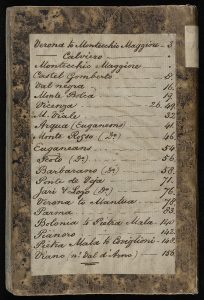
Cover and index of Sir Charles Lyell's notebook, Italy, 1828 (Ref: Coll-203/A1/7)
The fundraising campaign to digitise Sir Charles Lyell’s notebooks is now well underway. To reach our ambitious target of £125,000 we are hoping that new and existing Lyell supporters and friends will consider donating. Might you be able to help?
We have already been delighted to receive many individual donations from the UK and overseas. If you too would like to donate you can do so online via our Donation Portal or if you are from the United States of America, please see our guidance here
If you are involved in an historical, geological organisation which would be interested in learning more about Lyell, his notebooks and collections, and our plans to make them fully accessible please do get in touch: david.mcclay@ed.ac.uk
David McClay
Philanthropy Manager, Library & University Collections
Senior Lyell Archivist, Elaine MacGillivray, reviews her first month in post and shares some of the exciting work and plans afoot for the internationally significant Sir Charles Lyell archive.
The Sir Charles Lyell archive is of international importance and attracts great interest from academics and researchers from around the world. A key aim of our Lyell project is to make the archive as openly accessible as possible. To achieve this aim, we are progressing a number of areas of project work.
The Charles Lyell Notebooks, 1825-1874 (Ref: Coll-203/A1)
Our project archivist, Elise Ramsay’s cataloguing work continues apace and Elise is aiming to complete the cataloguing of Lyell’s 294 notebooks by the end of July 2021. Between January and March 2021, Elise also undertook a pilot project to transcribe a sample of Lyell’s notebooks using ground-breaking transcription technology, Transkribus. Elise and I were delighted to showcase the Lyell archive, our project plans, and to share our learning from the pilot with 150 international delegates at the EDITOR Transcription Workshop held earlier in March 2021. (More on that exciting development in a future blog post).
While Elise has been diligently cataloguing, I have been busy mapping all of the Lyell archive. We now have a really useful and comprehensive overview of the location, extent, scope and content of the four main elements of the collection, which feeds into our newly devised cataloguing work plans.
On completion of the first phase of cataloguing, the subsequent focus will be Lyell’s vast working correspondence and notes allocated to the University of Edinburgh in Lieu of Inheritance Tax in 2020. We have already migrated some of the existing descriptive data for this series to an electronic data-set which we can use to undertake a stock-take. This work will allow us to enhance the existing item level descriptions which we will then import into our online archives catalogue ArchivesSpace. With almost 1200 letters and a further 54 folders of papers including lecture notes and field-work we expect this work to keep us busy for some time!
Lyell’s correspondence includes letters between Lyell family members from as early as 1806 (when Charles Lyell was only 9 years old), as well as over 640 letters received by Charles Lyell between 1829 and 1874. 65 of those letters are from botanist, explorer and close friend of the naturalist Charles Darwin, Sir Joseph Dalton Hooker (1817-1911). They cover almost 40 years (1846-1874) during which time, Hooker was appointed botanist to the Geological Survey of Great Britain, undertook expeditions to India, the Himalayas, Syria, Palestine, and Morocco, and was latterly appointed Director of the Royal Botanic Gardens at Kew. We can’t wait to discover how these letters further illuminate the relationships and ideas shared between Lyell, Darwin and Hooker. We will be sure to share our findings with you here - watch this space.
Thanks to generous funding from the National Manuscripts Conservation Trust, supplemented by philanthropic donations we are delighted that a comprehensive conservation and preservation project will commence, we hope, later in the summer of 2021 (global pandemic permitting). I have been working closely with our Special Collections conservator to pull together a work-plan for our incoming project conservator. The conservation project will see all of the Lyell archive cleaned, repaired, consolidated, stabilised, rehoused and the conservation work fully documented. This work will serve to stabilise the collection, preventing the exacerbation and risk of further deterioration. Expect more updates on this work later this year.
Other work for me has centred around developing our project plans for the next three years: looking at how we can best enable collections access and bring to light the fascinating stories, ideas and knowledge from within the Lyell collections, to support learning, teaching and research. With this in mind, we quietly launched our public engagement account on Twitter on 8 March 2021. We were somewhat overwhelmed by the warm welcome we received and are delighted to have amassed 184 friendly followers already. You can follow us @LyellTime for more regular project highlights and chat from the project team as we work to preserve, catalogue, digitise and engage with the Sir Charles Lyell archive.
As well as plans for the development of our online resource ‘Charles Lyell’s World Online’ (thanks to generous funding from the International Association of Sedimentologists), we have a high profile, impactful and collaborative exhibition and engagement programme in our sights for the second half of 2023.
Our plans also include a significant programme of collections digitisation. We have completed a trial of photographing at high resolution 12 of Lyell’s notebooks. This means that you can now view over 1500 pages from these 12 notebooks via the University of Edinburgh Image Collections website. These images are CC-BY licensed supporting the University of Edinburgh's open education activities and initiatives. You can find more information on CC-BY licensing on the Centre for Research Collections Image Licensing website pages.
Digitisation helps us to protect and preserve this unique archive collection whilst simultaneously enabling and enhancing access. Completing the digitisation programme means that digital images of the Lyell collections will be openly accessible online. Digitised content is also critical to our plans to generate transcriptions of the Lyell collections using Transkribus. Our ambition is to build on our existing transcription pilot to build a significant body of transcribed material, making the collections more broadly accessible to all levels of scholar.
We hope you have enjoyed reading about our news from the last month. Please share your thoughts in the comments. Next month, Elise and our project volunteer Erin McRae, will be bringing you an update on our pilot transcription project – stay tuned!
22 February marks the anniversary of the death of renowned Scottish geologist, Sir Charles Lyell (1797-1875). Newly appointed Senior Lyell Archivist, Elaine MacGillivray, says ‘hello’ and reflects on Lyell’s contribution to our understanding of the world.
Elaine MacGillivray Senior Lyell Archivist
Hello Everyone! My name is Elaine MacGillivray and I am very happy to introduce myself as the newly appointed Senior Lyell Archivist at the University of Edinburgh’s Centre for Research Collections.
I am a registered archivist and bring to the project almost 20 years of experience working across archives in the local authority, business, community, and higher education sectors. I have worked at the University of Edinburgh since 2014, first as the archive lead on the School of Scottish Studies Archives refurbishment project and later, managing two Wellcome-funded, collaborative, archive cataloguing projects. In 2019, I was awarded 'Record Keeper of the Year' by the UK Archives and Records Association. I am a trustee of, and professional advisor to, a number of rural heritage organisations.
I enjoy the meticulous organisation of what often seems to others like utter chaos, and I love to connect people and their research interests to each other and to archive collections. When I am not knee-deep in project management and archive metadata, you will find me outdoors; up a hill, or exploring the back roads of Perthshire on my bicycle.
It is a real privilege to be entrusted with responsibility for the Sir Charles Lyell archive collections. Prior to the collections being transferred to the Centre for Research Collections, it is clear that the Lyell family invested a great deal of time and care in preserving and organising the collections whilst in their care. This places our archives and conservation team on a great foothold as we progress conserving and cataloguing the collections further, in order to ensure that they are preserved for posterity and, at the same time, made more widely accessible.
Lyell’s notebooks, correspondence, papers and objects are an immense and invaluable body of evidence. Collectively, they serve to illustrate how Lyell and others in his vast network came to formulate, interrogate and revise their ideas and their understanding of the world around them. Lyell is renowned for his contributions to geology, but the collections bring to light yet more about his own and others’ thinking, across a range of subjects and disciplines.
Earlier this week, Europe’s most active and iconic volcano, Mount Etna in Sicily, erupted once again. The 3,350m tall mountain has the longest recorded history of volcanic eruptions, dating back to 1500BC. The historic lava flows are considered to date as old as 300,000 years. It was Lyell’s systematic and methodical observations of Mount Etna from 1828 onwards that led him to develop his theories around geological time and to argue that the Earth was much older than had been previously believed. Lyell’s work throughout the nineteenth century was key to a monumental shift in our understanding of time and our place in the universe.
In 2021, Mount Etna is still one of the best-studied and monitored volcanoes in the world and its significance endorsed by its status as a Unesco World Heritage Site of Outstanding Universal Value.
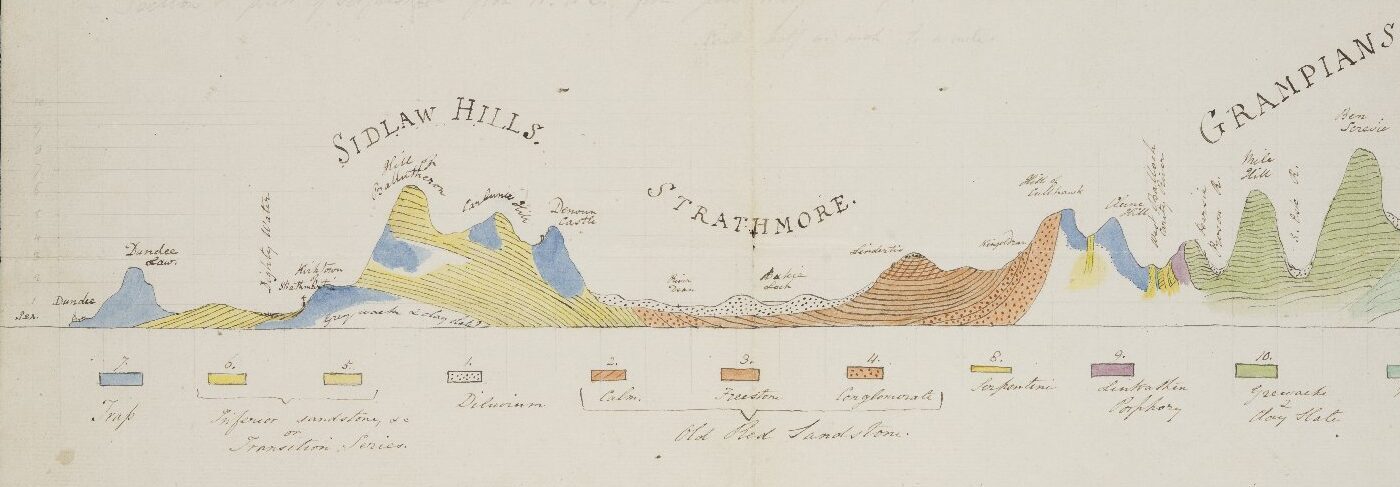
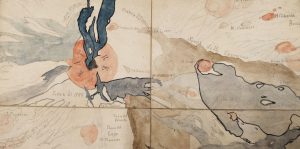
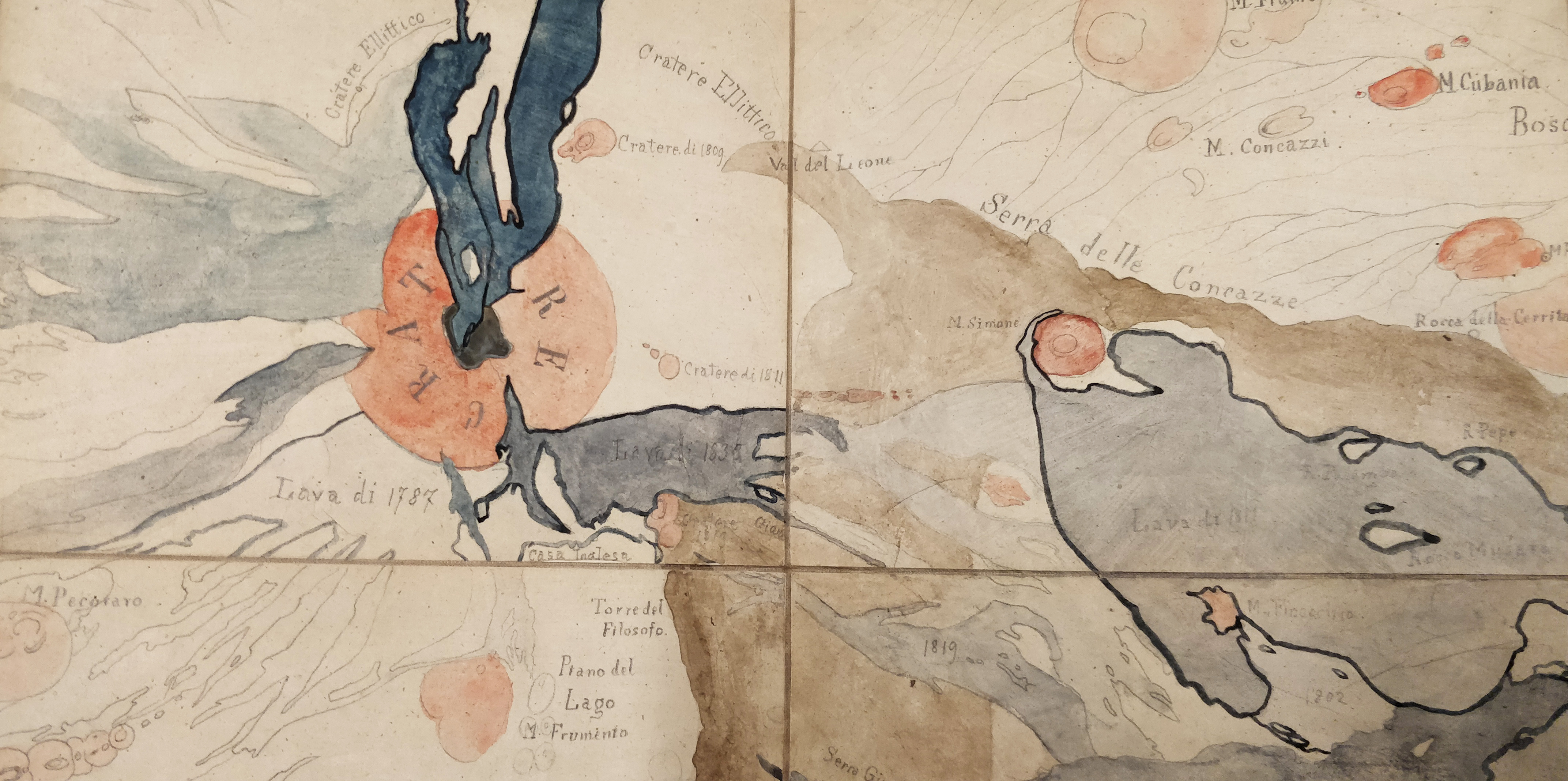
Detail of a hand-drawn watercolour map of Mount Etna from the Sir Charles Lyell archive (Ref: Coll-203/Uncat).
One of my favourite items from the collection thus far is a hand-drawn watercolour illustration of Mount Etna. My colleague and Head of Special Collections, Daryl Green, discovered the drawing in August 2020 as he sifted through part of the collection shortly after it arrived at the Centre for Research Collections. The drawing forms part of the continuous record of observations of Mount Etna dating from 1500BC to the present day. I suspect that it is only the first of many remarkable finds to come.
I am looking forward to working with colleagues, building on the fantastic work already undertaken in cataloguing, digitising and making the collections more accessible. We will continue to share our discoveries and project progress here.
We want to hear from you!
What else would you like to see on the ‘Through Lyell’s Eyes’ blog? Would you like to hear from our volunteers and interns? Perhaps you would like to read guest posts from academic experts? Would you like to meet more of our team? What about a ‘behind the scenes’ look at some of our cataloguing, transcription or conservation work? Should we include more visual content illustrating some of the items from our the collections? Would you be interested in more audio-visual content?
Let me know your thoughts and ideas in the comments below – I look forward to hearing from you.
Juliette Lichman working on Lyell digitisation assessment
In November 2019 the Library excitedly welcomed Sir Charles Lyell’s two hundred and ninety-four notebooks into its Special Collections. With support and funding from leading institutions, groups and donations pledged from over 1000 individuals, this tectonic acquisition meant the notebooks were able to stay in the UK and join the Library's existing collection of Lyell-related materials. As part of the DIU team, I was lucky enough to photograph Lyell’s notebooks, working with the world’s finest quality cameras to digitise a previously private collection into the public sphere and beyond.
Before I dig a little deeper I would like to share a quote from Charles Withers, who we filmed late last year talking about Lyell. He captures the essence of these notebooks perfectly in his description;
“They contain, in a sense, the emergence of thought of one of the world’s leading Earth scientists. But Lyell is much more than that. Lyell was a leading geologist but he was also a geographer, an antiquarian, an archaeologist. He writes with literary references, he writes with a lawyer-like precision, and he’s in touch with very many people whose names, along with Lyell’s, inform our understanding of the emergence of 19th century science.”
Professor Charles W J Withers, Ogilvie Chair of Geography,
University of Edinburgh, Geographer Royal for Scotland
We're very lucky that Lyell was such a great organiser and essentially catalogued his notebooks for us. With a robust system of pagination and a glossary, he was able to quickly reference information when needed. These small, unassuming notebooks accompanied him everywhere, and in his regular 'Memoranda for Town' (a.k.a. to-do lists) there are mentions of particular notebooks which he wanted to pack for later reference, as seen in no.4 below. Very conveniently the locations he visited are neatly labelled on the front of the notebooks. The writing within, however, can be difficult to decipher in some cases, especially where Lyell used his own form of shorthand and references, or if he was in the field resisting against the elements and pressure of the wind.
I find that to-do lists are a simple and yet revealing insight into our every day lives and passing thoughts; little reminders which help us to achieve a larger goal or shape our daily lives. Without having to read a whole passage as you would in a journal, we are able to get a sense of Lyell’s day to day life.
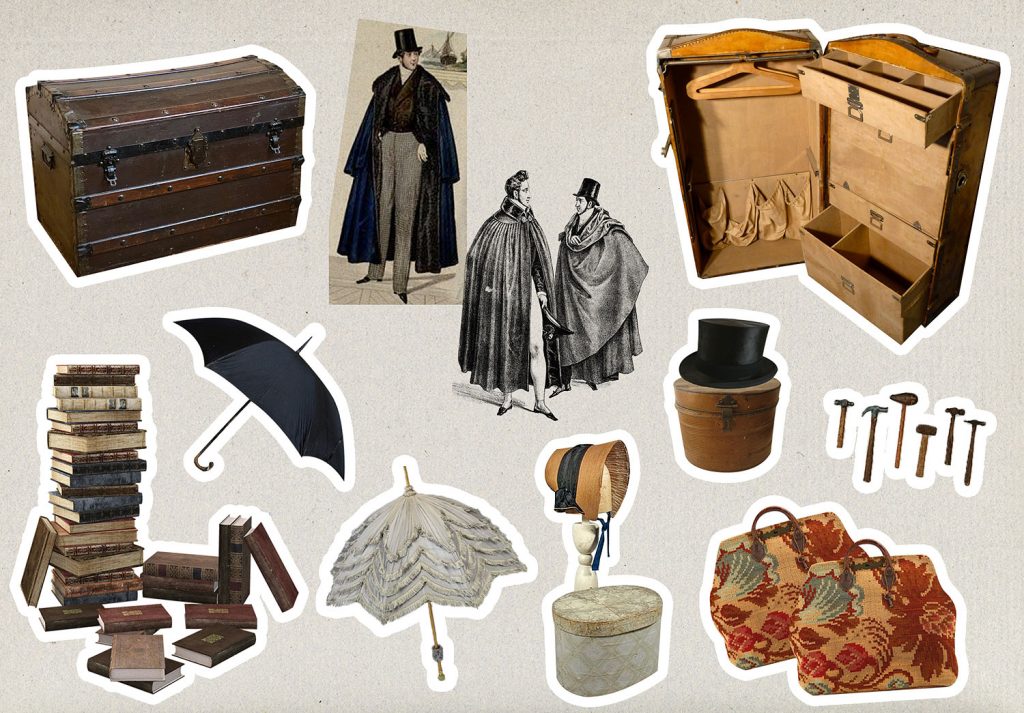
My favourite list is for items to take on an upcoming voyage. There is a glimpse of 'Lyell the husband', as he mentions a hat box and a bonnet box, separately, and again, a parasol and an umbrella, alluding to his wife's presence with him. Indeed, this notebook is from 1837 and the catalogue description indicates:
"This notebook was kept by Lyell during his travels with Mrs. Lyell to Denmark and Norway, where they focused on contact zones between sedimentary rocks and large intrusive bodies of granite and syentie, as well as dykes and sills."
If you wondered what it was like to travel with Lyell, this is a great example of how he packed light.
I came across an example of 'Lyell the brother' in this simple note. His sister, Marianne was a keen lepidopterist, and enjoyed collecting and naming insects. This was especially popular in Scotland, where much of the flora and fauna had no official name. He writes, 'Curtis - No. 1. Did he not find a spider'. Maybe it was of personal interest, but there is no doubt he would have had illuminating conversations with his sister about entomology and the natural world, perhaps describing foreign insects he encountered in the field, to her delight!
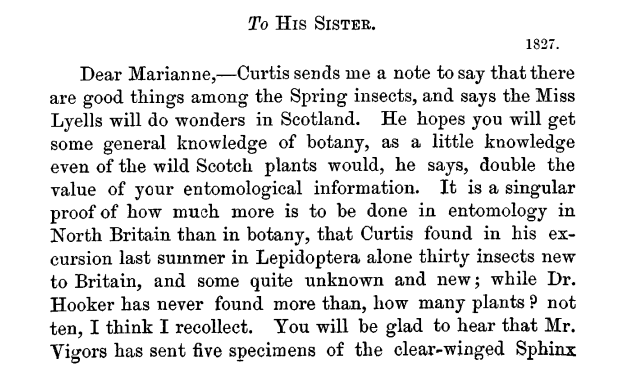
Lyell was well acquainted with the notable entomologist, John Curtis which is evident in this letter he sent to his sister in 1827;
"Dear Marianne, Curtis sends me a note to say that there are good things among the Spring insects, and says the Miss Lyells will do wonders in Scotland. He hopes you will get some general knowledge of botany, as a little knowledge even of Scotch plants, would, he says, double the value of your entomological information. "
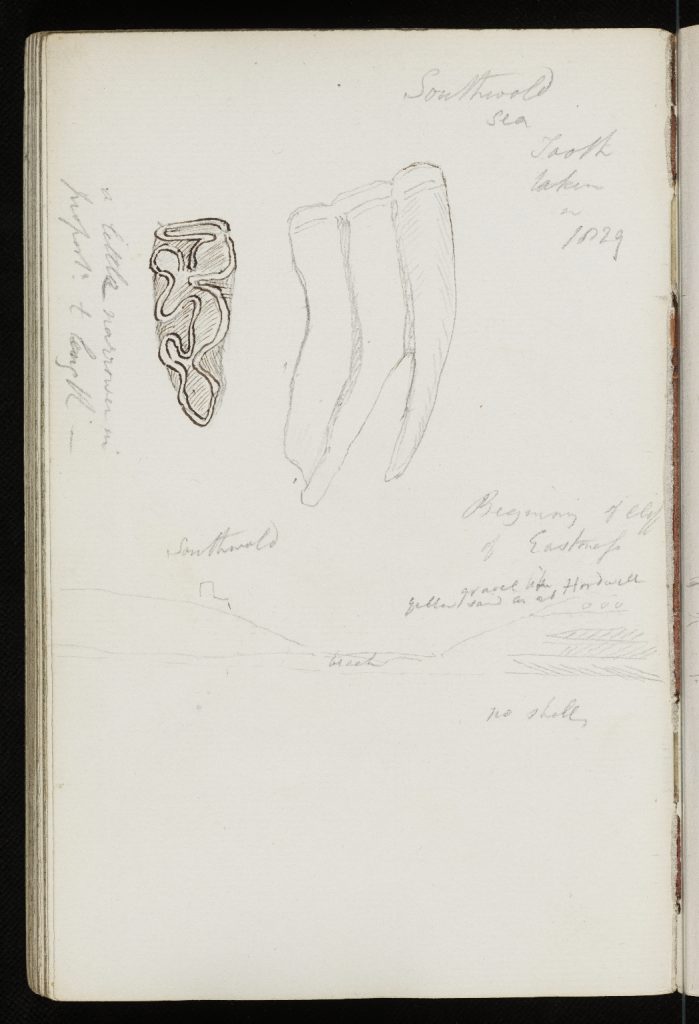
Another favourite find of mine was this illustration of what I assume to be a bovine tooth, with a sketch of Southwold Sea and the beach where he found it. After walking back and forth along the beach, looking intently at the sand for specimens, he stops and notes sadly "no shells", only teeth!
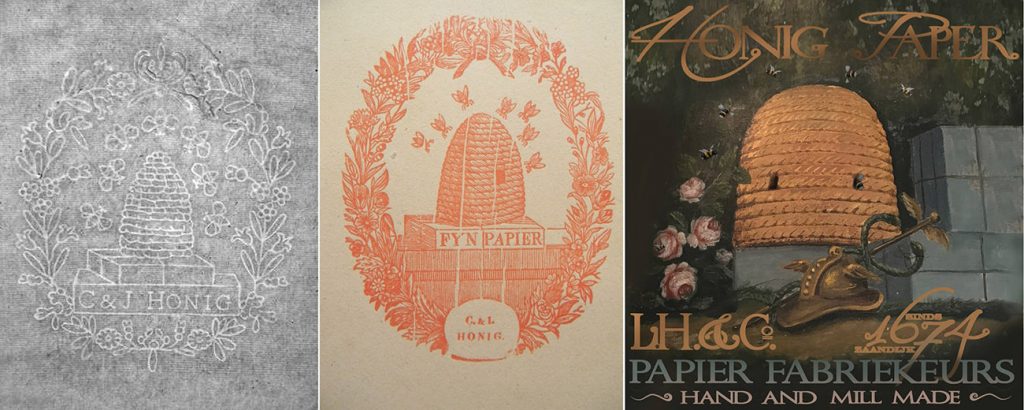
My most recent find in the notebooks was the most exciting by a landslide. We often come across interesting and unique watermarks in our department, but we found one in the notebooks which was very sweet and ornate. This was found in a loosely bound section that Lyell added to the start of a notebook, acting as a preface. The watermarks in the corresponding volume do not bear the same image, so it's likely that he needed extra paper while travelling and bought some directly from the supplier.
The 'Beehive' watermark originated with a family of Dutch papermakers by the name of Honig [honey], who owned mills in Zaandyk (1675–1902). The coat of arms of the Honig family (incorporating the beehive motif) became a watermark extensively copied throughout the Netherlands and abroad in places such as Russia and Scandinavia.1 The 'Beehive' watermark became a common motif for Dutch papermakers and those who wished to allude to Dutch papermaking. Eventually it also came to represent a particular paper size.
National Gallery of Australia https://nga.gov.au/whistler/details/beehive.cfm
Here are a few examples of watermarks and branding from C&J Honig. Note that ours is very similar to the first watermark, with the exception of larger bees.
We're thrilled that this second batch of notebooks is now digitised and available online for all to enjoy. I photographed Lyell's notebooks for the majority of the year, and with the added lockdown and social distancing restrictions, for a time it was just myself and the notebooks in the DIU. I will certainly miss seeing Lyell’s familiar scrawling hand and pencilled field sketches - intimate notes that he likely never anticipated sharing with anyone.
It’s been just over a year since our acquisition of these notebooks and it feels as though we have only scratched beneath the surface of the treasures contained within. They are a rare and fascinating glimpse into this famed geologist’s daily life, and like many others I shall be eagerly awaiting the transcriptions and new discoveries from this most beloved rockstar!
We are excited to offer a new opportunity to experience this collection, a Zoom presentation by the Lyell Project staff on 10 December 2020 at 1pm GMT. This event reveals the ongoing work at the University of Edinburgh with the geological collection of Sir Charles Lyell, a rich corpus of material including his notebooks, family papers, and geological specimens.
Elise Ramsay, Project Archivist, will introduce Lyell and show several key pieces of the collection using the Centre for Research Collection’s new innovative visualizer technology. This collection includes specimens collected by Charles Darwin, letters between Lyell and Darwin, and notebooks in Lyell’s own hand during his fateful tours to France and Italy. Dr. Gillian McCay, from the Cockburn Geological Museum at the Grant Institute, will connect Lyell’s legacy to modern scientific perspectives. Each will discuss adapting working practices over the past year to continue opening up this rich collection of earth science material.
This talk is part of the Carlyle Circle 30th Anniversary online exhibition. The Carlyle Circle was formed in 1990 and in 2020 it celebrates three decades of impact, highlighting the many ways legacy giving has supported opportunities for world-leading teaching and research.
Instructions to join this free talk will go out to all attendees in advance of the online event. We welcome any who are interested, and look forward to seeing you.
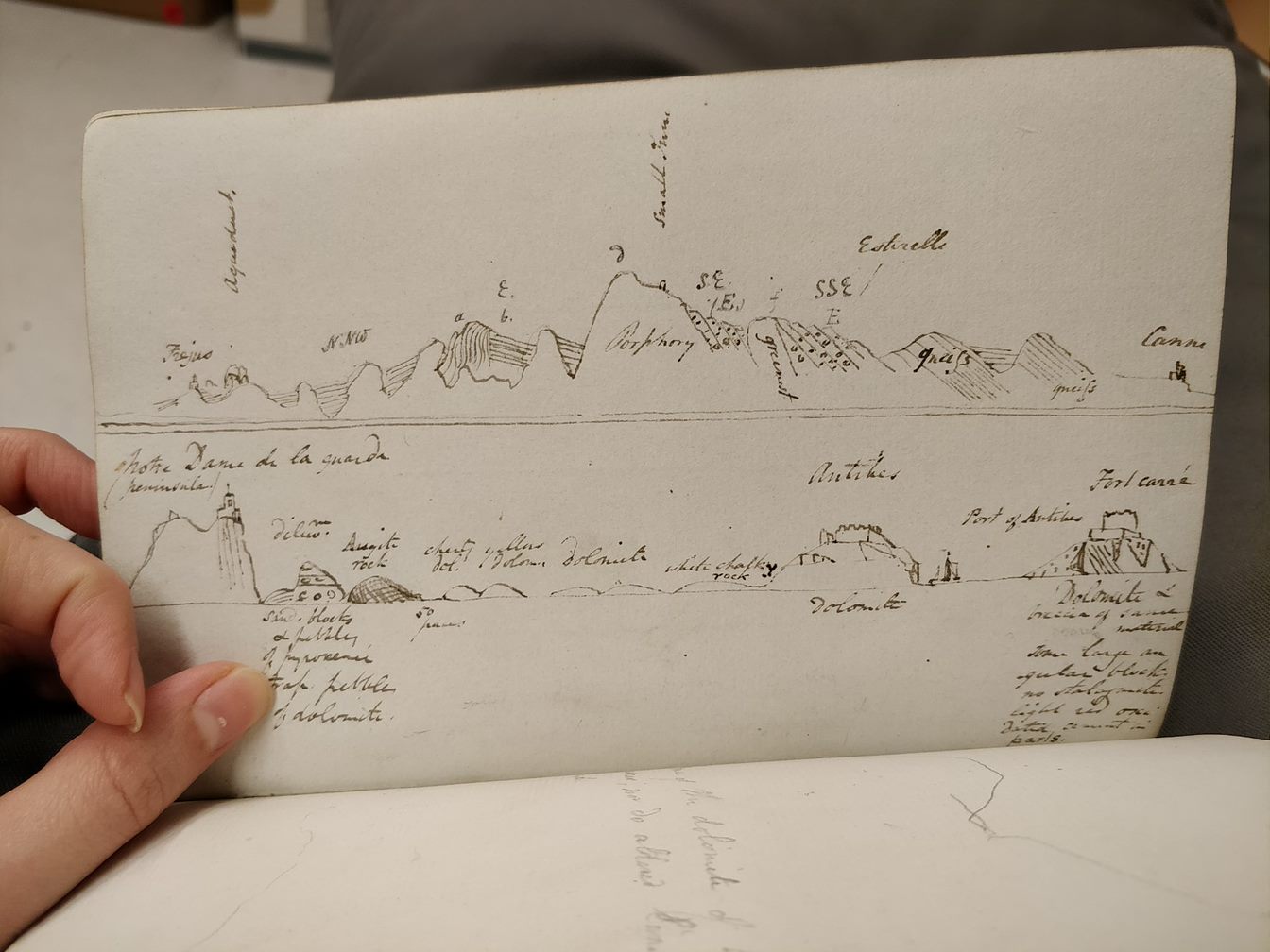
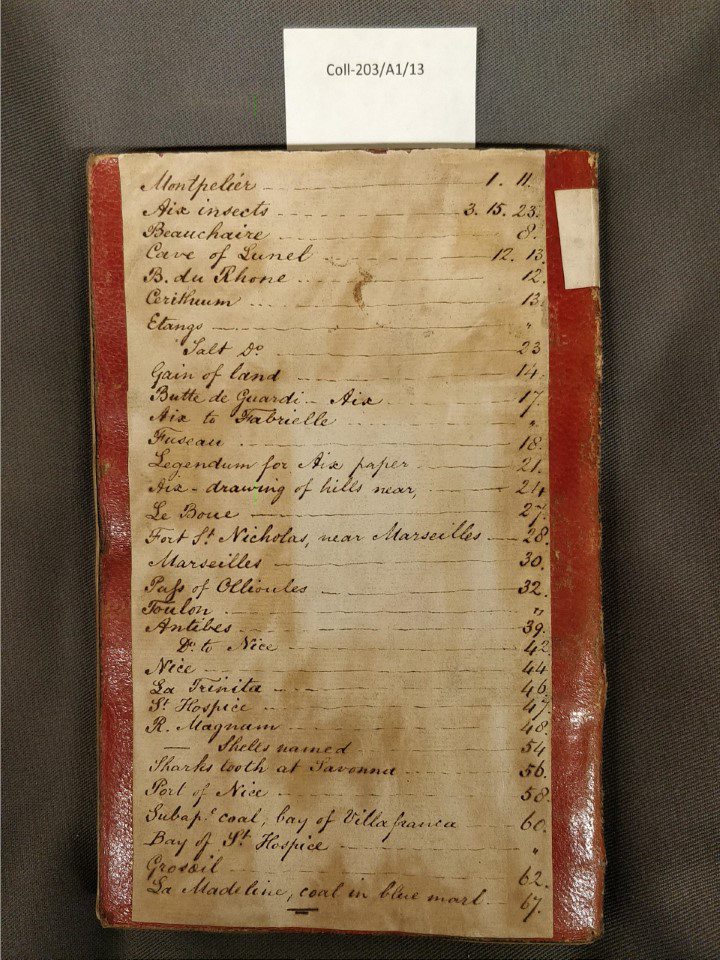
This week I spent some time working with the following notebook, No. 13, which Charles Lyell kept during his tour in southern France in 1828. This tour was originally started with Roderick and Charlotte Impey Murchison, and was foundational in Lyell's decision to devote his work to geology over law, and also to begin work to write Principles of Geology. It was in comparing the rock formations of Paris to the south of France, Montpellier, Nice, and Italy that he found common fossilised shellfish, and concluded that these areas must at some point have been underwater, and have since been slowly lifted. (Maddox, p. 42) It was here, too, that in writing to Murchison from Naples 15 January 1829, he devoted himself to the study of geology, "I shall never hope to make money by geology, but not to lose, and tax others for my amusement."
The notebook is filled with journal style writing, daily entries, with full page detailed sketches, as pictured below. Lyell writes in ink and pencil. Subjects include: Valley of Magna, Etangs, Comparison of Montepellier calcium deposits to those in Paris.
References:
Maddox, Brenda. Reading The Rocks. Bloomsbury Publishing, 2017.
Elise Ramsay
Project Archivist (Charles Lyell Collection)
Centre for Research Collections, University of Edinburgh
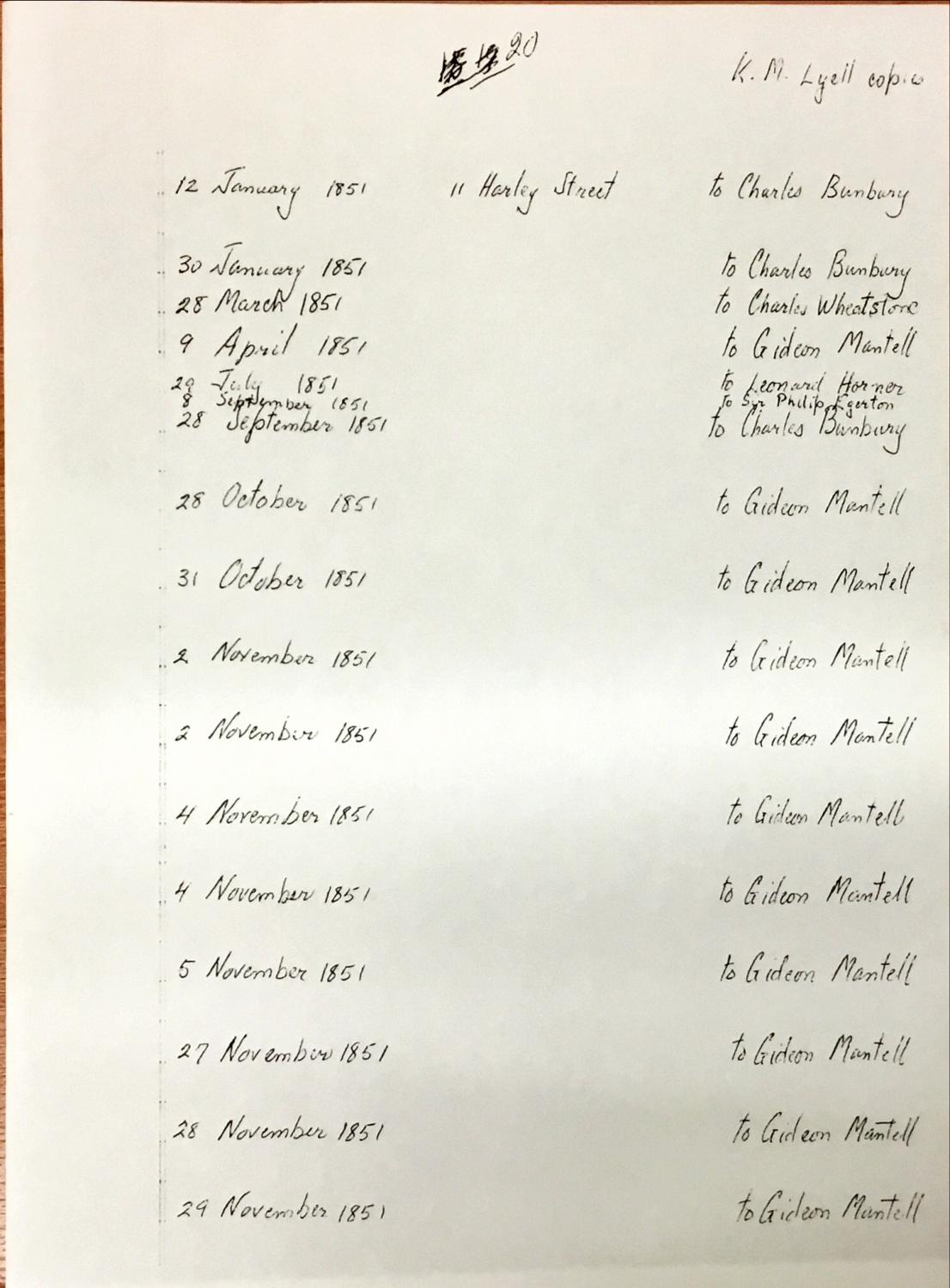
This week in the stores, I began to delve into the box lists which describe the new-to-us collection of further papers of Charles Lyell and the family which was received by the University in the summer through the Acceptance in Lieu scheme. These are 18 boxes of papers and correspondence of Lyell, and I have embarked on scanning these box lists which will prepare for more in-depth cataloguing in the short to medium term. Here is what most box lists look like:
Gideon Mantell was a frequent correspondent of Lyell, and their life-long relationship started with a bang in 1821, when Lyell casually called on Mantell while visiting his old school at Midhurst. Having heard tell of the doctor from some workmen in the nearby quarry, Lyell rode the 25 miles over the South Downs and knocked on Mantell's door nearly at dusk. Presumably they might have known each other's names from the Geological Society, but one would imagine the visit would still have come as surprise at best. However, common interest prevailed, a well-stocked fossil cabinet provided great amount of conversation, and the two reportedly gossiped until morning. (Bailey, p. 48) Their published letters cover all from scientific theories, discoveries, to the latest gossip and accounts from the GeolSoc and Royal Society, of which they were both members.
In a week which is dominated by a race for a vaccine, we see similar scientific rivalries in the early years of geological science. Today Mantell is known for bringing to light and describing dinosaur reptiles. These letters from 1851 with Lyell may relate to a legendary dispute between Mantell, Lyell, and Sir Richard Owen surrounding a reptile fossil which was found in ancient rock, which previously had only yielded fish. At this time, years before Darwin's Origins of the Species, views of the evolution of life were split into two camps; progressionists (today, this sect is called orthogenesis) believed that organisms have an innate tendency to evolve to a particular goal, and most followers believed this to mean a trend of increasing biological complexity through time. Any description of a tree of life usually falls within this hypothesis. Lyell and Mantell opposed this belief, identifying as anti-progressionists. A famous dispute occured between Lyell, Mantell, and Owens when Mantell and Owens wrote opposing descriptions of this curious fossil. The legend resolved with Owens in the wrong, and Lyell and Mantell in the right, but research using the archival collections of Owens and Mantell proves the legend wrong, revealing that Lyell urged Mantell, thought infirm and ailing, to write the description long after Owens had already been tapped to view and describe the fossil, and it was Mantell and Lyell who were in the wrong. This is a woefully clipped version of events, but I find the true value of work with archives here: with access and research to correspondence archives such as this one, the true stories of history are told, and legends can be found faulty.
Progress in the Lyell project has taken a giant leap these last two weeks thanks to two developments. Firstly, physical work in the stores where the collection is secured at the University Main Library has been deemed safe, if approached with new procedures, which has meant I have been able to access the collection in person for the first time since March 10th. This has meant the first stage of rapid capture and transcription of Lyell's indexes has begun. This level of detail will make for rich metadata in the catalogue, and eventually allow researchers to search across the notebooks by subject matter. Thus the need for a new series of blog posts, released each week on Tuesday, where I can highlight all the discoveries I made in working with the collection!
Secondly, I am so excited that Nicky Monroe, a former History of the Book student, has agreed to volunteer on the project remotely. He will be transcribing these indexes and researching Lyell's life for extra context in the catalogue. We will hear about his progress and discoveries in the collection in the coming weeks!
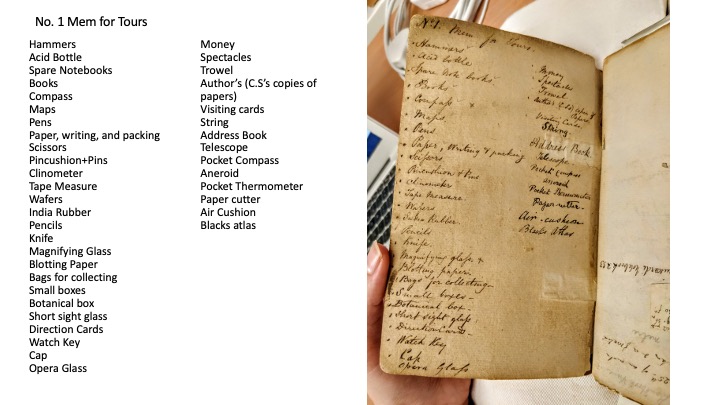
From my time in the stores last week, I captured this fantastic packing list, inscribed by Lyell in the earliest notebook we have of his, from 1825. During this time he would have been balancing his fondness for geology with his law work, which is reflected in the organisation of this notebook. The first half is brief notes on cases, mainly tenancy law and divorce cases. The second half begins from the back of the notebook, and reverse orientation compared to the first half, where Lyell writes notes from a Geology lecture he attended April 29 1825.
It is during this time, while he struggled with his law practice and his eyesight, that he invested more in geological field trips, often with visiting gentleman scientists. In the early summer of 1824 Lyell and Prevost travel from London to Bristol and Land's End, ending up at Lyme Regis when Mary Anning made her great discovery of two complete Ichthyosauri. (Bailey, 1962) In the autumn, Lyell focuses on his Scottish roots, living at the Kinnordy estate and hosting William Buckland (his geology tutor from Oxford) to venture to Stonehaven, Aberdeen, Elgin, and Inverness to Brora; then back to Inverness and, after a quick jaunt to Brora, south by Blair Atholl, Glen Tilt, Perth, and Kinnordy to Edinburgh. Throughout these journeys, they were "comfortably interlarded with breakfasts and dinners without end", stopping to see Sir James Hall near St. Abb's Head, and twice at the Jameson's. (Lyell and Lyell, 2019) I would bet that this packing list would have been in preparation for any of these foundational field trips. Stay tuned for Tuesday next week when another installment will be published!
References
Bailey, E., 1962. Charles Lyell. Edinburgh: Thomas Nelson and Sons Ltd.
Lyell, C. and Lyell, K., 2019. Life, Letters And Journals Of Sir Charles Lyell, Bart. Alpha Editions.
"[Charles Lyell's] cultivated mind and classical taste, his keen interest in the world of politics and in the social progress and education of his country, and the many opportunities he enjoyed of friendly intercourse with the most leading characters of his age, make the letters abound in lively anecdotes and pictures of society, constantly interspersed with his enthusiastic devotion to Natural History." -Katherine Lyell, Life, Letters and Journals of Sir Charles Lyell, Bart, 1881
To mark 7 months working with the Lyell collection, I'd like to share some discoveries I've made while cataloguing these amazing notebooks, and researching Lyell's published works. Lyell today is known for his great discoveries of the Earth, and the elevation and establishment of the science. Here, we see Lyell's other interests.
Discoveries:
Charles Lyell was deeply interested in the role of universities and education in society. He writes in his notebooks extensively about the religious requirements at Oxford and Cambridge, to which he objected. In Notebook 4 he makes this list:
Notebook No 4, p. 106, one instance of Lyell's notes on Universities and education.Transcription: “What is the portion of those who ought to have a Univ[ersit]y Ed[ucatio]n in England. Who really have one? 1. Learn number Att[ourn]ys & their cle-rks. Barristers not Oxf[or]d or any Univ[ersit]y men – Dissenters who an barrister, attournies, or spe-cial pleaders &c [etc] 2. Engineers, Architects, Surveyors 3. Physician dissenters how many Surgeon d[itt]o. Discipline was intended. ought not those below 16, to be required to go to church.”
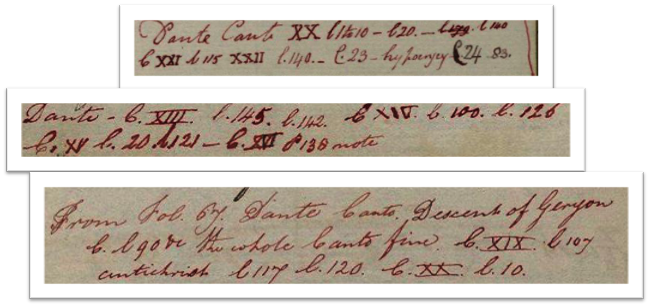
2. Dante's Inferno was a constant reference in Lyell's notebooks, though it's not clear yet for what purpose, other than the geologist's keen interest. In the midst of notes on other subjects, Lyell often makes brief abbreviated citations of the parts and lines of Dante. These must have been important to him, because he regularly references these citations in his table of contents. His father being a Dante scholar, this is intriguing for further research to understand how Dante's poetry influenced Lyell's understanding of the earth.
Excerpts from Notebook No. 4 (1827), where Lyell cites Dante.
3. Lyell wasn't the only naturalist in his family, his sisters and father were keen on insect collecting and naming. In those days, much of the flora and fauna of Scotland had no official name, and therefore budding lepidopterists "discovered" and named the insects they caught. We hope to describe illuminating family letters like this in the newly acquired papers of Lyell.
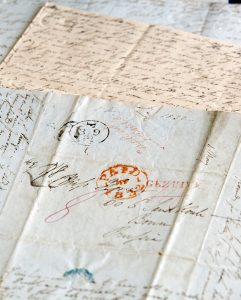
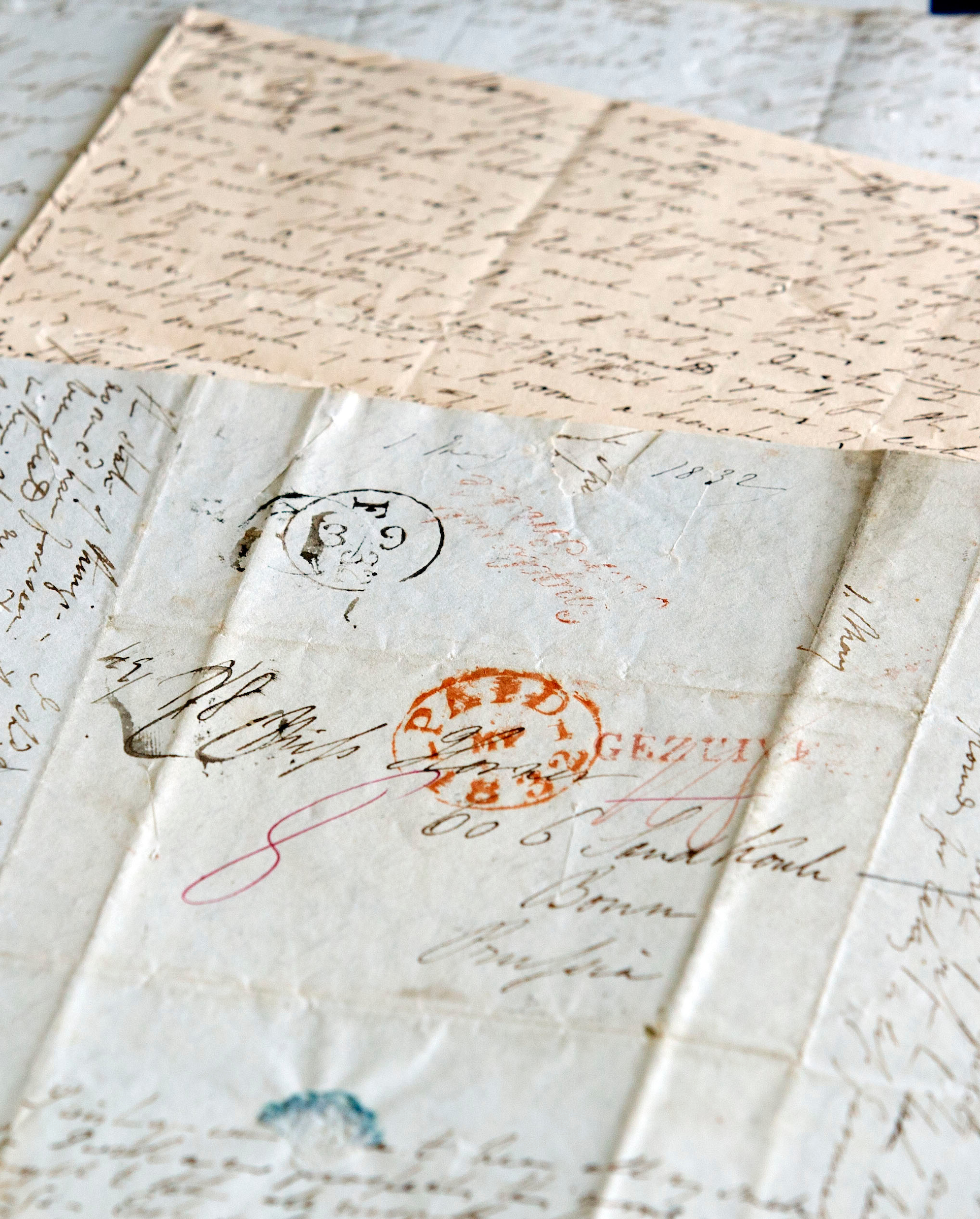
Letter to Marianne from Charles Lyell concerning the Lyell sisters' prowess and interest in identifying insects
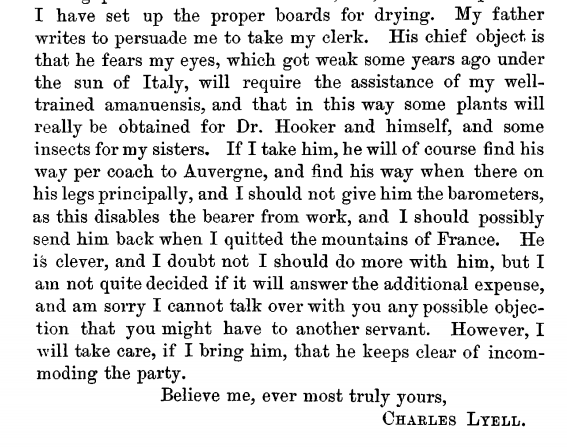
4. Lyell's eyesight is known for being poor and limiting his abilities all his life, but the reason why is now contested. Most biographies cite that his eyesight worsened while studying the law by candlelight, but in a letter to Murchison in preparation for their Grand Tour to France and Italy, Lyell writes that his eye injury was caused by the long days in the Tuscan sun on holiday with his family. On that Grand Tour, to appease his father, Lyell brought with him a clerk named Hall to aid him in his work and treatment of his eyes - though no detail of the treatment has yet been found.
Excerpt from a letter to Murchison, April 29, 1828, explaining his father's wishes for Lyell to bring his clerk with him, to make up for his troubles with his eyes.
References:
Lyell, C. (2010). Life, Letters and Journals of Sir Charles Lyell, Bart (Cambridge Library Collection - Earth Science) (K. Lyell, Ed.). Cambridge: Cambridge University Press. doi:10.1017/CBO9780511719691
Bailey, E., 1962. Charles Lyell, F.R.S., (1797-1875). Edinburgh: Thomas Nelson and Sons Ltd.
Charles Lyell Notebook No. 4, digitised here: https://images.is.ed.ac.uk/luna/servlet/s/cennww
July was a busy month for the Sir Charles Lyell Collection, and the Centre for Research Collections.
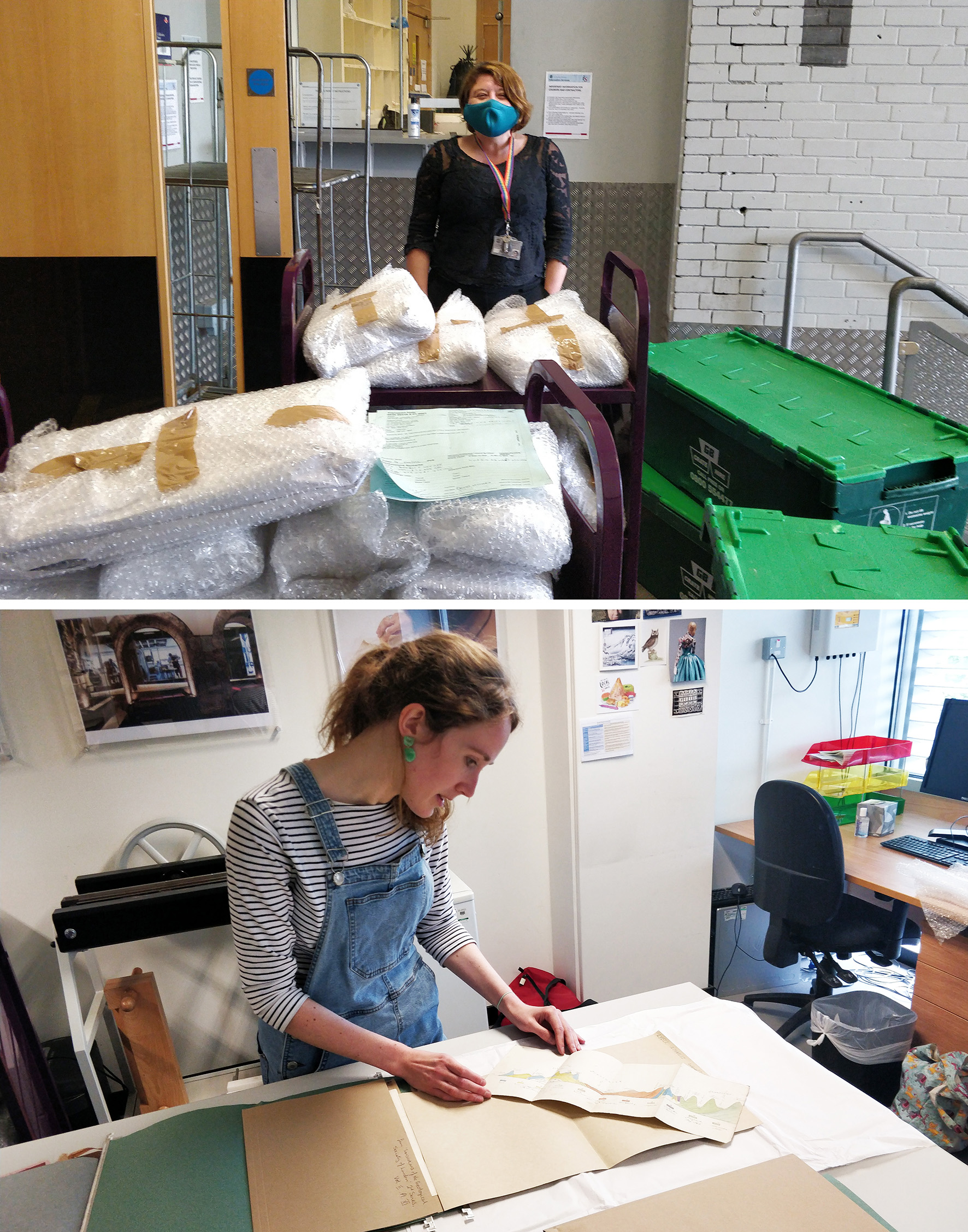
After much planning and advice, the CRC passed inspection, and we opened again for University of Edinburgh researchers on 8 July with new ways of working, but offering access to our collections once again. This has also meant that we were able to welcome in new acquisitions whose delivery was paused during the nation's lockdown. Which means, at long last, we are able to share the news of a very exciting addition of papers, correspondence, and rare manuscripts to the University's Sir Charles Lyell Collection.
Rachel Hosker assists with off-loading the material in auction boxes, and moving them to be condition checked by Katherine Richardson.
This new collection includes over 900 letters to and from Sir Charles Lyell (including additional letters from Darwin, Joseph Dalton Hooker, John Murray, etc.); intimate correspondence between Lyell and his wife, Mary Horner Lyell, and his wider family; autograph manuscripts of a number of lectures delivered both in the United States and in the United Kingdom; a part of the autograph manuscript of Principles of Geology; maps commissioned for lectures and publications; and heavily annotated editions ofPrinciples of Geologyand other works marked up for later editions. This additional collection was allocated to the University of Edinburgh Library in 2020 by HM Government under the Acceptance in Lieu of Inheritance Scheme, from the estate of the 3rd Baron Lyell.
Daryl Green, our Head of Special Collections and Deputy Director of the CRC, has had a chance to have an initial dive into this collection in order to check its inventory and gauge its quality. Here’s some initial reactions:
“Having arrived in March to my new post as Head of Special Collections, one of my first tasks was to oversee the transfer of this material from its holding location in London to the University. Lockdown prevented our best laid plans, however, and the Acceptance in Lieu material finally arrived on a warm and quiet day mid-July. Sifting through this material in an initial ‘getting to know you’ session, I was struck at how thorough the correspondence archive was. There are folder and folders of correspondence with Charles Bunbury, Joseph Dalton Hooker, John Murray and many others, but also transcripts of letters going out that were copied by one of Lyell’s sister-in-laws, Katherine Murray Lyell. Here, too, is a lifetime of correspondence between Charles and Mary Horner Lyell, from initial courting, to full blown intellectual romance, to letters later in life.
As I sorted through folders I came across diagrams for how Lyell wanted his lecture theatre laid out for his tour of the States, I found hand-drawn maps and illustrations, both by Lyell and commissioned from others, including alluring diagrams, a gorgeous watercolour map of Etna, and a huge geological map of the Kinnordy Estate and its district.
Detail of a hand-drawn map of Mount Etna from the newly acquired Sir Charles Lyell archive.
"This archive is by all accounts an amazing resource in its own regard."
Letters upon letters between geologists, students, and admirers have all been beautifully preserved and organized by the Lyell family, and included in the archive was some of the work done by a member of the Lyell family in the 20thcentury to track down and copy correspondence, especially between Lyell and Charles Darwin, which had ended up in other collections. This archive is by all accounts an amazing resource in its own regard and, when paired with the notebooks, the further archive material, the publications and the geological samples, gives a more complete picture of how science was conducted in the 19thcentury than any other archive I am aware of.”
During this lockdown, the Lyell Project has been able to continue enhancing metadata, despite having no access to the Lyell notebooks, thanks to some quick digitisation done by the amazing team at the DIU prior to lockdown. We've been working quite a bit with Notebook No. 4, from 1827, when Lyell was balancing his two callings; the law and geology. In 1825 his eyesight was no longer ailing him as it had been years previously, and following his father's wishes, he was called to the bar and joined the Western Circuit for two years. But during this time, as we can see from the Notebook, he also maintained fervent correspondence with fellow geologists, read the works of George Poulett Scrope, and Lamarck, and thereby fostered a great curiosity for the volcanic Auvergne region in France. In 1825 he joined Scrope as a Secretary to the Geological Society, and contributed frequently to the Quarterly Review (published by John Murray, the archive of issues are available with EASE access here).
This notebook is a fascinating look into this dichotomy Lyell was facing; pages constantly change between matters of law and geology. He expresses great passion and opinion on both, but his notes concerning law and society are often tinged with a sense of discontentedness, whereas his entries on geology are mostly "Queries" about the properties of geological phenomena, or discussions on how he disagrees with a recently published position.
Another curious element in this notebook is the inclusion of citations to works by Dante, namely Dante's Inferno. These appear often among entries on other subject, and without explanation. Clearly, this an excellent area of research, as we know Lyell's father was a great scholar on Dante.
That's all for today's update! Explore Notebook No. 4 for yourself here!
Of the many celebrations of Earth Days, Earth Day 2020 will be remembered.
Not only because it is the 50th anniversary of the first Earth Day, but that it occurs during this unprecedented public health crisis; the parades, marches, and demonstrations characteristic of Earth Day have now been moved online, in the form of Earth Day Live. This intersection of Earth Day and COVID-19 is significant, as it comes at a time when we likely have heightened awareness of the power of nature, and its ability to stop humanity in our tracks, and shift our focus to the natural world we live in (which, here in Edinburgh, is springing to life in truly magnificent ways).
Sir Charles Lyell, known as a founder of modern geology, was innately interested in the course of nature, and keenly observed natural phenomena to form and prove theories about the Earth's age, and continuous processes. Today, our understanding of climate change is built upon the concepts laid down by early geologists
like Lyell. Only with the concept of the Earth's continuous process of deposition and erosion are we able to understand how our actions have consequences on the Earth and climate. Daryl Green, Head of Museums and Special Collections, writes,
"Lyell made acceptable the theory that the earth was millions of years old and that it was shaped by geological processes still active in the modern era. He made it possible for people to think about the earth as a dynamic and developing planet in the way we do today."
-Daryl Green, Head of Special Collections, Deputy Head of Centre for Research Collections
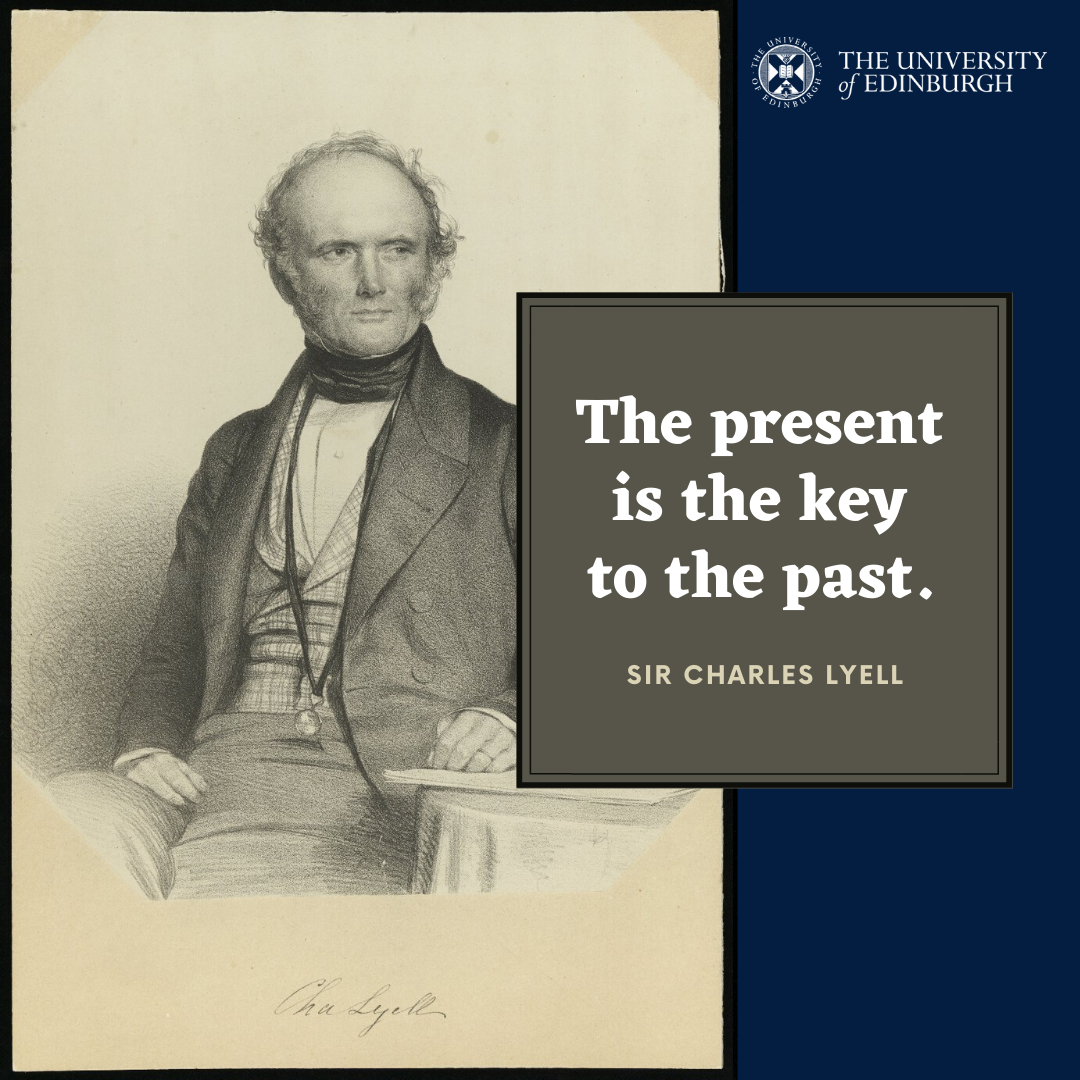
In his seminal book, Principles of Geology, Lyell constructed a main, pivotal point: "The present is the key to the past." This keenly illustrates his outlook on geology, as he observed modern phenomena, data, and formations to interpret the geological history of the Earth. His book was key to implementing evidential methods to geology, but also to illustrating these ideas in a way that the public could understand. Dr. Gillian McCay, Curator of the Cockburn Museum writes,
"He was one of the first to open up the development of science through publishing books aimed at a more general reader, allowing lay people to access ideas, and thus allowed more people to examine the world around them and draw conclusions."
- Dr. Gillian McCay, Curator, Cockburn Museum
On this landmark Earth Day, we highlight the outstanding work of Charles Lyell, through his observation and writing, which allows us to study the Earth and make conscious decisions in our daily lives. In the weeks to come, we will be sharing more from our collection of his scientific notebooks, and correspondence.
My name is Elise Ramsay, and I am delighted to introduce myself as the University of Edinburgh's new Project Archivist on Climate Change. My remit includes cataloguing the Lyell notebooks, and scoping other collections the University holds related to Charles Lyell, climate change, and Earth Science. Even in my short time working with the collection, it is apparent that there is an incredible wealth of research opportunity in these notebooks, not only concerning the environment and climate change, but also women's contribution to science, 19th century social dynamics, international relations between scientists, and 19th century methods of travel, to name but a few.
about me:
I am an Archivist, trained at the University of Glasgow's Information Management and Preservation course, and with experience in a variety of academic institutions, recently St. George's School for Girls, and as a volunteer cataloguing on other projects at the Centre for Research and Collections (CRC). In my undergraduate studies, I read French and History, but was very interested by environmental and earth sciences, so in working on this collection, I can employ my understanding of French (Lyell often drafts letters to French colleagues in his notebooks), and continue to learn about Earth Science so as to create detailed metadata.
why climate change?
The University of Edinburgh has committed to become zero carbon by 2040. In line with this, the CRC is committed to improve access to Earth Science collections, and create opportunities for ground-breaking research about the climate, species biodiversity, and more. The Lyell collection particularly captures many of these initiatives.
progress so far...
For a collection of this size, a set methodology is key to completing the project, and ensuring that all items are catalogued equally. Therefore, I dedicated the first few weeks to reading biographies of Lyell, highlighting important people, organisations, and places (known archivally as authorities), and created a process for cataloguing. To ensure that each notebook isn't damaged in the process of cataloguing, I limited the time each notebook is open to 15 minutes. In those 15 minutes, I take note of the following information:
How many pages? How many folios? (Imagine you're taking a picture of each page with text; how many pictures?This number tells us how full the notebook is, and allows us to estimate the effort needed to digitise)
Authorities
Subjects (the goal of this is to be as detailed as possible; specimen terms are especially important to make note of so researchers can access material based on their specialisation; for example, volcanoes and volcanic activity; strata; lithification; silicification; opal; coal)
Illustrations, and page numbers
Index, page numbers
All of these elements are then created in Archive Space, and included in the catalogue entry.
character of the collection
In reading the notebooks, I have relied on the support of Dr. Gillian McCay to provide specialised knowledge and identify key areas which will be important to researchers. This means learning about geological theories and concepts, and often opposing ideas from scientists of the time. It is clear that the network Lyell operated in featured intense, driven personalities, all motivated to prove their theories about the Earth's origins and activity. This therefore informs the way I will catalogue this collection to prioritise authorities and give context to Lyell's contemporaries.
more to come...
Watch this space for details about the collection, discoveries, photos, and updates on the project!
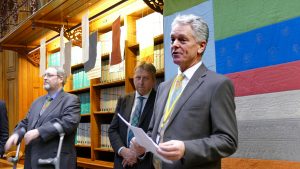
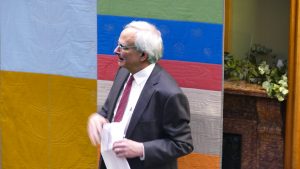
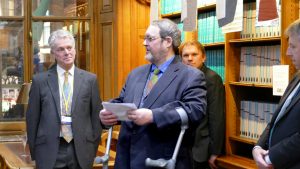
On Friday 28th February, over 100 guests attended an event at the Geological Society in London's Mayfair to celebrate the University's successful campaign to buy the Charles Lyell notebooks.
Eight of the notebooks were taken south for guests to view at the event, carefully transported by a team from the Library's Centre for Research Collections. David McClay, Philanthropy Manager for the Library and University Collections team, introduced the speakers: Richard Hughes, Executive Secretary, Geological Society of London, and Professor David Stocker, National Hertitage Memorial Fund.
Peter Mathieson, vice-chancellor and principal of the University, thanked all those present for their support in acquiring the notebooks and presented gifts to Richard Hughes and Professor Secord.
Richard Hughes, Executive Secretary, Geological Society of LondonProfessor Jim Secord, University of CambridgeProfessor David Stocker, National Heritage Memorial Fund
We’ve done it. They’re finally here. Late last week I was lucky enough to go down to London and pick up the Lyell notebooks.
The first step in gaining custody was to head to Sotheby’s on New Bond Street with the paperwork to prove they could be released. It’s a curious process of heading down to pre-sales to prove ownership and then be given a token for collection. I was then taken to their manuscripts and rare books department to pick up the archive. There I got my first glimpse of them.
Their scale surprised me. They are more compact and very consistent compared to even the pictures I’d seen of them and with my love of palaeography and our plans for deciphering them, I had to have a look at the content. Having been to Catania in Sicily last year, I picked the Sicily volume and was immediately struck by the depiction of the landscape around Mount Etna and the flow of his hand across the page providing detail. I know we’re going to have a lot of fun making these available in the future!
I had to draw myself back from getting immersed as our colleagues George and Ryan had arrived from Constantines, who were going to look after me and the notebooks, getting us back to Edinburgh securely. And wow what a large lorry, for small notebooks, down the tiny London lanes!
After checking every volume and packing in order securely, I signed the final piece of paperwork and we could take the notebooks on the next stage of their journey.
They were taken to a secure location, through the streets of London in our rather large lorry, with me sat up top in the cab with a birds eye view. I wondered what Lyell’s view of London was, having lived there in the 1830s and how very different the environment and landscape was now.
The next day we were at the secure location at 6am ready to leave. While the team were getting ready, I chatted to a curator from the British Museum, taking items for exhibition out to the Far East. Never thought, at 6am I’d be meeting such interesting people and sharing our experiences of couriering our rare and unique items throughout the world!
George, Ryan and myself soon set off through London, watching it wake and get busy. Over the next 9 ½ hours we drove north through the changing landscape, with all kinds of weather, from rainbows and hail to bright sunshine, looking at moors and hills, farmland planes to forests. I wondered again what Lyell would have thought, interpreted and seen.
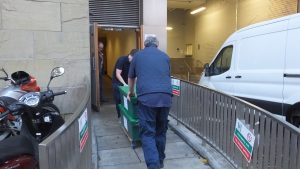
At about 3:30pm we arrived back in Edinburgh, after a very smooth journey (worst bit was the traffic in Edinburgh!) and were met by Grant and Norman, with these photos being taken, so we could show you their arrival.
So, they are here and the next part of our work begins with our archivists and conservators checking and listing them over the next couple of weeks. I’ve delighted to have had my Lyell adventure, picking up these notebooks, so they now can be made available to the world.
Thanks to George and Ryan from Constantines who were consummate professionals and looked after the notebooks and myself with good humour and brilliant driving skills, getting us to Edinburgh safely.
Rachel Hosker
Archives Manager and Deputy Head of Special Collections
Sir Charles Lyell (1797 - 1875) was a Victorian Scottish geologist, recognised as one of the outstanding scientists in an age of remarkable thinkers.
He’s best known as the author of Principles of Geology (1830-33), which has been called the most important scientific book ever, and which presented to a wide public the idea that the earth was shaped by natural forces over a very long period of time not unique catastrophes - such as Noah's flood and other biblical events. He pioneered an explanation of climate change and is credited with providing the framework that helped Darwin develop his evolutionary theories. So it is for this and more that Lyell is counted amongst the founders of modern geology.
Lyell’s 294 notebooks are his field notes and they capture, in remarkable detail, his daily engagement with scientific and social issues. They contain travel accounts of his journeys all over the UK, Europe, and the US and are full of queries and discussions on the letters and books he was reading at the time. As a result, we have his thoughts on social and political issues such as slavery in the United States of America, women in science and university education. There are also geological observations, long essays on earthquakes and volcanoes, real sense of the man standing there in front of Mount Etna or in Pompeii, observations on glacial moraines, lists of fossils and shells and notes on threats to species diversity, and letters to Darwin.
Earlier this year it came to light that, having been kept safely in the Lyell family for generations, the Sir Charles Lyell notebook collection was at risk of being sold abroad. The Government set an export bar giving us until 15th October 2019 to buy the books at a cost of £966,000. The University of Edinburgh began a campaign to save the notebooks for the nation and mounted an awareness and fundraising campaign with our colleagues in D&A. Lectures, advocacy events, a website, social media campaign and a flurry of meetings, phone calls and funding applications were done at speed. Support and funding was secured from leading institutions, groups and over 1000 individuals who pledged donations and, as a result, we have been able to buy the notebooks.
We know that the pledgers will want to see the notebooks as soon as they get here, so it is our duty to make them as accessible as possible as quickly as possible. We’ll do some initial work to make that happen including digitation and display.
The collection will join our existing extensive archive and geology collections, giving us an unrivalled Lyell collection. Working with our colleagues in Geosciences, we are considering the best ways we can make our extended Lyell collections accessible and used. We’re also going to virtually join up all the Lyell Collections across the world, mount an exhibition on climate change with cultural partners in Edinburgh, and make the books and the data open. Finally - in some eerie echo to the future: in notebook 39 in 1830 Lyell refers to his concerns about ‘present and future climate changes,’ in Paris no less.
Earth sciences are relevant to us all – given the impacts of climate change and the changing geographical environment – and understanding the Lyell story has huge potential impact on us all.
That is why Lyell rocks.
Jacky MacBeath
Head of Museums & Centre for Research Collections
 Thank you to all the individual donors and bodies who have supported us so far. In addition to our anonymous supporters, we would also like to acknowledge the ongoing support of the Murray family, Jim Hunter, the History of Geology Group and the Geologists’ Association Curry Fund. If you are interested in helping us complete the digitisation project’s funding target that would be wonderful. Individual gifts may be made online at: https://donate.ed.ac.uk/portal/public/donate/donate.aspx?destination=LyellAccess

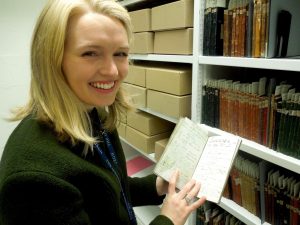







 We are excited to offer a new opportunity to experience this collection, a Zoom presentation by the Lyell Project staff on 10 December 2020 at 1pm GMT. This event reveals the ongoing work at the University of Edinburgh with the geological collection of Sir Charles Lyell, a rich corpus of material including his notebooks, family papers, and geological specimens.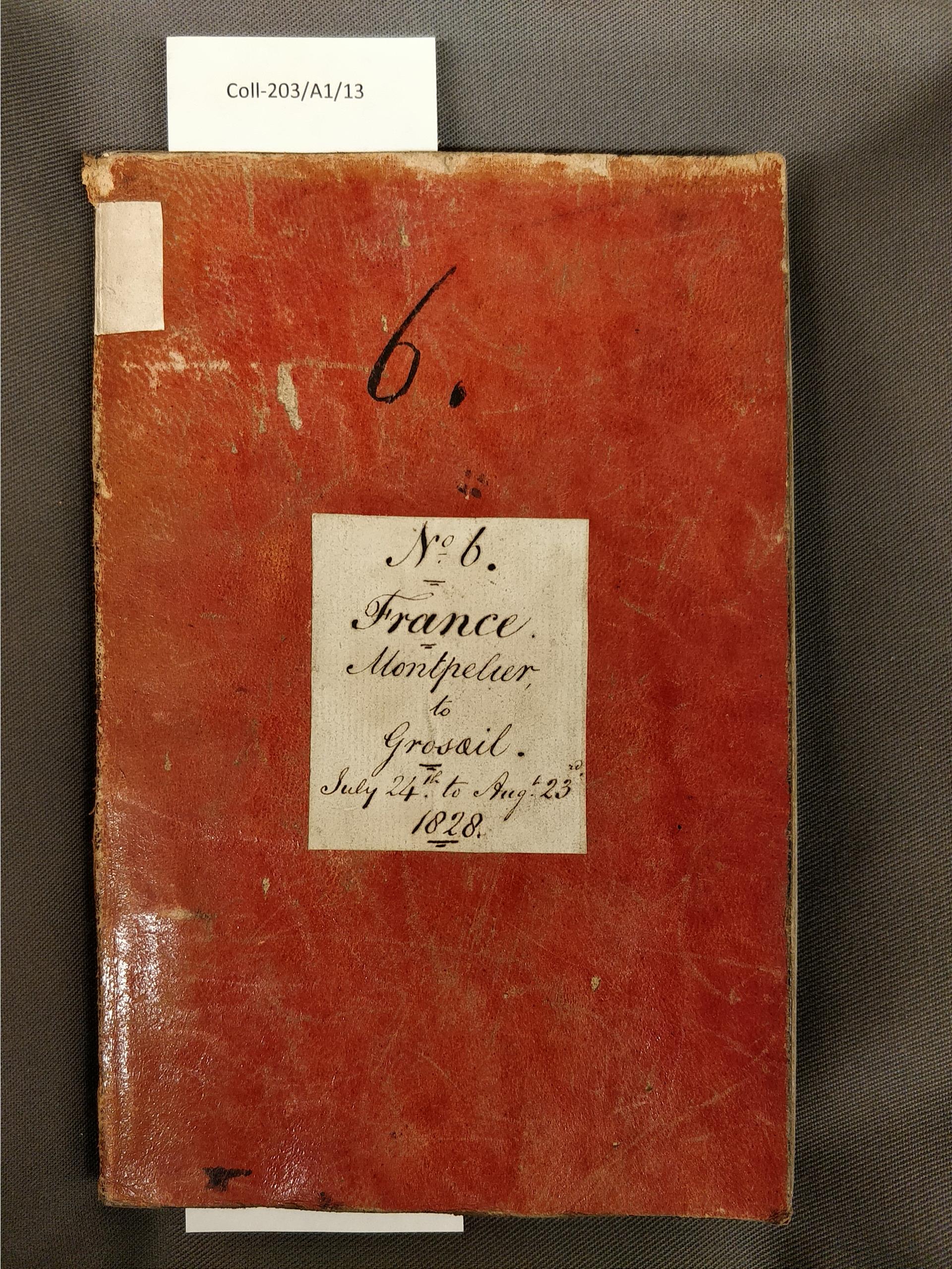

![An image of a notebook page written in pencil or light pen in which Charles Lyell writes his thoughts on University education. Transcript: What is the portion of those who ought to have a Univ[ersit]y Ed[ucatio]n in England. Who really have one? 1. Learn number Att[ourn]ys & their cle-rks. Barristers not Oxf[or]d or any Univ[ersit]y men - Dissenter who an barrister, attournies, or spe-cial pleaders &c [etc] 2. Engineers, Architects, Surveyors 3. Physician dissenters how many Surgeon d[itt]o. Discipline was intended. ought not those below 16 to be required to go to church.](https://blogs.ed.ac.uk/lyell/wp-content/uploads/sites/12201/2020/09/0183475c.jpg)
 During this lockdown, the Lyell Project has been able to continue enhancing metadata, despite having no access to the Lyell notebooks, thanks to some quick digitisation done by the amazing team at the DIU prior to lockdown. We've been working quite a bit with Notebook No. 4, from 1827, when Lyell was balancing his two callings; the law and geology. In 1825 his eyesight was no longer ailing him as it had been years previously, and following his father's wishes, he was called to the bar and joined the Western Circuit for two years. But during this time, as we can see from the Notebook, he also maintained fervent correspondence with fellow geologists, read the works of George Poulett Scrope, and Lamarck, and thereby fostered a great curiosity for the volcanic Auvergne region in France. In 1825 he joined Scrope as a Secretary to the Geological Society, and contributed frequently to the Quarterly Review (published by John Murray, the archive of issues
  Another curious element in this notebook is the inclusion of citations to works by Dante, namely Dante's Inferno. These appear often among entries on other subject, and without explanation. Clearly, this an excellent area of research, as we know Lyell's father was a great scholar on Dante.