

What is a critical reflexive in creative writing?
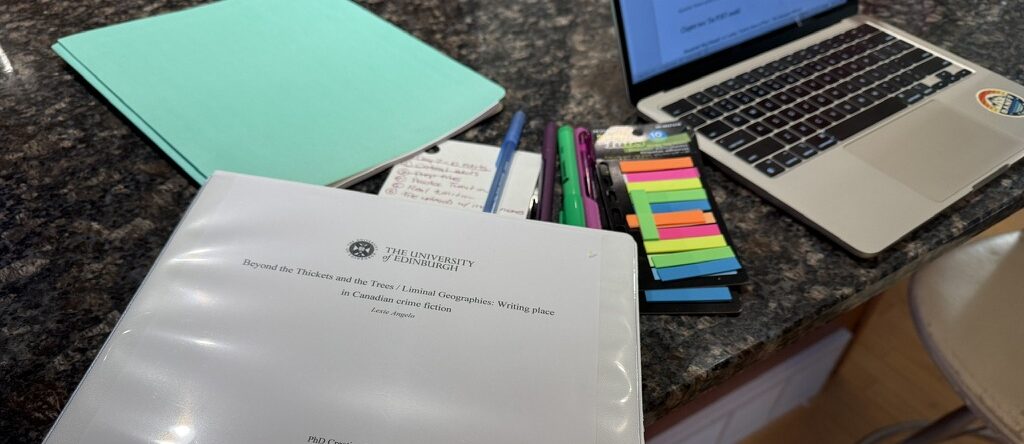
It took me a long time to figure out what a critical reflexive was. When I began my doctoral studies in creative writing, I had (wrongly) interpreted the critical reflexive as an essay, therefore my original attempts after year one were very incorrect.
I thought I was supposed to create some kind of academic analysis on a text, and then compare it to my novel. For example, I originally compared how food was appearing in a crime novel and tried to draw some kind of connection to my work (maybe because there was a cafe?). Anyways, that was wrong. You are not supposed to do that.

PhD student room at 50 George Square with several desks overlooking the Edinburgh streets
It was pretty clear I needed some more guidance, so I did some research on other PhD thesis examples where someone had done a critical reflexive. These were very difficult to find. And the fields that seemed to use critical reflexivity were not in the arts, in fact, many of them were in business, education, health, science and technology. Insert swear words here.
Researcher Ann Cunliffe, wrote an article titled, “On Becoming a Critically Reflexive Practitioner” Redux: What Does It Mean to Be Reflexive? which she reinforced her definition of reflexivity as “examining our own assumptions, decisions, actions, interactions, and the assumptions.”
This was a good start. I was supposed to be examining my own creative decisions and actions. Her paper also helped me understand the difference between being self-reflexive and critically reflexive. If I was meant to be self-reflexive, then my thesis would examining my personal beliefs, values, and relationships with others. I did do some of this.
However, I was also meant to be critically reflexive, and question organizational practices, policies, social structures, and knowledge bases. Now, that’s a bit more complicated for a creative writer. What organization was I supposed to critique? What policies?
-
- Thesis and Critical Reflexive
-
- Teviot Row House Edinburgh University
-
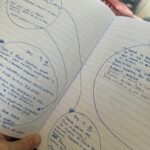
- My venn diagram of plotting
But as I kept writing, I understood that to mean the real-life structures that were informing the fictional novel, and in my case, that was the rise of white supremacy in Canada. This manifested in the form of hate groups designed to cause civil disruption, and block borders and highways in the same way as the Freedom Convoy. Then, I went further in my reflexive examination because I was also writing a police procedural, so it meant I could also examine police structures, justice, and government policies. Stretching even further, the novel gave me the space to provide my own commentary on modern policing and dig into corruption, racism and misogyny operating within the police system.
Eventually, I started to feel like a detective in an interrogation room, but instead of questioning a criminal, I was interrogating myself. That’s how my critical reflexivity manifested in the field of creative writing. And some of the questions I had to contend with were:
- Why was I choosing to set my novel in Canada?
- Was there a reason I was choosing a police procedural?
- How was I going to address systemic racism in policing?
- What was I trying to say about the rise of white supremacy?
- How did I plan on representing Calgary in fiction?
These are not exactly easy questions to answer, because the intention was to put the answers into the novel and hard-bake them into fiction. Maybe the reader would notice, or maybe not? I am certain that Canadian readers will know that a Canadian author wrote the book – there will be no mistaking that. But it wasn’t my original plan to set the novel in Calgary, and I am still not sure if readers will resonate with the setting (or if anyone will get to read the book at all seeing how many yes’s I’m getting, only to be rejected.)
Ultimately, I found the reflexive process helpful. It gave me a method to discover my artistic tools, and see my writing process clearly. Not all artists want to see their creative process, and many want to keep it a mystery for fear if they know it – it will go away. I was incredibly fascinated by my process and I might even do a smaller version of a reflexive for every novel I write going forward.

Share