by Mingxi Li, Psychotherapy and Counselling
January brought a wave of “New Year, New Me” energy, and I decided to try something new. I needed something embodied – something to pull me out of my head and break the cycle of endless rumination at my desk.
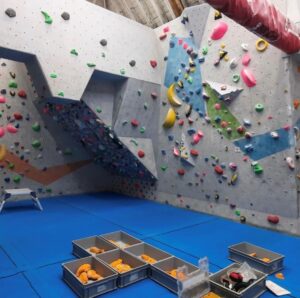
I’ve always wanted to try bouldering. I booked my first session at Pleasance Gym. It was a Thursday evening, fully booked, and I walked into a small room with eleven other people.
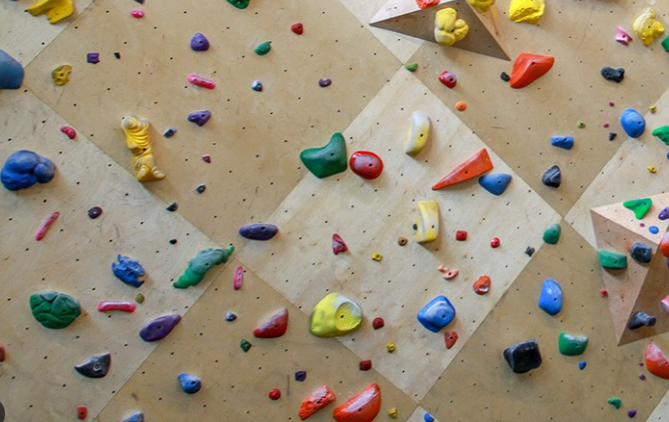
The walls looked high and intimidating, covered in colourful holds and volumes.
The Solo Problem Solver
The first time I stepped onto the wall was very daunting; it felt strangely like starting doctoral research. I could hear people talking about it and all the different experiences, but once I was on it, all the noise and other faces faded away, and I was left all alone.
Everybody down on the mat, everyone who’d been through this journey could tell me where to grab and where to step, but it was only me hanging on the wall, alone – feeling where the centre of my weight was, feeling whether it was impossible to take that step or reach for that jug, feeling if I’d fall.
Everyone up on the wall is a solo problem solver.
It is also fascinating how our different bodies lead us to very different solutions to the same problem. I could try copying others, but would soon find out my body simply doesn’t move the same way. I need to figure out a way that my body permits me to take.
Trust Yourself – with Baby Steps!
Rarely did I take steps that seemed impossible to my mind but were approved by my body. Those moments felt like my body was thrilled to prove to me that it could do more than I believed it could.
I’m still learning to trust it a little more, with baby-stepping practices: hanging at a spot where I feel safe, letting go of one hand, and realising my body can still support itself without clenching every muscle. Or trying to move slowly, realising I can maintain balance even in motion.
Ask for Help
I have also come to realise that the vision I have on the wall is very different from the one I see when I look at it from the mat. I often don’t struggle to see all the steps when standing on the mat, but once on the wall, some of them become invisible, and I lose track of how to support my body. That’s when a supporting fellow boulderer comes to play! As they remain on the mat and could read the route as I go. They will tell me where the places are that I can put my foot on, even if they’re invisible to me!
I’ve asked for help from people with various levels of experience.
From someone who seems similarly clueless, we look at the beginning of a route and wonder, “How the hell do you even hold onto the starting point?”
To someone who looks much more experienced than me and kindly shows me the tricks of keeping your body as close to the wall as possible repeatedly.
I like how it feels like we are all trying to crack the same routes, but we have a more collaborative relationship than a competing one.
The Good Practice – Falling Safe
I think about falling both as the physical falling, and the mentally felt “fail” – when I realise, I couldn’t do the route.
It has been very helpful to adopt a mindset that normalises “failure,” as climbing often feels like most of the time is spent trying to figure it out. It’s so normal if I don’t figure it out immediately. When I realise I can’t, or maybe don’t trust that I can, complete the route in mid-air, I practice downclimbing. Tracking my steps back and trying to stay safe throughout, as even just climbing down is such a good practice that will benefit me in the long term.
I also intentionally practice the physical part of falling. It felt childlike when I tried to practice falling from the first session I went – I started from very low, doing “unnecessary” squatting and rolling back down to the mat when I jumped down from a very low place, just to learn how much I can trust the mat to catch me. Again, those baby steps of practising and eventually letting my body tell me how to protect myself.
It came in handy the last time I went, when I felt exhausted midway up and couldn’t even perform a decent down climb, so I lowered my body and pushed myself away from the wall. Allowing the falling that I’ve been practising repeatedly at a very low height to happen, land, squat, roll back onto the mat, and catch my breath. The practices I did protected me from hurting, and I just learnt to trust my body a wee bit more.
Ending Notes 🙂
I have only been bouldering four times so far, but I’m already getting so much out of it – as you can probably tell from all the metaphors! I will keep going and would like to recommend it to anyone looking to learn how to collaborate better with their own body.



Very warmly written!