Any views expressed within media held on this service are those of the contributors, should not be taken as approved or endorsed by the University, and do not necessarily reflect the views of the University in respect of any particular issue.
Thanks to a request from a member of staff in HCA the Library currently has trial access to the Illustrated London News Historical Archive, 1842-2003. Illustrated London News was the world's first pictorial weekly newspaper and this archive gives access to the full run of this iconic illustrated newspaper.
You can access this online archive via the E-resources trials page. Access is available both on and off-campus.
Trial access ends 31st October 2017.
The first issue of Illustrated London News was published on Saturday 14 May 1842 and as the world’s first fully illustrated weekly newspaper, it marked a revolution in journalism and news reporting. ...continue reading "On trial: Illustrated London News 1842-2003"
Got your reading list but not sure what you’re being asked to read (is it a book, is it an article, is it a bird, is it a plane…)? Or are you just not sure how you’re meant to search for and find these items in the Library (in print or online)?
It may just be the first week of semester but many of you will already be required to start reading material in preparation for your lectures, seminars or tutorials. Finding and accessing this material can be an early hurdle for many new students but don't panic, it can be a lot easier than you think.
Learning how to read your reading list and recognise references now will make you more confident using the Library and will save you a lot of time in your studies later. And these skills will be of use to you at all stages of your University life and beyond.
What's in a reading list?
Reading lists are just lists of essential, recommended or further readings for your course. They can include a wide range of material including books, book chapters, journal articles, documentaries, films, newspaper articles, websites, blogs, etc., but I am going to concentrate on the 3 most common:
Following a request from a student in HCA I'm pleased to let you know that the Library currently has trial access to State Papers Online: Eighteenth Century, 1714-1782, Part II: State Papers Foreign: Low Countries and Germany from Gale Cengage.This contains the papers written or received by the secretaries of state in the course of British diplomacy in the Low Countries and Germany through the 18th century.
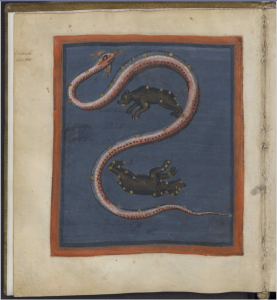
Thanks to a request from a member of staff in Classics, we currently have trial access to Brill's Codices Vossiani Latini Online which publishes all 363 codices which form the world-famous Latin part of Isaac Vossius’ manuscript collection held at Leiden University Library.
You can access this resource via the E-resources trials page. Access is available both on and off-campus.
Trial access ends 27th September 2017.
Screenshot from VLQ 079 - Aratea, c. 850.
Isaac Vossius (1618-1689) was a Dutch scholar and collector of manuscripts, maps, atlases and printed works, who for a few years was also the court librarian to Queen Christina of Sweden. According to contemporaries Vossius's extensive library was the best in Europe, if not the world, and after he died his library of books and manuscripts was sold to the University of Leiden. ...continue reading "On trial: Codices Vossiani Latini Online"
Exciting major online primary source database now available at the Library.
I'm really pleased to let you know that the Library has got a 1-year subscription to the fantastic primary source database Archives Unbound from Gale Cengage. Archives Unbound currently has 265 collections of primary source material, with new collections added every year. It is a huge database and covers a wide range of subject areas and time periods.
You can access Archives Unbound from the Databases A-Z list and appropriate Database by Subject lists. The Library has already previously purchased permanent access to 9 collections from Archives Unbound and you can find out more about these at Spotlight on Archives Unbound.
What is Archives Unbound?
Archives Unbound presents topically-focused digital collections of historical documents that support the research and study needs of students and academics. Collections cover a broad range of topics from the Middle Ages forward-from Witchcraft to the Second World War to 20th century political history and the collections are chosen for Archives Unbound based on requests from scholars, archivists, and students.
In Archives Unbound you can search through all 265 collections at one time or you can choose to search/browse individual collections or groups of collections.
*The Library has access to all Early European Books collections until 31st July 2024 as part of ProQuest Access 350.*
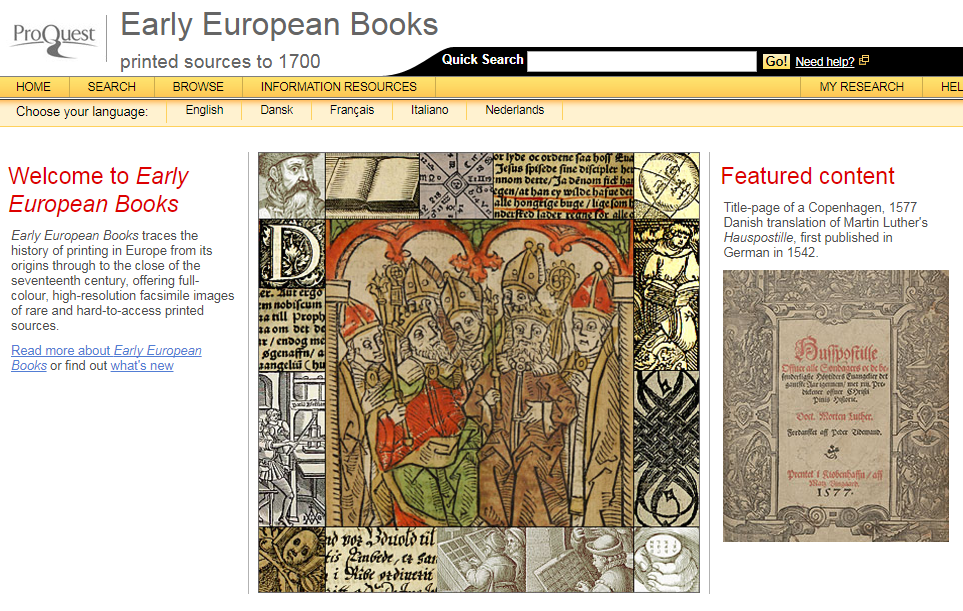
Following a request from staff in History the Library currently has trial access to all collections available in ProQuest's Early European Books, a database that aims to trace the history of printing in Europe from its origins to 1700.
While the Library already gives you access to Collections 1-4, this trial period gives you access to the further 7 collections currently available in Early European Books.
You can access this resource via the E-resources trials page. Access is available both on and off-campus.
Trial access ends15th September 2017.
Building on the success of Early English Books Online (EEBO) - which the Library already has access to - Early European Books is set to encompass all European printed material, and material printed in European languages, from the early modern period. ...continue reading "On trial: Early European Books"
In August 1947 British India won its independence from the British and split into two new states, India and Pakistan (East Pakistan subsequently became Bangladesh), that would govern themselves. The Partition of India, as it was known, created a huge refugee crisis with millions of displaced people and the level of violence and loss of life prior to and after the Partition has caused reverberations over the years, with hostile relations between India and Pakistan continuing to this day.
With the 70th anniversary of the Partition of India being marked this month I've pulled together just a small selection of Library resources that will help you explore the Partition of India further.
What did the papers say?
The Library subscribes to a large number of online newspaper archives that will allow you to see what events were being reported on at the time and how they were being reported. Read full text articles, compare how different newspapers were covering the same issues and stories, track coverage from the start of the Indian independence movement in the 19th century until post-partition.
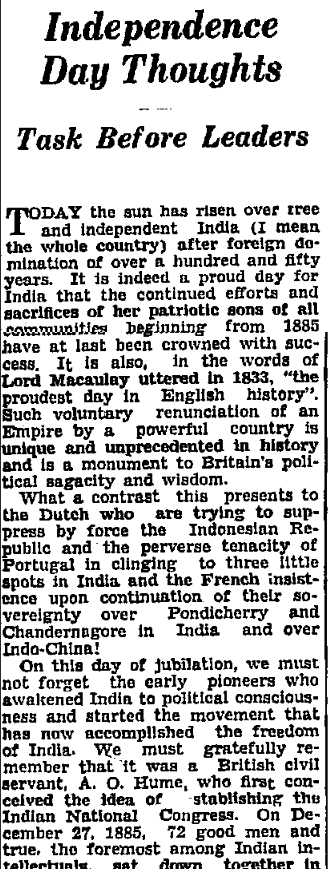
Screenshot from The Times of India.
The Times of India (1838-2007)
The Library has access to the online archive of The Times of India, which covers the period 1838-2007. The Times of India is the world's largest circulation English daily newspaper and, as would be expected, is particular valuable for its coverage of key historical events in India, such as the Partition.
Want to look at more recent coverage of the Partition of India?The Library also subscribes to databases, such as Factiva and Nexis UK, that allow you to search and access the full text of a large number of UK and international newspapers from around the 1980s up to date. You can access these, the databases mentioned above and many other newspaper archives and magazine archives from Newspaper Databases. ...continue reading "Explore the Partition of India through our library resources"
I'm pleased to let you know that after a successful trial in semester two, 2016/17, the Library has now purchased access to four more collections from ProQuest's Digital National Security Archive (DNSA).
The four new collections are:
Chile and the United States: U.S. Policy toward Democracy, Dictatorship, and Human Rights, 1970–1990
Electronic Surveillance and the National Security Agency: From Shamrock to Snowden
The Iran-Contra Affair: The Making of a Scandal, 1983–1988
Iraqgate: Saddam Hussein, U.S. Policy and the Prelude to the Persian Gulf War, 1980–1994
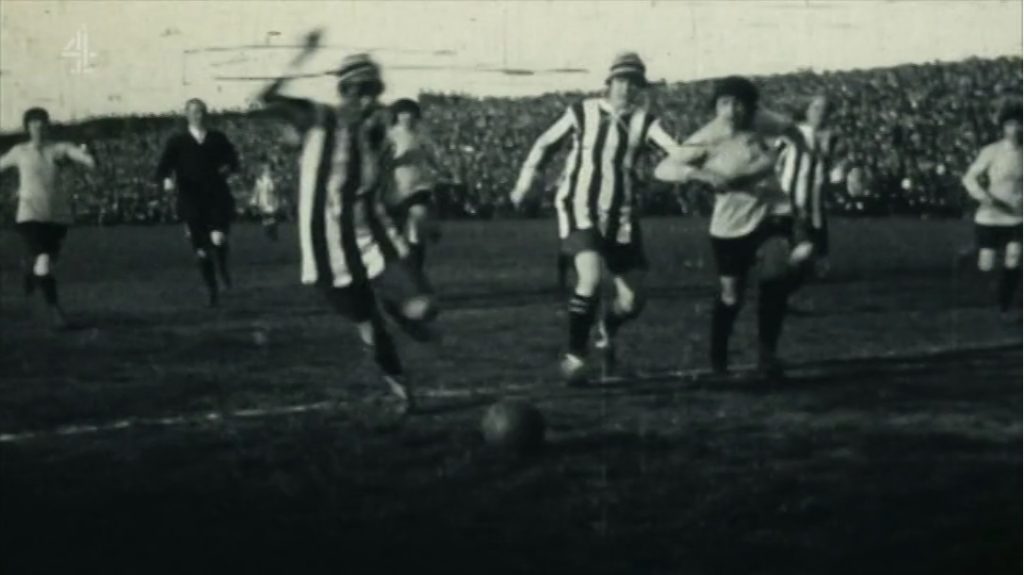
In this week’s blog I’m using some of the Library’s online resources to find primary source material relating to the popularity of women's football during and just after the First World War and the decision by the FA to ban it.
The other night on catch-up I watched the Channel 4 documentary When Football Banned Women, programmed to coincide with the Women’s EURO 2017 (which Channel 4 just happens to be showing, it’s like they thought about their programming or something!) This interesting documentary looked at the rise in popularity of women's football during the First World War and the subsequent decline after the decision by The Football Association (FA) to ban the women's game in 1921.
Screenshot from 'When Football Banned Women' (Channel 4).
As I am always looking for an excuse to use some of the University Library’s fantastic online primary source collections, I decided this was a perfect story to try and find out more about from our online archives.
While I primarily used some of the online newspaper archives the Library has access to for that period, I did do some searching in some other primary source collections that covered the period in question. You can find a list of the specific databases I used at the end of the post.
Women's football in the First World War
With 1000s of men being called up to fight in the First World War, women were expected to take on roles as never before in the workplace and with this came other opportunities. Women’s football teams began to form, often put together or sponsored by the industries and companies now employing the vast female workforce. These teams began to play matches with the primary aim of raising money for charity and while spectators may have originally attended to help raise money and to watch what they thought of as a novelty, they continued to attend as the matches were good and the teams had skill. ...continue reading "Why football banned women"
The Library now has access to the fascinating Presidential Recordings Digital Edition. This rich resource includes transcripts and corresponding audio of secretly recorded conversations in the Oval Office from Presidents John F. Kennedy, Lyndon B. Johnson and Richard M. Nixon.
Presidents Franklin D. Roosevelt through to Richard M. Nixon all secretly recorded many of their conversations in the Oval Office. The resulting 5,000 hours of telephone and meeting tape recorded during their time in the White House capture some of the most significant moments in modern American political history. From Birmingham to Berlin, from Medicare to My Lai, from Selma to SALT, and from Watts to Watergate, the presidential recordings offer a unique window into the shaping of U.S. domestic and foreign policy. ...continue reading "New to the Library: Presidential Recordings Digital Edition"

 It may just be the first week of semester but many of you will already be required to start reading material in preparation for your lectures, seminars or tutorials. Finding and accessing this material can be an early hurdle for many new students but don't panic, it can be a lot easier than you think.
 Thanks to a request from a member of staff in Classics, we currently have trial access to Brill's Codices Vossiani Latini Online which publishes all 363 codices which form the world-famous Latin part of Isaac Vossius’ manuscript collection held at Leiden University Library.