Any views expressed within media held on this service are those of the contributors, should not be taken as approved or endorsed by the University, and do not necessarily reflect the views of the University in respect of any particular issue.
The Conservative government’s proposed repeal of the Human Rights Act (HRA) and possible withdrawal from the European Convention on Human Rights (ECHR) and Council of Europe, would have far-reaching implications for the UK’s devolved administrations and relations with the Republic of Ireland. These run deep into the constitutional marrow of the nations involved; so deep that it is difficult to see how repeal of the Act could take place without their consent. The government’s difficulties in relation to, especially, Scotland and Northern Ireland are significant but different and worth reviewing separately.
In 1994 and early 1995, I was working for a small British charity in Bosnia and Herzegovina. We, like the United Nations and many other agencies, had been trying for months to make our way through Eastern Bosnia to get food and medicine to the isolated enclave of Srebrenica. We all knew that many thousands of people had fled to the town from surrounding municipalities as a consequence of a brutal policy of “ethnic cleansing”.
The United Nations had a military presence in the town. NATO member states gathered intelligence on what was happening and the status of the enclave was consistently raised at the highest levels, by international peace envoys from the UN and the EU.
Can the UK’s Human Rights Act be repealed? What would the process need? Is it even possible? What are the legal implications?
Christine Bell, Professor of Constitutional Law at Edinburgh Law School, Assistant Principal Global Justice and Director of the Global Justice Academy, offers this review of the current debate on repealing the Human Rights Act, and points readers to other available resources.
In the past few days repeal of the Human Rights Act, and in particular its devolution implications have attracted a lot of attention. Today, a new report is launched from a legal expert seminar in April 2015, on the legal implications of repeal of the human rights act (see below). The report provides the full chapter and verse, but here are a few quick points on the devolution implications, with further more detailed and reasoned resources below.
This is a guest post by Sean Molloy, who is a Principal’s Development Scholar at the University of Edinburgh, where he is completing his PhD at the School of Law. Sean edits the Global Justice Academy newsletter, which you can subscribe to by clicking here.
In March of this year I attended a roundtable at Chatham House on the issue of business and human rights. Comprised of state officials, civil society organisations, academics, and corporate representatives, the focus of the event was on the extent to which (or not) a consensus is beginning to form on how to operationalise and implement the UNGP. In this post I wish to convey some of the discussions of that meeting in attempting to articulate the current position, the obstacles remaining and potential solutions going forward. Firstly, a little background is required.
On 26-27 February 2015, the Post-Conflict Research Center from Sarajevo, Bosnia and Herzegovina, visited the University of Edinburgh to present its award-winning “Ordinary Heroes” project. “Ordinary Heroes” won first place in the 2014 UN Alliance of Civilizations and BMW Group Intercultural Innovation Award in a ceremony hosted by UN Secretary General Ban Ki-moon in Bali, Indonesia. The Global Justice Academy at the University of Edinburgh sponsored PCRC’s travel to Edinburgh.
Mina Jahić is a widowed octogenarian from Rogatica, in eastern Bosnia and Herzegovina, whose husband and two sons lost their lives in the wars that followed the violent dissolution of Yugoslavia in the early 1990s. She lives by herself in an upper floor of a prefabricated apartment block not far from the capital Sarajevo. A devout Muslim, Mina’s hope for the future of her country lies in the youth, who she believes still have the power to change the ethnocratic system that has blocked any attempts for reconciliation and reform since the end of the war in 1995. What Mina’s wartime experiences separate her from her neighbours, however, are the risks she took to save a stranger escaping his execution. Mina is an ordinary hero.
Ferid Spahić, a gas station attendant in Ilijaš, a small town to the northwest of Sarajevo, was in his mid-twenties when the first shots were fired in Bosnia by Serb paramilitary forces bent on “cleansing the land” for a “Greater Serbia” under the guise of preserving Communist Yugoslavia from dissolution. A Bosniak Muslim, too, he and his neighbours were targets of ethnonationalist destruction that quickly engulfed Bosnia’s three main ethnic groups – Serbs, Croats and Bosniaks. One day in June 1992, a Serb man from his village, whom he had seen as a trusted neighbour, rounded the local Bosniak men into buses, telling them as they were separated from their wives and children that they would be transferred to Skopje, Macedonia, and later reunited with their families.
This guest post is by Sean Molloy,a Principal’s Career Development Scholar in Law at the University of Edinburgh. Sean completed his LLB Law at Queen’s University Belfast, continuing to read for an LLM in Human Rights Law and Transitional Justice at the Transitional Justice Institute. Following a period working as a research assistant for a human rights solicitor, Sean began his PhD research at Edinburgh in September 2013. He edits the monthly Global Justice Academy Newsletter, and is a founding member of the Global Justice Society.
Freedom of Conscience in Northern Ireland
In December 2014 DUP MLA Paul Girvan introduced a Freedom of Conscience Bill aimed at allowing businesses to refuse services to a customer if they feel it is against their religious convictions. The Bill arose following the announcement of the Northern Ireland Equality Commission that they would be issuing legal proceedings against Ashers Baking Company for their refusal to accept an order for a cake with a pro-gay marriage slogan.
In 2014-15, the Global Justice Academy launched its Urban Justice Lab. Based on the MIT-pioneered model to address global challenges, the Urban Justice Lab creates space for discussions and debates as well as collaborations in research, teaching, and outreach for university academics that study or operate on the city.
Dr Tahl Kaminer, GJA Co-Director (Urban Justice Lab), is a Lecturer in Architectural Design and Theory at the Edinburgh School of Architecture and Landscape Architecture (ESALA). One track of Tahl’s research studies the means of social amelioration via urban transformation. In 2014, students from the MSc programme in Urban Strategies and Design produced the Craigmillar Project Report – an extensive analysis of the Edinburgh neighbourhood, of the regeneration project, and of current conditions.
L-R: ‘Charlie’s Bus’ Craigmillar Festival playscheme Bus, historical photograph by Andrew Crummy; Craigmillar flats, photograph by David Flutcher; the White House in Craigmillar, photograph by John Lord.
Professor Toby Kelly is Head of Social Anthropology at the University of Edinburgh and Deputy Director of the Global Justice Academy.
Northern Ireland MLA, Paul Givan has proposed a Freedom of Conscience Bill. Invoking a three hundred year tradition of freedom of conscience and the Universal Declaration of Human Rights, Givan calls for greater toleration of different beliefs. Yet, Amnesty International has said the bill was ‘not welcome and is not needed at all’. Indeed, it went so far as to say ‘what is proposed is not a conscience clause, it is a discrimination clause’. At first glance this appears a little surprising, given that Amnesty first came to public prominence as an organization that campaigned explicitly for freedom of conscience, and Prisoners of Conscience still play a significant part in Amnesty’s activities.
This guest post is by Dr Tom Slater, Reader in Urban Geography at the University of Edinburgh. It first appeared in January 2014 on openDemocracy, in the openSecurity: Conflict and Peacebuilding theme.
On 27 January 2014, I noticed a few tweets announcing the Guardian’s new “Cities” section. The newspaper has a track record of publishing excellent short essays addressing urban issues, especially in its “Comment is Free” section, so I confess to initial interest and perhaps even mild excitement. Then I read two of the introductory pitches by the editorial team, delivered with an intention to “start the debate”. The first was by editor Mike Herd, entitled “What makes your city so special?” the sort of emetic rubric you might expect to find a ‘Business Traveller’ section of an in-flight magazine. Here is how he invited browsers to contribute:
The University of Edinburgh’s Annual Gifford Lecture Series has now begun. Professor Jeremy Waldron is University Professor at the New York University Law School. Professor Waldron’s work in jurisprudence and political theory is well known, as are his articles on constitutionalism, democracy, homelessness, judicial review, minority cultural rights, property, the rule of law, hate speech, human dignity, and torture. This post appeared originally on the Gifford Lecture Blog.
In a stimulating opening Gifford Lecture tonight, Professor Jeremy Waldron emphasised the urgency of not only eradicating ‘surface inequality’ in public legal relations, but in carrying out a theological and philosophical examination of what may underpin human equality in a world where ‘grotesque differences in economic lives’ create the risk of ‘leech and leak’ to undermine our commitment to a common humanity. We re-assure ourselves that the ‘surface inequality’ between rich and poor is compatible with an inviolate ‘basic human equality’ which underlies our mutual existence. But is that weakening in our society, such that the view may emerge that ‘the poor are not fully human’ and ‘only the prosperous live fully human lives’? Is there a danger now that a ‘conditional’ legal status due to the vicissitudes of life, such as that of an African-American in jail, becomes re-inforced as a ‘sortal’ status of permanent identity to delineate rights and all human potential, in like kind to the evils of slavery or apartheid in the past?
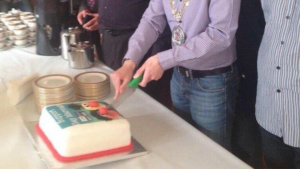 In December 2014 DUP MLA Paul Girvan introduced a Freedom of Conscience Bill aimed at allowing businesses to refuse services to a customer if they feel it is against their religious convictions. The Bill arose following the announcement of the Northern Ireland Equality Commission that they would be issuing legal proceedings against Ashers Baking Company for their refusal to accept an order for a cake with a pro-gay marriage slogan.