This is the fourth blog in a series written by LLM students on the Human (In)Security course at Edinburgh Law School. This series celebrates…
Comments closedCategory: Women
This is the third blog in a series written by LLM students on the Human (In)Security course at Edinburgh Law School. The series celebrates the…
Comments closedThis is the first blog in a series written by LLM students on the Human (In)Security course at Edinburgh Law School. This series celebrates the…
Comments closedThis blog is by Daniel Erhardt Nielsen, LLM Candidate in Human Rights at Edinburgh Law School. It presents some of the issues he examined during…
Comments closed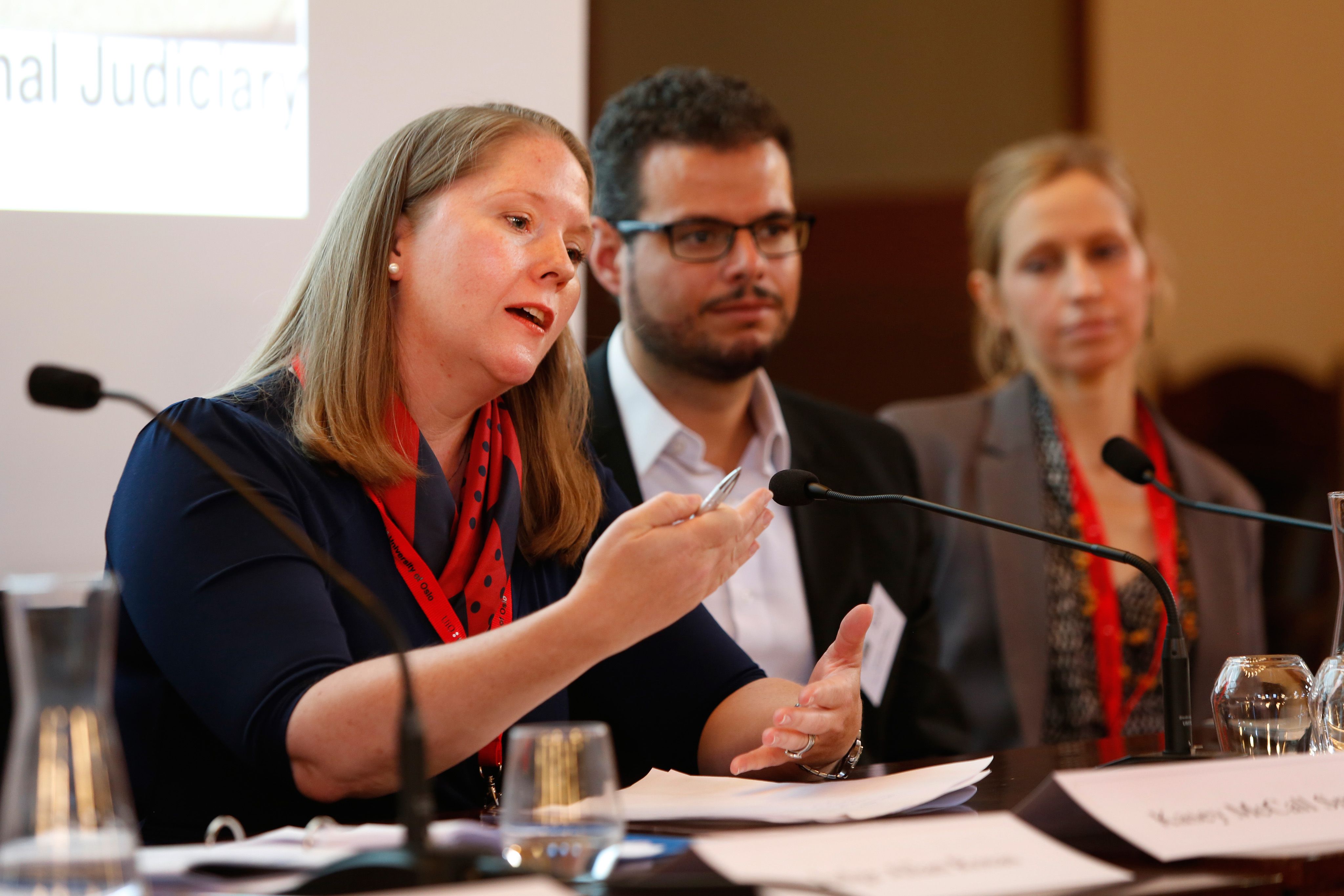 Dr Kasey McCall-Smith, Chair of the Association of Human Rights Institutes and member of the Global Justice Academy, discusses recent steps towards a UN Global Compact for Migration. This is the first of two blogs from Dr McCall-Smith on the Migration Compact negotiations.
The next steps toward a UN Global Compact for Migration to combat the ever-growing legal and policy issues associated with mass and irregular migration were taken at the UN headquarters in Vienna, Austria, 4-5 September 2017. The Compact aims to deliver a comprehensive approach to human mobility as well as further clarification of and support for existing international frameworks addressing migration, refugees and trafficking, including the Refugee Convention and its Protocol, the UN Convention against Transnational Organized Crime (UNTOC), the UN Protocol to Prevent, Suppress and Punish Trafficking in Persons, Especially Women and Children (Trafficking in Persons Protocol) and the Protocol against the Smuggling of Migrants by Land, Sea and Air (Smuggling of Migrants Protocol), as well as a number of human rights instruments such as the Convention on the Elimination of all forms of Discrimination against Women (CEDAW) the Convention on the Rights of the Child (CRC), among many others.
Comments closed The Global Justice Academy is delighted to support the launch on the Postgraduate Gender Research Network of Scotland (PGRNS). This guest post by co-organiser, Rhian Sutton, reflects on the launch event which took place in October, and plans for the Network over the coming months – including how you can get involved. Rhian is reading for a PhD in History at the University of Edinburgh.
The Postgraduate Gender Research Network of Scotland (PGRNS) was formed in August, 2016. PGRNS aims to provide a platform on which postgraduates engaged in researching gender across Scotland can share their work, advertise events, workshops, and conferences, as well as learn about calls for papers and funding opportunities. Our goal is to facilitate discussion among researchers with common interests across both universities and disciplines in order to allow students to engage with people and ideas that they would not usually encounter through the course of their study. Ultimately, the network hopes to assist postgraduate students in enriching their research through the discovery of, and engagement with, new perspectives of gender research.
Comments closedRosie Ireland is a GJA Student Ambassador for 2015-16, and is reading for an LLM in Human Rights. Rosie co-authored our first student report on international law and peace negotiations with her colleague, Siobhan Cuming. In this report, Rosie reflects on the 2015 Crystal Macmillan Lecture, which was delivered by Madeleine Rees.
Last semester on the 26 November, the distinguished international lawyer and human rights advocate Madeline Rees, Secretary General of the Women’s International League for Peace and Freedom, delivered the second Chrystal Macmillan Lecture of 2015. The report provides a brief summary and covers some of the key points made during the lecture.
Law has developed since 1948 to address conflicts, promote peace and end war. Addressing the root causes of conflict – such as inequalities between people and nations – is essential to the prevention of future conflict.
Comments closedThis post first appeared on the Centre for Criminal Justice and Human Rights blog from the Faculty of Law at University College Cork.
Dr Catherine O’Rourke is Senior Lecturer in Human Rights and International Law at Ulster University Transitional Justice Institute. She is currently also co-coordinator of the Gender Stream of the DFID-funded Political Settlements Research Programme, where she is investigating how international law norms for gender equality influence domestic power-brokering.
In the aftermath of last week’s High Court judgment declaring Northern Ireland’s prohibition of abortion to be incompatible with UK human rights legislation in specific instances, there has been much valuable consideration of the judgment’s legal and political implications, for this jurisdiction and others. In this contribution, I reflect on what the litigation and judgment say about human rights advocacy in Northern Ireland.
Comments closed
This post first appeared on the European Futures Blog.
In this extended article, Jane Rooney analyses the recent Northern Ireland High Court decision that current abortion law is not compatible with the European Convention on Human Rights. She suggests that the judgement could have gone further in testing the compatibility of the legislation with the ECHR, and that possible appeals are unlikely to take the politics of Northern Ireland as closely into account.
On 30 November 2015 in the case of The Northern Ireland Human Rights Commission’s Application [2015] NIQB 96, the High Court of Northern Ireland found that Northern Irish law regulating abortion was incompatible with Article 8 (right to private life) of the European Convention on Human Rights (ECHR). This was an historical judgement made possible through the conjoined efforts of many, including women directly affected by the legislation, the Northern Ireland Human Rights Commission and Amnesty International.
Comments closed
Rosie Ireland is a student on this year’s LLM in Human Rights at The University of Edinburgh. This is Rosie’s second report as a Global Justice Academy Student Ambassador – from the 2015 Montague Burton Lecture, which was delivered by Frances Guy on 2 November. Frances Guy is the Head of the Middle East region at Christian Aid. Rosie’s report outlines the key points made during the lecture, which was entitled ‘Serving women in Iraq and Syria: has UNSCR 1325 made a difference?’.
It is nearly the fifteenth anniversary of the UNSCR 1325; the first ever resolution aimed to enhance the role of women in peace building. Frances Guy analysed the effectiveness of the resolution in the context of Iraq and Syria in relation to four key areas: participation, protection, prevention, and relief and recovery.
Comments closed