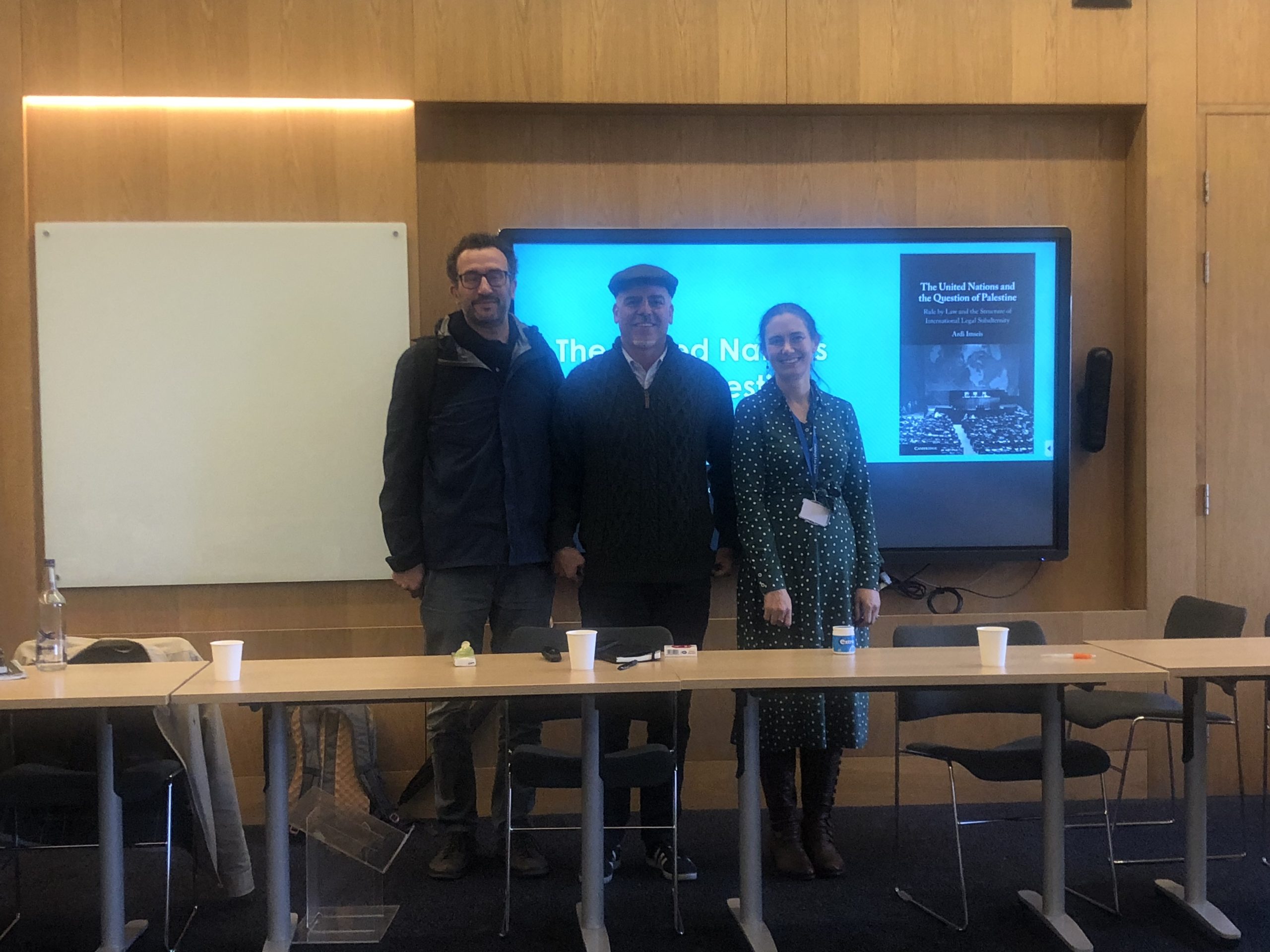
Last Friday, on May 3rd, 2024, the Global Justice Academy collaborated in hosting a book launch event featuring Dr. Ardi Imseis, who introduced his latest work titled “The United Nations and the Question of Palestine.” Dr. Imseis, presently serving as Assistant Professor of International Law at Queen’s University, has previously contributed to UNRWA and has maintained active engagement in advocacy in the field of international humanitarian law.
Comments closedCategory: UN
The Secretariat for the Association of Human Rights Institutes (AHRI), hosted by the Global Justice Academy (GJA) and Strathclyde Centre for the Study of Human Rights…
Comments closedOn 4 November 2021, the Global Justice Academy together with the Edinburgh Centre for Global and International Law hosted their first in-person seminar for the…
Comments closedThis post by is by Oskar Granskogen Kjorstad, Alexandra Haider and Tess Gallagher. They are students enrolled in PLIT10063 ‘Human Rights in International Relations’, an honours-level…
Comments closedThis blog is by Daniel Erhardt Nielsen, LLM Candidate in Human Rights at Edinburgh Law School. It presents some of the issues he examined during…
Comments closed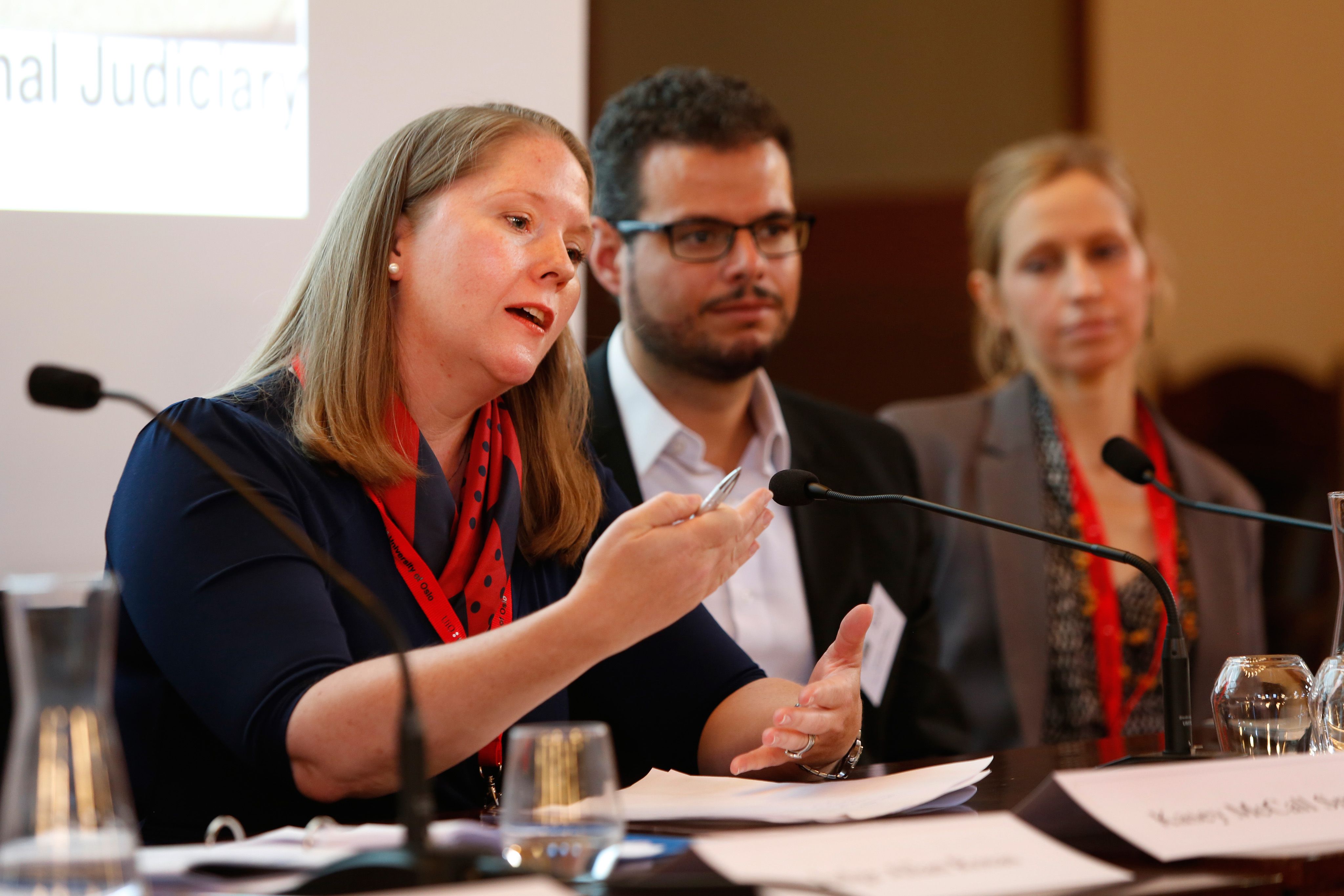 Dr Kasey McCall-Smith, Chair of the Association of Human Rights Institutes and member of the Global Justice Academy, discusses Human Trafficking and Modern Slavery in the context of the UN Global Compact for Migration.
In a previous post, I gave general overview of the UN Global Compact for Migration and a brief analysis of the Migration Compact thematic discussions on the distinctions between human smuggling and human trafficking. This note considers modern slavery, a topic with which the University of Edinburgh is highly engaged through both academic projects as well as its Modern Slavery initiatives. Following on from the distinction between migrants smuggled into a state for the sole purpose of evading legal migration and individuals trafficked into (or within) a state for purposes of exploitation, the following will present key debates about modern slavery and human trafficking that are highly relevant to the conclusion of a comprehensive Migration Compact.
Comments closedDr Kasey McCall-Smith, Chair of the Association of Human Rights Institutes and member of the Global Justice Academy, discusses recent steps towards a UN Global Compact for Migration. This is the first of two blogs from Dr McCall-Smith on the Migration Compact negotiations.
The next steps toward a UN Global Compact for Migration to combat the ever-growing legal and policy issues associated with mass and irregular migration were taken at the UN headquarters in Vienna, Austria, 4-5 September 2017. The Compact aims to deliver a comprehensive approach to human mobility as well as further clarification of and support for existing international frameworks addressing migration, refugees and trafficking, including the Refugee Convention and its Protocol, the UN Convention against Transnational Organized Crime (UNTOC), the UN Protocol to Prevent, Suppress and Punish Trafficking in Persons, Especially Women and Children (Trafficking in Persons Protocol) and the Protocol against the Smuggling of Migrants by Land, Sea and Air (Smuggling of Migrants Protocol), as well as a number of human rights instruments such as the Convention on the Elimination of all forms of Discrimination against Women (CEDAW) the Convention on the Rights of the Child (CRC), among many others.
Comments closedDagmar Topf Aguiar de Medeiros is reading for a PhD in Law at the University of Edinburgh, and is an intern at UN House Scotland.…
Comments closedThis post was written by Sara Valencia and Alejandra Londoño. It reports from a series of recent workshops on the Colombian peace process, led by…
Comments closedLauren Donnelly is reading for an LLM in Human Rights at Edinburgh Law School. In her role as a Global Justice Academy Student Ambassador, Lauren reflects on discussions raised from the Paris talks on climate change, including what Scotland can do.
On Saturday the 19th of March, the UN House Scotland held, “Climate Change: Global Challenges, Local Solutions Conference” to explore the impact of the much publicised 2015 Paris Climate Change agreement. The event consisted of two panel discussions, the first which examined from an international perspective and the second which explored the Scottish response, to the various challenges faced in achieving the goals set out in this agreement.
 The opening address of conference was delivered by Tom Ballantine, the Chair of Stop Climate Change Scotland. The opening address paved the way for what was to be an inspiring and enlightened discussion throughout the afternoon. The presentation outlined briefly why climate change matters, the broader effects of climate change and climate change after the Paris agreement. It highlighted that climate change has been discussed since the nineteenth century, stressing that despite the fact that the developing world is contributing the least to climate change, these countries are most likely to suffer the impact of global warming. Expanding on this point, the presentation outlined that if we do not act urgently we can expect to see: coastal flooding and displaced people due to land loss; reduced yields of major crops; human insecurity; and mass poverty.
