Any views expressed within media held on this service are those of the contributors, should not be taken as approved or endorsed by the University, and do not necessarily reflect the views of the University in respect of any particular issue.
Press "Enter" to skip to content

Category: Theory

Complicity, Elitism and Storytelling: Exploring Moral Ambiguity in Times of Injustice

In her second post for this blog, GJA Communications Intern, Jee-Young Song, reflects on the recent GJA GREYZONE Summer School keynote session on ‘Conceptual Perspectives’.

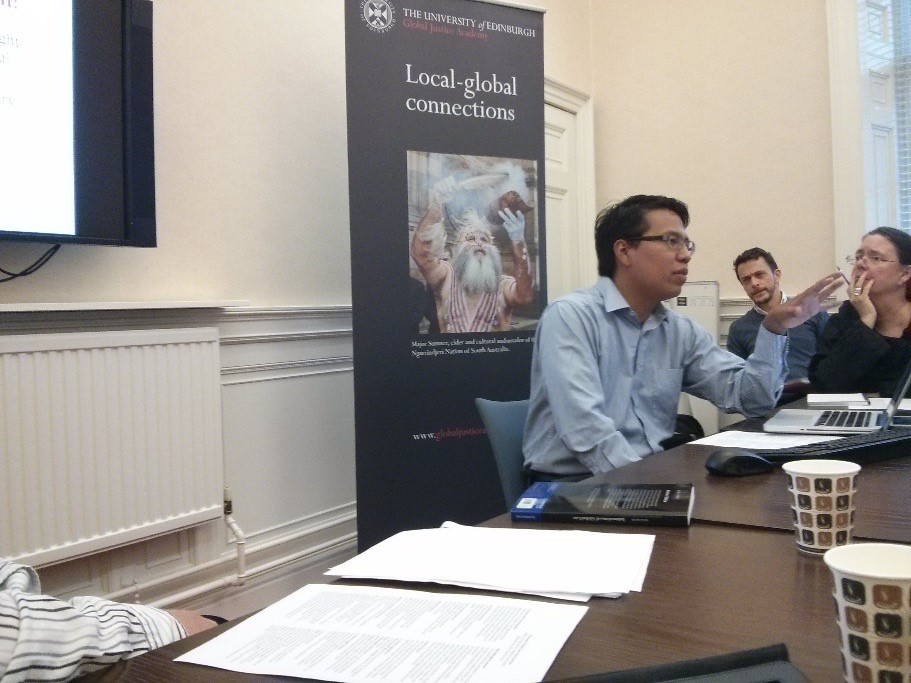
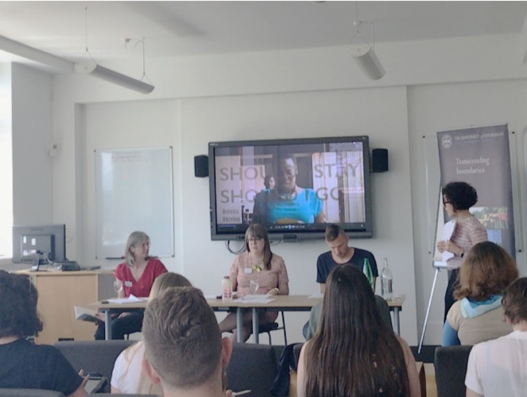
The Summer School kick-started on Monday the 25 June, the theme this year being ‘Navigating the Grey Zone: Complicity, Resistance and Solidarity’.The following is from the ‘Conceptual Perspectives’ talks, where expert speakers from the fields of human rights, philosophy, and political theory (Ruth Kelly, Charlotte Knowles and Lukas Slothuus, pictured above) each gave their unique insight on the key issues.

Storytelling as a way to reinforce human rights

First to speak was Ruth Kelly, who focused on the potential for narrative to help communities articulate approaches to the development of human rights. To give an example of such artistic intervention, she showed footage taken at a poetry workshop in Uganda, where a woman recites a poem about struggling to choose between action and complicity, entitled ‘Should I stay? Should I go?’.

Comments closed

Global Justice Academy Spring School: Using Critical Discourse Analysis in Community Settings

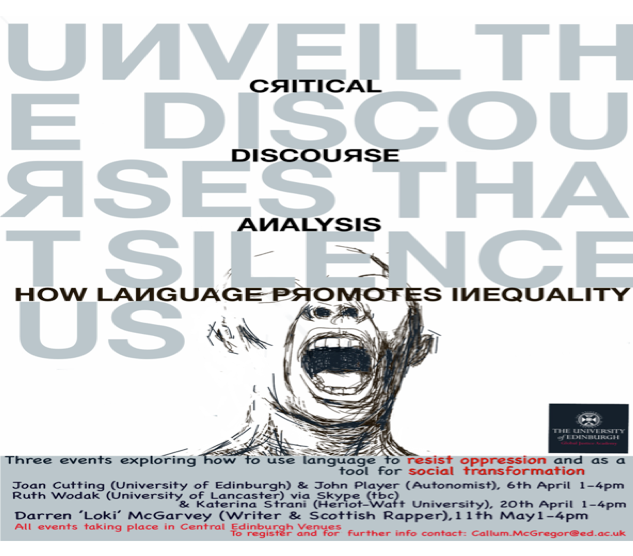
In April 2018, the GJA sponsored its first ‘Spring School’ in a collaboration with Moray House School of Education. In this post, Spring School Co-organiser and GJA Management Group member, Dr Callum McGregor, reflects on the Spring School’s innovative community-university partnership, which fostered strong links with local organisations and social justice practitioners. It is hoped that a similar Spring School will run again next year. Callum is also the programme director for the online MSc in Social Justice and Community Action, which is sponsored by the Global Justice Academy.

Callum McGregor

The Global Justice Academy (GJA) is an institutional forum for dialogue with practitioners engaged in justice issues locally and globally. This short blog highlights one such example of local dialogue, in the form of a series of community-university workshops on Critical Discourse Analysis (CDA). CDA is a form of critical social research, whose purpose is to analyse the ways in which language can be used to both reproduce and challenge social injustice. Discourses can be thought of as representationsof various aspects of our social lives. These representations are made up sets of rules and statements that determine whatcan be expressed within a particular context, howit can be expressed, by whom and under what conditions. Discourses are important because they have real material effects on the distribution of burdens and benefits along different axes of inequality.

Between April and May 2018, three workshops were held, with the purpose of bringing together community practitioners, community-based adult learners, activists, students and academics to learn together about CDA. Specifically, the workshops focused on how CDA can be used creatively to link education to social action, through addressing the interests and struggles of ordinary people in communities.

Comments closed

Reflections from the Tenth Aniversary Edition of the Edinburgh Legal Theory Festival: Workshop on Virtue Ethics, Markets, and the Law

The Global Justice Academy recently sponsored one of the workshops at the 10th Anniversary Edition of the Edinburgh Legal Theory Festival. In this blog post, the co-convenors of the Edinburgh Legal Theory Research Group—Richard Latta and Joaquín Reyes—report on the issues raised during the workshop.

The workshop on ‘Virtue ethics, Markets, and the Law’—held on Tuesday 5thJune, the second day of the week-long Edinburgh Legal Theory Festival (4th-8thJune)—was devoted, as its name suggests, to explore the implications of a virtue-centred approach to legal theory for a wide-ranging variety of related topics, including the relationships between power, virtue and the constitutional state (Dominic Burbidge), algorithmic governance (René Urueña), the Rule of law and the law of equity (Irit Samet), intent to contract and trust (Prince Saprai), and the future of virtue jurisprudence (Chapin Cimino). All sessions were followed by a lively discussion in which the participants had the opportunity to give and receive important feedback on their ongoing research projects.

Comments closed

Recent Discussions in Legal Theory at the Edinburgh Legal Theory Research Group

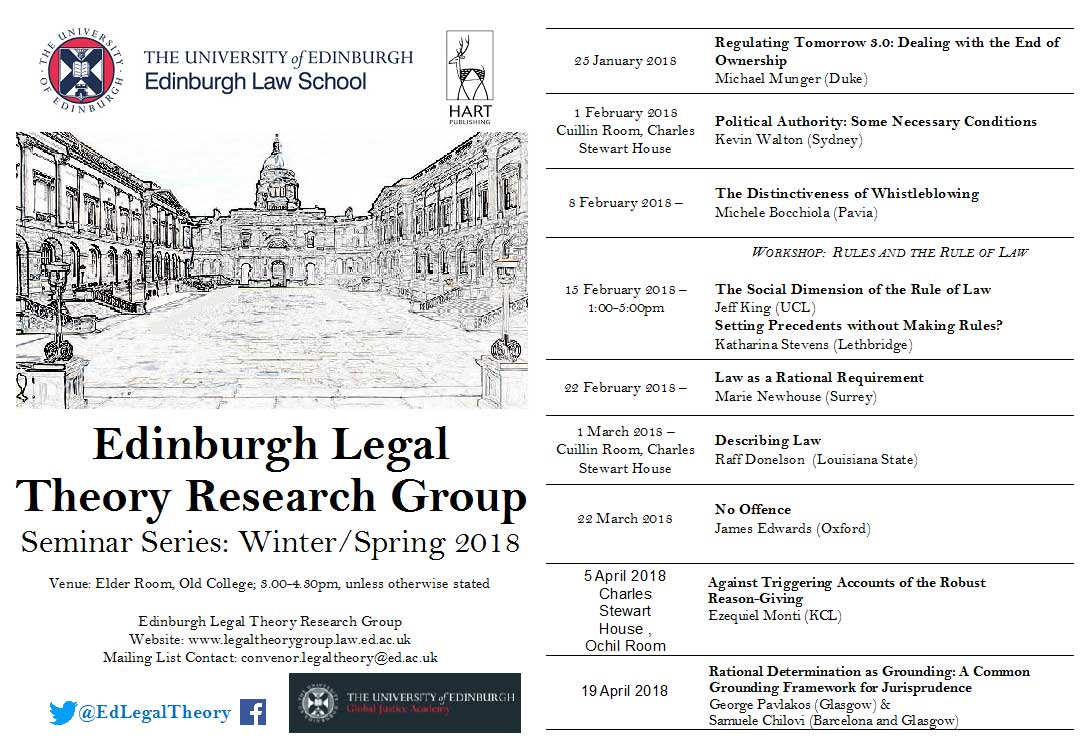
In this post, the Co-Convenors of the Edinburgh Legal Theory Research Group for 2017-18, Richard Latta and Joaquin Reyes, report on their recent Winter/Spring seminar series and the topics discussed.

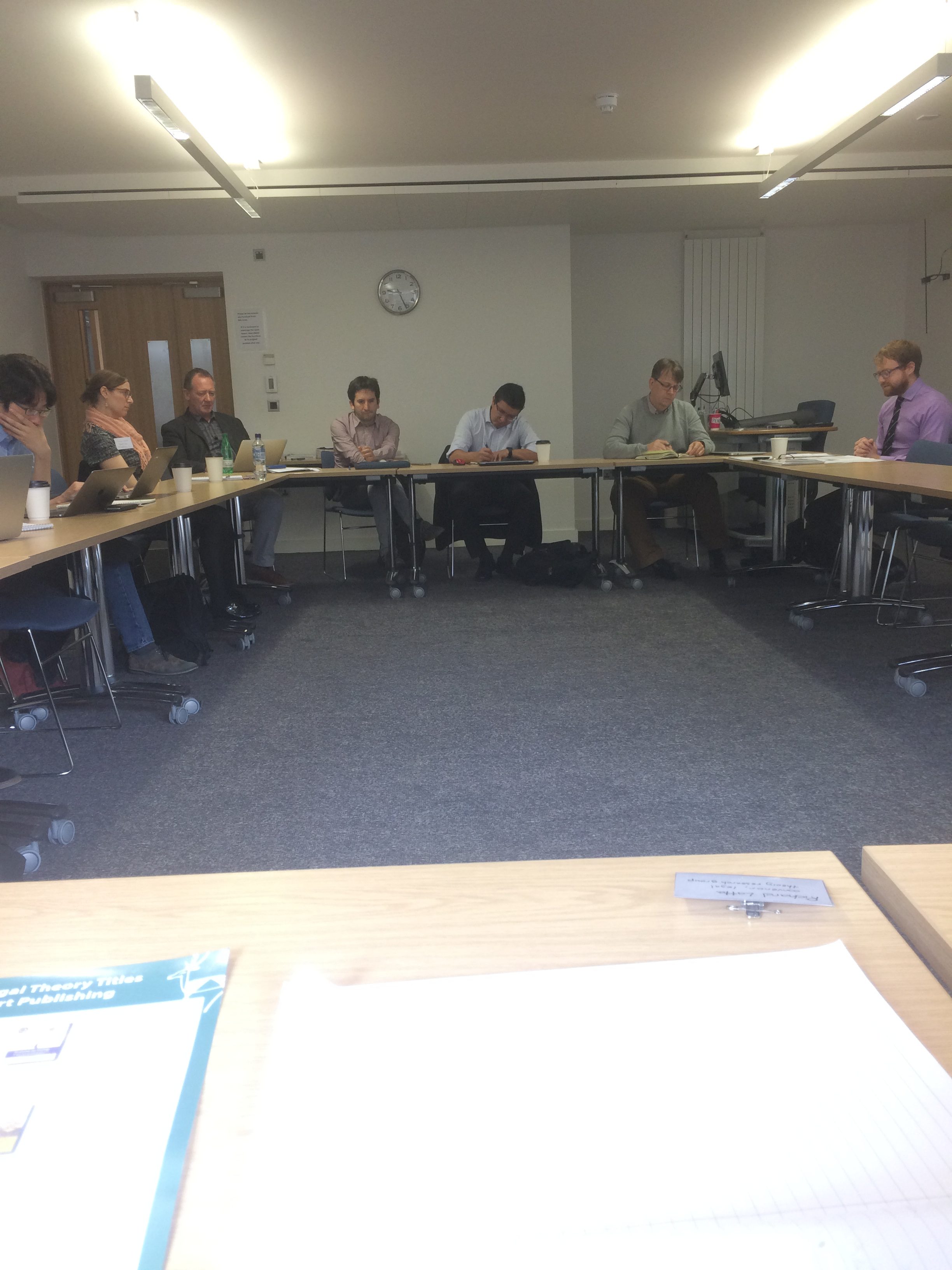
The Edinburgh Legal Theory Research Group is very grateful for the support of the Global Justice Academy for the Edinburgh Legal Theory Research Group’s Seminar Series of Spring 2018. This semester we hosted speakers from all over the world to discuss issues in legal theory and beyond legal theory.

Comments closed

Liberating Comparisons: Report from the Workshop

The Liberating Comparisons network emerged out of a workshop by the same name in Edinburgh on 8 December 2017. The workshop drew together scholars from across the UK to explore the potential of comparative methods.

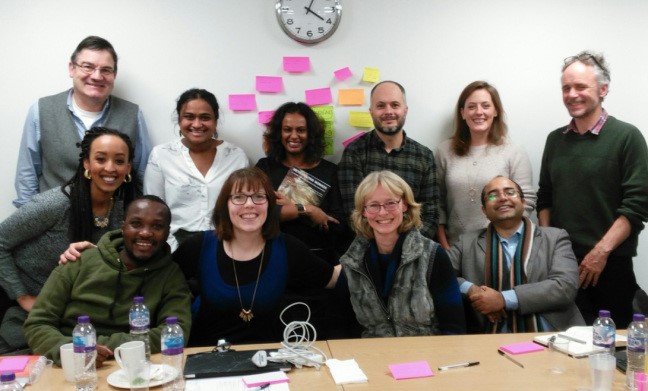
From back left: Jonathan Spencer, Sneha Krishnan, Kesi Mahendran, Juliano Spyer, Sarah Linn, Ian Harper, Mikal Woldu, Patrick Mutahi, Simone Lamont-Black, Indrajit Roy

The workshop started from the premise that comparative methods had the potential to reify or disrupt the way we see the world and our place within it. Our workshop drew together scholars who were interested in the latter: the transformative insights that comparative methods could bring to the complex and important issues of our day.

Comments closed

‘Buildings are for (Some) People’: Reconsidering Architecture and the Struggle for Urban Space

profile-jg
GJA Student Ambassador, James Gacek

The Global Justice Academy is delighted to post its second book review of the 2016-17 academic year as part of its Student Ambassador Programme. James Gacek is reading for a PhD in Law. Here, he review’s Bill Caplan’s Buildings are for People as part of our Urban Justice Lab.

Exploring the interactions between people and the natural environment, Bill Caplan’s Buildings are for People: Human Ecological Design issues a clarion call for the design/build professions to critically assess architecture, green design and sustainability in the context of human ecology—that is, the examination between people, community spaces and the ecosystem which surrounds and penetrates us.

Such a focus is significant, as sustainable building has gained resonance in recent professional and academic accounts (Jones & Card, 2011). The built environment of urban spaces has the potential to alter “our living environment in material and experiential ways, shaping the character of human experience, the physical, mental and economic wellbeing of individuals and the community at large” (Caplan, 2016, p. xvi, italics in original). Caplan’s book is a unique approach to further understanding the process of conceiving architectural design, while both highlighting the social aspects of human interaction as well as the benefits of ‘green’ and sustainable architectural designs.

Comments closed

Workshop on Dignity: Reporting from an Innovative Initiative Fund Event


The Edinburgh Legal Theory Research Group had the pleasure of hosting, with the kind sponsorship of the Global Justice Academy through its Innovative Initiative Fund, the Workshop on Dignity on 6 October 2016. The workshop had three speakers: Ioanna Tourkochoriti (National University of Ireland Galway), Colin Bird (University of Virginia), and Adam Etinson (St. Andrews).

This guest post by co-organisers, Lucas Miotto and Paul Burgess, discusses the presentations and debate that took place.

The workshop was well attended by both staff members and students. An interesting, and beneficial, feature of the audience, was that it reflected the interdisciplinary character of the topic; we had attendees coming from myriad fields, such as politics, human rights, international and constitutional law, as well as legal and moral philosophy. Discussion was very lively and, perhaps due to the diverse character of the audience, presenters received feedback and questions from several different angles.

Comments closed

Reflections from the Association of Human Rights Institutes 2016 Conference

Dr Kasey McCall-Smith and Dr Dimitrios Kagiaros attended the 2016 Association of Human Rights Institutes (AHRI) conference on behalf of the Global Justice Academy. The conference was hosted by the Netherlands Institute of Human Rights (SIM) of Utrecht University, and welcomed over 200 academics and researchers. In this short post, Kasey McCall-Smith reflects on the discussion.

The theme of the conference was ‘50 Years of the Two UN Human Rights Covenant: Legacies and Prospects’. The conference enjoyed presentations, debates and interventions from well-known faces on international human rights scene.

Comments closed

The Concept of Global Law: what is it and what are the rules?

A guest post from Lucas Miotto Lopes, Convenor of the Edinburgh Legal Theory Group, who received an award of £400 from the GJA Innovative Initiative Fund to host a seminar on ‘The Concept of Global Law’.

With the sponsorship of the Global Justice Academy the Edinburgh Legal Theory Group held the seminar entitled The Concept of Global Law on September 24th. Jorge Fabra, a PhD candidate at McMaster University, was the presenter and Professor Neil Walker, from the University of Edinburgh, acted as the discussant. We had the privilege of counting with a wide and diversified audience – from undergrads to staff members. Participants were keen to engage in discussion and offered both critical remarks and constructive feedback. As a result, discussion was very live, friendly and informal.

Jorge Fabra addresses the seminar group

Comments closed
css.php

Report this page

To report inappropriate content on this page, please use the form below. Upon receiving your report, we will be in touch as per the Take Down Policy of the service.

Please note that personal data collected through this form is used and stored for the purposes of processing this report and communication with you.

If you are unable to report a concern about content via this form please contact the Service Owner.

Please enter an email address you wish to be contacted on. Please describe the unacceptable content in sufficient detail to allow us to locate it, and why you consider it to be unacceptable.
By submitting this report, you accept that it is accurate and that fraudulent or nuisance complaints may result in action by the University.

  Cancel