On 14 March 2022, the Global Justice Academy hosted a conversation between Mohamedou Ould Salhi, author of the best-seller Guantánamo Diary, and Dr Kasey McCall-Smith,…
Comments closedCategory: Terrorism
This post continues the blog series by Dr Kasey McCall-Smith which examines some of the contentious legal issues raised in the US v. Khalid Shaikh…
Comments closedThis is the third post in a blog series by Dr Kasey McCall-Smith which examines some of the contentious legal issues raised in the US…
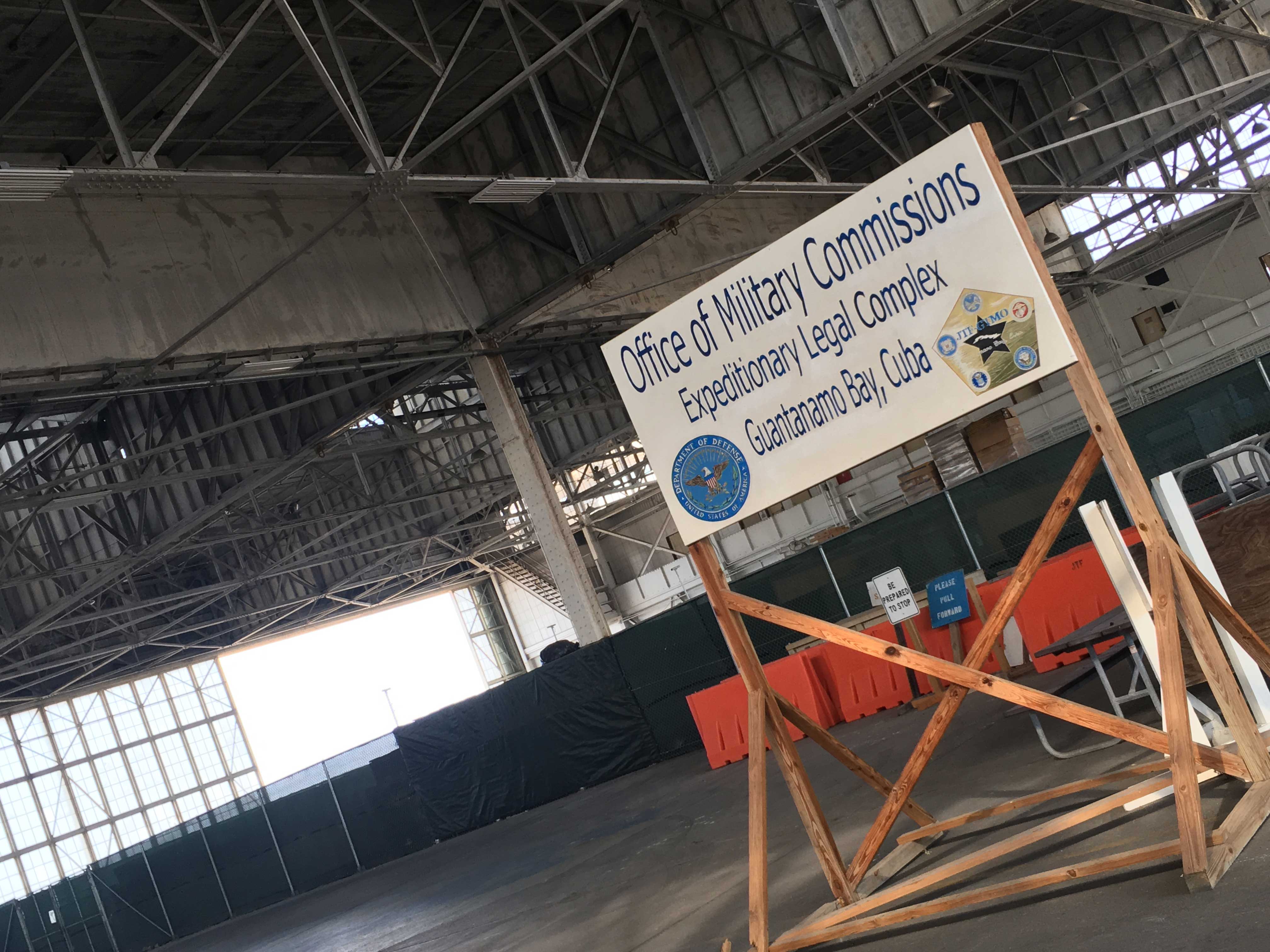
Comments closed This series of blogs presents a number of the legal issues raised at the April – May 2018 military commission proceedings against the alleged plotters of the 11 September 2001 (9/11) terror attacks against the US in the case of US v. Khalid Shaikh Mohammad, et. al. taking place at Camp Justice, Guantánamo Bay Naval Station, Cuba.
The author, Dr Kasey McCall-Smith, is conducting a research project entitled Torture on Trial, which is funded by the Royal Society of Edinburgh.
1. The Shadows of Torture
When people speak about torture and the war on terror, the most egregious and publicly decried acts generally pop to mind: waterboarding, walling, sleep deprivation, and so on. As the military commission proceedings in case of US v. Khalid Shaikh Mohammad, et. al. (KSM case) unfold, less examined examples aspects of torture reveal the irreversible physical and mental impacts on victims of such abuse.
Vivek Bhatt, a Student Ambassador with the Global Justice Academy (GJA), has written this blog following a panel event he attended at the Edinburgh Law School. The event, hosted by the GJA, explored…
Comments closedThis post is by Kasey McCall-Smith: a lecturer in Public International Law and programme director for the LLM in Human Rights at Edinburgh Law School.
This post is the fourth in a series of blogs that chronicle the history and current state of play regarding the US rendition and detention programme in the immediate aftermath of 9/11. They were written during the author’s visit to Guantánamo Bay, Cuba, to observe military commission proceedings in the case of USA v. Khalid Shaikh Mohammad, et. al. 30 May – 3 June 2016, which is the initial phase of her project Getting to Grips with Guantánamo.
- Click here to read the first post in the series: ‘Rendition to the Caribbean’
- Click here to read the second post in the series: ‘Getting to Grips with Guantánamo: Military Commissions & Law of War Detention’
- Click here to read the third post in the series: ‘Getting to Grips with Guantánamo: Torture Evidence’
In my last post, the use of evidence obtained through torture in the case of US v. Khalid Shaikh Mohammad, et. al. (KSM case) was introduced. This post further considers how torture impacts detainees held at Guantánamo and the 9/11 trial. An interesting addition to the already complex pre-trial considerations is the possible appearance of a detainee who has not been seen in public since he was rendered into the custody of the CIA. Abu Zubaydah, a Palestinian, is believed to have been taken into CIA custody in 2002 following his capture in Pakistan. After three years on a CIA ‘black site’, he was delivered to Joint Task Force-Guantánamo (JTF-GTMO) in 2006 where he remains a High Value Detainee (HVD) despite never having been charged with a crime. As characterised by former FBI agent, Ali Soufan, Zubaydah is the ‘original sin’ of the US in its post-9/11 anti-terror campaign.
Comments closedThis post is by Kasey McCall-Smith: a lecturer in Public International Law and programme director for the LLM in Human Rights at Edinburgh Law School.
This post is the third in a series of blogs that chronicle the history and current state of play regarding the US rendition and detention programme in the immediate aftermath of 9/11. They were written during the author’s visit to Guantánamo Bay, Cuba, to observe military commission proceedings in the case of USA v. Khalid Shaikh Mohammad, et. al. 30 May – 3 June 2016, which is the initial phase of her project Getting to Grips with Guantánamo.
- Click here to read the first post in the series: ‘Rendition to the Caribbean’
- Click here to read the second post in the series: ‘Getting to Grips with Guantánamo: Military Commissions & Law of War Detention’
Right now, on a small island in the Caribbean, what will ultimately be one of the most comprehensive examinations of torture is taking place in the form of a military commission proceeding in the case of US v. Khalid Shaikh Mohammad, et. al. (KSM case). A common understanding among the observers that are witnessing KSM is that half are there to see the 9/11 trial and half are there to see the torture trial. In anticipation of what many view as a foregone conclusion, the defence lawyers are diligently representing their clients in order to ensure that if the ultimate penalty, death, is pursued in the sentencing phase of the trial; then the brutality that they suffered at the hands of the CIA is in the trial record. This record will be instrumental to mitigation of the death penalty and speak to the reality that much of the evidence presented may have been extracted or derived through torture, which is prohibited under international law.
Comments closedThis post is by Kasey McCall-Smith: a lecturer in Public International Law and programme director for the LLM in Human Rights at Edinburgh Law School.
This post is the second in a series of blogs that chronicle the history and current state of play regarding the US rendition and detention programme in the immediate aftermath of 9/11. They were written during the author’s visit to Guantánamo Bay, Cuba, to observe military commission proceedings in the case of USA v. Khalid Shaikh Mohammad, et. al. 30 May – 3 June 2016, which is the initial phase of her project Getting to Grips with Guantánamo. Click here to read the first post in the series: ‘Rendition to the Caribbean’.
The military commission proceeding against the 9/11 five in the case of US v. Khalid Shaikh Mohammad, et. al. (KSM case) is viewed as having parallel purposes, bringing justice to the nation and victims’ families for the terrorist attacks of 9/11 and laying bare the flagrant torture campaign under the US Central Intelligence Agency’s (CIA) post-9/11 Detention and Interrogation Program (DIP). The KSM case stems from charges filed on 31 May 2011 against the five men charged with conspiracy, murder and destruction of property in violation of the law of war for the conception and facilitation of the 9/11 attacks which resulted in the deaths of close to 3000 people. The subsequent ‘war on terror’ launched by the Bush administration in the aftermath set in motion a ruthless anti-terrorism campaign by the CIA that has been acknowledged by the US government as comprising widespread use of torture in breach of both US domestic law and international law.
Comments closedThis post is by Kasey McCall-Smith: a lecturer in Public International Law and programme director for the LLM in Human Rights at Edinburgh Law School.
This post is the first in a series of blogs that chronicle the history and current state of play regarding the US rendition and detention programme in the immediate aftermath of 9/11. They were written during the author’s visit to Guantánamo Bay, Cuba, to observe military commission proceedings in the case of USA v. Khalid Shaikh Mohammad, et. al. 30 May – 3 June 2016, which is the initial phase of her project Getting to Grips with Guantánamo.
Following the attacks against the US on 9/11, then-President Bush declared open-season on all individuals with any established link to al Qaeda. In furtherance of the Bush declaration, the US Central Intelligence Agency (CIA) commenced what would eventually prove to be the most egregious and calculated rendition and detention campaign in modern, post-WWII history. A campaign defined by blatant breaches of both US and international law. To this day, it serves as a black mark on America’s international image, and the resulting impact of the decisions taken by the Bush Administration in the early days of 2001 continue to resonate today.
Comments closedOn Friday 15 January 2016, the Global Justice Academy and the Centre for Security Research at The University of Edinburgh hosted a panel discussion on the Prevent Strategy obligations that have been placed on higher education institutions. GJA Student Ambassador, Rebecca Smyth, went along to the debate and outlines the debated arguments as well as her thoughts on this contentious issue in this guest post.
A thing of nothing or something more sinister? Under section 26 of the 2015 Counter-Terrorism and Security Act universities must “have due regard to the need to prevent people being drawn into terrorism.” The origins of this ‘Prevent’ duty, and its potential implications for staff and students, were considered at a panel discussion organised by the Global Justice Academy and Centre for Security Research last Friday. Chaired by Akwugo Emejulu, the panel comprised Gavin Douglas, Deputy Secretary of Student Experience here at the University of Edinburgh; Richard Jones of the School of Law; Genevieve Lennon of the University of Strathclyde Law School; Urte Macikene, EUSA Vice President of Services; and Andrew Neal of the Politics and International Relations department.
Continue readingCounter-Terrorism, Radicalisation, and the University: Debating the Prevent Strategy
Comments closed 