Any views expressed within media held on this service are those of the contributors, should not be taken as approved or endorsed by the University, and do not necessarily reflect the views of the University in respect of any particular issue.
Press "Enter" to skip to content

Category: Student Ambassadors

‘Buildings are for (Some) People’: Reconsidering Architecture and the Struggle for Urban Space

profile-jg
GJA Student Ambassador, James Gacek

The Global Justice Academy is delighted to post its second book review of the 2016-17 academic year as part of its Student Ambassador Programme. James Gacek is reading for a PhD in Law. Here, he review’s Bill Caplan’s Buildings are for People as part of our Urban Justice Lab.

Exploring the interactions between people and the natural environment, Bill Caplan’s Buildings are for People: Human Ecological Design issues a clarion call for the design/build professions to critically assess architecture, green design and sustainability in the context of human ecology—that is, the examination between people, community spaces and the ecosystem which surrounds and penetrates us.

Such a focus is significant, as sustainable building has gained resonance in recent professional and academic accounts (Jones & Card, 2011). The built environment of urban spaces has the potential to alter “our living environment in material and experiential ways, shaping the character of human experience, the physical, mental and economic wellbeing of individuals and the community at large” (Caplan, 2016, p. xvi, italics in original). Caplan’s book is a unique approach to further understanding the process of conceiving architectural design, while both highlighting the social aspects of human interaction as well as the benefits of ‘green’ and sustainable architectural designs.

Comments closed

The Apportionment of Shame: Rodrigo Duterte and the Cosmopolitan Discourse of International Criminal Law

vivek-bhatt-headshot
GJA Student Ambassador, Vivek Bhatt

The Global Justice Academy is delighted to launch the second year of its Student Ambassador programme with a guest post by Vivek Bhatt. Vivek is an incoming student reading for a PhD in Law. He recently completed the MSc in Political Theory at the London School of Economics, and holds a Bachelor of Arts (Advanced) (Honours) and Master of International Law from the University of Sydney. His primary interest is in international laws relating to counterterrorism, conflict, and human rights.  

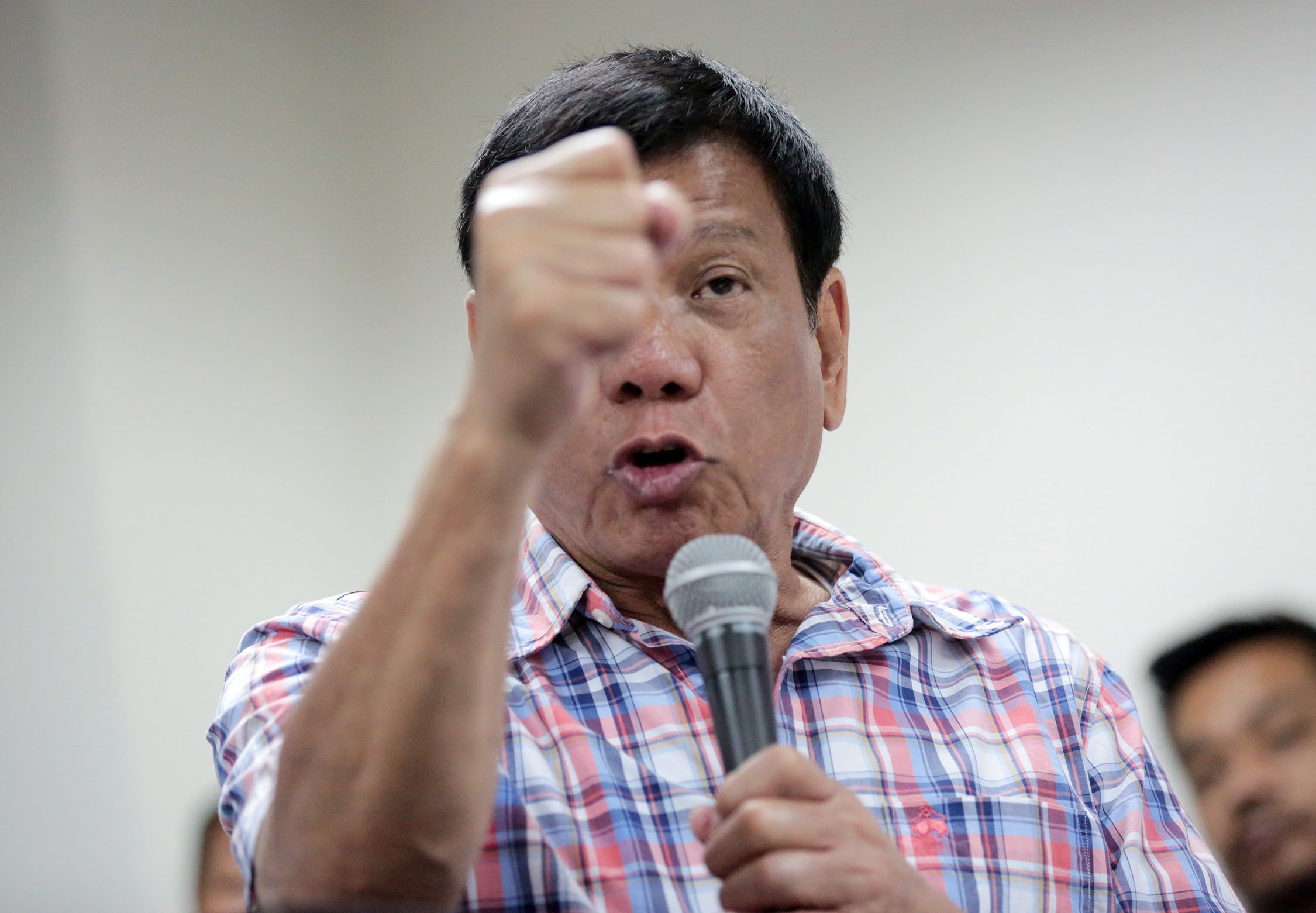
Rodrigo Duterte’s war on drugs in the Philippines has recently been deemed an international crime. This post reflects upon issues arising from the condemnation of Duterte, asking whether international criminal law can enable the realisation of cosmopolitan ideals. 

duterte
Rodrigo Duterte, President of the Philippines

When elected President of the Philippines on 9 May 2016, Rodrigo Duterte vowed to reduce rates of drug-related crime within the state. Duterte has since waged a violent anti-drug campaign, authorising the extra-judicial execution of individuals thought to use, possess, or traffic illegal substances.  The President’s “death squad” comprises select members of the police force and civilian volunteers. Most of these individuals were lured into their roles as amateur mercenaries through payment, and promises of impunity for their actions. Others were coerced into joining Duterte’s campaign; men and women were guaranteed immunity from punishment for their own drug-related offences in exchange for their services as assassins.[1] The OHCHR suggests that over 850 people have been killed since Duterte’s election, but reports that take into account unexplained deaths during that period suggest the number is closer to 3,000.[2]

Comments closed

COP 21: the Global Challenge of Climate Change

Lauren Donnelly is reading for an LLM in Human Rights at Edinburgh Law School. In her role as a Global Justice Academy Student Ambassador, Lauren reflects on discussions raised from the Paris talks on climate change, including what Scotland can do.

On Saturday the 19th of March, the UN House Scotland held, “Climate Change: Global Challenges, Local Solutions Conference” to explore the impact of the much publicised 2015 Paris Climate Change agreement. The event consisted of two panel discussions, the first which examined from an international perspective and the second which explored the Scottish response, to the various challenges faced in achieving the goals set out in this agreement.

COP 21The opening address of conference was delivered by Tom Ballantine, the Chair of Stop Climate Change Scotland. The opening address paved the way for what was to be an inspiring and enlightened discussion throughout the afternoon. The presentation outlined briefly why climate change matters, the broader effects of climate change and climate change after the Paris agreement. It highlighted that climate change has been discussed since the nineteenth century, stressing that despite the fact that the developing world is contributing the least to climate change, these countries are most likely to suffer the impact of global warming. Expanding on this point, the presentation outlined that if we do not act urgently we can expect to see: coastal flooding and displaced people due to land loss; reduced yields of major crops; human insecurity; and mass poverty.

Comments closed

Counter-Terrorism, Radicalisation, and the University: Debating the Prevent Strategy

On Friday 15 January 2016, the Global Justice Academy and the Centre for Security Research at The University of Edinburgh hosted a panel discussion on the Prevent Strategy obligations that have been placed on higher education institutions. GJA Student Ambassador, Rebecca Smyth, went along to the debate and outlines the debated arguments as well as her thoughts on this contentious issue in this guest post.

A thing of nothing or something more sinister?  Under section 26 of the 2015 Counter-Terrorism and Security Act universities must “have due regard to the need to prevent people being drawn into terrorism.”  The origins of this ‘Prevent’ duty, and its potential implications for staff and students, were considered at a panel discussion organised by the Global Justice Academy and Centre for Security Research last Friday.  Chaired by Akwugo Emejulu, the panel comprised Gavin Douglas, Deputy Secretary of Student Experience here at the University of Edinburgh; Richard Jones of the School of Law; Genevieve Lennon of the University of Strathclyde Law School; Urte Macikene, EUSA Vice President of Services; and Andrew Neal of the Politics and International Relations department.

Comments closed

Myths and Realities – What is the Women, Peace and Security Agenda?

Rosie Ireland is a GJA Student Ambassador for 2015-16, and is reading for an LLM in Human Rights. Rosie co-authored our first student report on international law and peace negotiations with her colleague, Siobhan Cuming. In this report, Rosie reflects on the 2015 Crystal Macmillan Lecture, which was delivered by Madeleine Rees. 

Last semester on the 26 November, the distinguished international lawyer and human rights advocate Madeline Rees, Secretary General of the Women’s International League for Peace and Freedom, delivered the second Chrystal Macmillan Lecture of 2015. The report provides a brief summary and covers some of the key points made during the lecture.

Law has developed since 1948 to address conflicts, promote peace and end war. Addressing the root causes of conflict – such as inequalities between people and nations – is essential to the prevention of future conflict.

Comments closed

The Accountability and Remedy Project: Corporate Liability for Human Rights Undergoes Some Research & Development

Helen Kemp is a GJA Student Ambassador for the 2015-16 academic year. Helen is reading for her Law LLB at Edinburgh Law School. She is a fourth-year student and is writing her dissertation on the role of human rights in international environmental law.

Convincing multinational corporations to protect the rights of people involved in, or affected by, the flourishing of their business is hardly a simple task. Endless frameworks and guidelines may be available to help States induce companies to comply with human rights law, but the quality of life of factory workers in a faraway nation has not usually shown to outweigh the short-term profit brought about by their exploitation.

The United Nations Guiding Principles on Business and Human Rights (UNGP) resulted from a decades-long effort to set standards for states to address human rights violations resulting from global business activities.

Comments closed

What Can Scotland Do?

Rebecca Smyth is a Global Justice Academy Student Ambassador for 2015-16. In this post, Rebecca reflects on the third in our series of Rapid Response Roundtables on the current refugee crisis. Rebecca also report from the second roundtable, ‘Is the Global Refugee Regime Fit for Purpose?’.

Chaired by Dr Patrycja Stys of the Centre of African Studies, this event was the last of three organised by the Global Justice Academy in relation to the current refugee crisis.

It began with a screening of LIVED’s Learning to Swim, a short documentary that aims to share something of the everyday lives of displaced young Syrians in the Zaatari Refugee Camp, the village of Zaatari, and Amman in Jordan. It’s a very special piece. Through seemingly disjointed snippets of interviews and footage, it gives a sense of the inner lives and daily routines of children and young people caught up in the Syrian conflict. We meet a girl who loves football, kites and fried food, and whose favourite place is Homs, a place of roses and affectionate people.

Comments closed

Is the International Refugee Regime Fit for Purpose?

Rebecca Smyth is a Global Justice Academy Student Ambassador for 2015-16. In this post, Rebecca reflects on the second in our series of Rapid Response Roundtables on the current refugee crisis. Rebecca will also report from the final roundtable, ‘What Can Scotland Do?’.

This panel discussion was a follow-on event from the first panel discussion held at the beginning of October on the roots of the current Syrian crisis. The panel was comprised of Professor Christina Boswell and Dr Lucy Lowe from the School of Social and Political Science; campaigner Amal Azzudin of the Mental Health Foundation; and Jamie Kerr, Partner at Thorntons Solicitors specialising in Immigration Law. It was chaired by Dr Mathias Thaler.

“The international refugee regime is spectacularly not fit for purpose”

Drawing upon her academic research and own experience working with the UNHCR in the mid-1990s, Professor Boswell demonstrated the ways in which the origins of the current global refugee regime have combined with EU policy to create an unsustainable system for dealing with the current refugee crisis.

Comments closed

International Law and Peace Negotiations

The Global Justice Academy has launched its Student Ambassadors programme for the 2015-16 academic year. Rosie Ireland and Siobhan Cuming are both students on the LLM in Human Rights. As GJA Student Ambassadors, they co-authored this report on a recent seminar by Phillip Kastner.

In this report we summarise the key points made by Professor Phillip Kastner (University of Western Australia) at a seminar on 9 October titled ‘The Role of International Law in the Context of Peace Negotiations.’

International Law and the Resolution of Internal Armed Conflicts

Today, internal armed conflicts are significantly more prevalent than inter-state conflicts. The resolution of internal armed conflicts is generally more complex than inter-state conflicts; involving a higher level of interdependence and giving rise to a multitude of issues.

Comments closed
css.php

Report this page

To report inappropriate content on this page, please use the form below. Upon receiving your report, we will be in touch as per the Take Down Policy of the service.

Please note that personal data collected through this form is used and stored for the purposes of processing this report and communication with you.

If you are unable to report a concern about content via this form please contact the Service Owner.

Please enter an email address you wish to be contacted on. Please describe the unacceptable content in sufficient detail to allow us to locate it, and why you consider it to be unacceptable.
By submitting this report, you accept that it is accurate and that fraudulent or nuisance complaints may result in action by the University.

  Cancel