On 14 March 2023, the Global Justice Academy hosted the Ruth Adler Human Rights Lecture by Ms Mama Fatima Singhateh, the UN Special Rapporteur…
Comments closedCategory: Scotland
This is Part 2 of a two-part blog post by Prof. Paul Clark comparing police discipline in the US and the UK. It identifies aspects…
Comments closedThis is the second blog in a series written by LLM students on the Human (In)Security course at Edinburgh Law School. The series celebrates the…
Comments closedThis post is 2 of 2 by Dr Kasey McCall-Smith examining the UNCRC (Incorporation) (Scotland) Bill. This post highlights how stronger interpretive tools could strengthen…
Comments closedThe global events occurring in the spring and summer of 2020 have ushered issues of racial discrimination and inequity into the foreground of social discourse.…
Comments closedThis post by Dr Kasey McCall-Smith looks at the recent Scottish Government consultation on incorporation of the UN Convention on the Rights of the Child…
Comments closed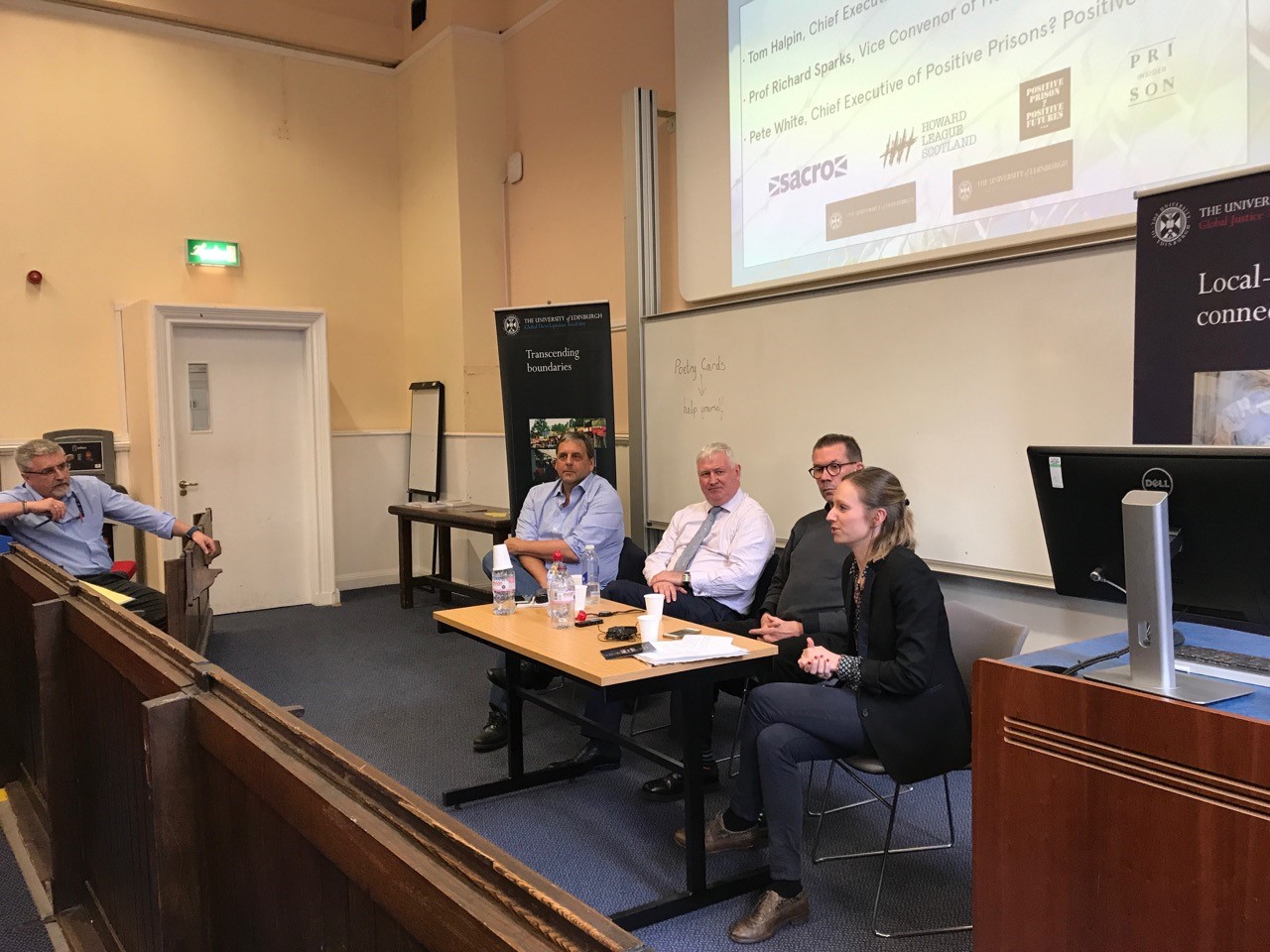 In this guest post, Coline Constantin reflects on the recent seminar that tackled issues around incarceration in Scotland. Coline is reading for an LLM in Human Rights at Edinburgh Law School, and applied for funding for this event from the Global Justice and Global Development Academies’ Innovative Initiative Fund.
Scotland has the second highest imprisonment rate in Europe. Although English headlines for issues of overcrowding, under staffing, rising rates of self-harming cases do not find an echo north of the border, the statistic still makes it worth taking a closer look at its system. On Thursday 26 April, an engaged audience gathered at the University of Edinburgh to hear more about the positive developments and challenges of the Scottish system of detention.
Three panellists from different fields of expertise and different view angles on the Scottish situation were invited to cover topics from policy-making, to the implementation and analysis of these policies. Professor Richard Sparks, Convenor of Howard League Scotland and criminologist specialised on the different systems of detention in the UK, took us through his analysis of the particularities of the Scottish case within the UK and European context. Tom Halpin, Chief Executive of Sacro and prominent figure in the reduction of inequalities in the Scottish criminal justice system, gave us a sense of the work that is being done with communities and specific groups of people with convictions to go towards better mentoring and guidance throughout the process. Pete White, Chief Executive of Positive Prisons? Positive Future and fascinating storyteller, treated the audience with a story of his personal experience from his time inside and the aftermath of this life-changing event.
Comments closed The Global Justice Academy is delighted to support the launch on the Postgraduate Gender Research Network of Scotland (PGRNS). This guest post by co-organiser, Rhian Sutton, reflects on the launch event which took place in October, and plans for the Network over the coming months – including how you can get involved. Rhian is reading for a PhD in History at the University of Edinburgh.
The Postgraduate Gender Research Network of Scotland (PGRNS) was formed in August, 2016. PGRNS aims to provide a platform on which postgraduates engaged in researching gender across Scotland can share their work, advertise events, workshops, and conferences, as well as learn about calls for papers and funding opportunities. Our goal is to facilitate discussion among researchers with common interests across both universities and disciplines in order to allow students to engage with people and ideas that they would not usually encounter through the course of their study. Ultimately, the network hopes to assist postgraduate students in enriching their research through the discovery of, and engagement with, new perspectives of gender research.
Comments closedGlobal Justice Academy Co-Director, Dr Tahl Kaminer, reflects on the Winchburgh Futures project that ran in ESALA at the beginning of this year.
An ESALA (Edinburgh School of Architecture and Landscape Architecture) team studied (2016) the current urban development around Winchburgh, West Lothian, in which a ring of 2000 or more housing units and a medium-scale town centre are being developed around an existing mining village of 2000 residents. The team responded to local residents’ request for support and advice regarding concerns for community cohesion and quality of development.
Comments closedLauren Donnelly is reading for an LLM in Human Rights at Edinburgh Law School. In her role as a Global Justice Academy Student Ambassador, Lauren reflects on discussions raised from the Paris talks on climate change, including what Scotland can do.
On Saturday the 19th of March, the UN House Scotland held, “Climate Change: Global Challenges, Local Solutions Conference” to explore the impact of the much publicised 2015 Paris Climate Change agreement. The event consisted of two panel discussions, the first which examined from an international perspective and the second which explored the Scottish response, to the various challenges faced in achieving the goals set out in this agreement.
 The opening address of conference was delivered by Tom Ballantine, the Chair of Stop Climate Change Scotland. The opening address paved the way for what was to be an inspiring and enlightened discussion throughout the afternoon. The presentation outlined briefly why climate change matters, the broader effects of climate change and climate change after the Paris agreement. It highlighted that climate change has been discussed since the nineteenth century, stressing that despite the fact that the developing world is contributing the least to climate change, these countries are most likely to suffer the impact of global warming. Expanding on this point, the presentation outlined that if we do not act urgently we can expect to see: coastal flooding and displaced people due to land loss; reduced yields of major crops; human insecurity; and mass poverty.
