The Global Justice Academy (GJA) and Political Settlements Research Programme (PSRP) recently hosted a free Peace Photography Masterclass at the University of Edinburgh. The workshop…
Comments closedCategory: Regeneration

The Global Justice Academy is delighted to post its second book review of the 2016-17 academic year as part of its Student Ambassador Programme. James Gacek is reading for a PhD in Law. Here, he review’s Bill Caplan’s Buildings are for People as part of our Urban Justice Lab.
Exploring the interactions between people and the natural environment, Bill Caplan’s Buildings are for People: Human Ecological Design issues a clarion call for the design/build professions to critically assess architecture, green design and sustainability in the context of human ecology—that is, the examination between people, community spaces and the ecosystem which surrounds and penetrates us.
Such a focus is significant, as sustainable building has gained resonance in recent professional and academic accounts (Jones & Card, 2011). The built environment of urban spaces has the potential to alter “our living environment in material and experiential ways, shaping the character of human experience, the physical, mental and economic wellbeing of individuals and the community at large” (Caplan, 2016, p. xvi, italics in original). Caplan’s book is a unique approach to further understanding the process of conceiving architectural design, while both highlighting the social aspects of human interaction as well as the benefits of ‘green’ and sustainable architectural designs.
Comments closedGlobal Justice Academy Co-Director, Dr Tahl Kaminer, reflects on the Winchburgh Futures project that ran in ESALA at the beginning of this year.
An ESALA (Edinburgh School of Architecture and Landscape Architecture) team studied (2016) the current urban development around Winchburgh, West Lothian, in which a ring of 2000 or more housing units and a medium-scale town centre are being developed around an existing mining village of 2000 residents. The team responded to local residents’ request for support and advice regarding concerns for community cohesion and quality of development.
Comments closedIn 2014-15, the Global Justice Academy launched its Urban Justice Lab. Based on the MIT-pioneered model to address global challenges, the Urban Justice Lab creates space for discussions and debates as well as collaborations in research, teaching, and outreach for university academics that study or operate on the city.
Dr Tahl Kaminer, GJA Co-Director (Urban Justice Lab), is a Lecturer in Architectural Design and Theory at the Edinburgh School of Architecture and Landscape Architecture (ESALA). One track of Tahl’s research studies the means of social amelioration via urban transformation. In 2014, students from the MSc programme in Urban Strategies and Design produced the Craigmillar Project Report – an extensive analysis of the Edinburgh neighbourhood, of the regeneration project, and of current conditions.
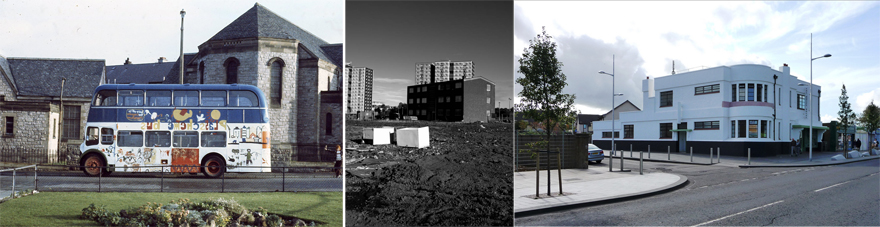
Comments closed
 This guest post is by Dr Tom Slater, Reader in Urban Geography at the University of Edinburgh. It first appeared in January 2014 on openDemocracy, in the openSecurity: Conflict and Peacebuilding theme.
On 27 January 2014, I noticed a few tweets announcing the Guardian’s new “Cities” section. The newspaper has a track record of publishing excellent short essays addressing urban issues, especially in its “Comment is Free” section, so I confess to initial interest and perhaps even mild excitement. Then I read two of the introductory pitches by the editorial team, delivered with an intention to “start the debate”. The first was by editor Mike Herd, entitled “What makes your city so special?” the sort of emetic rubric you might expect to find a ‘Business Traveller’ section of an in-flight magazine. Here is how he invited browsers to contribute:
Comments closed
