Any views expressed within media held on this service are those of the contributors, should not be taken as approved or endorsed by the University, and do not necessarily reflect the views of the University in respect of any particular issue.
Press "Enter" to skip to content

Category: Political Settlements

Peacebuilding and Syria: What Hope?

Between 13-15 October 2018, the Global Justice Academy co-hosted a weekend of events joining Relief & Reconciliation for Syria with peacebuilding communities in Scotland. This post from Dr George R. Wilkes, reflects on the series of events that took place.

The prospect of an inclusive peacebuilding process in Syria looks bleak now. From the perspective of millions of Syrians who have fled regime controlled areas, atrocity, terror and armed extortion all confront attempts to straddle divisions to talk about peace. Refugees face daily existential pressures in the face of which peace talks appear distant and untimely. Critics of regime ‘reconciliations’ see the concept reduced to the mechanics of overpowering the regime’s outlaws. In regime territory, a more inclusive embrace of populations controlled by Islamist armed groups is undercut by the sense that violence and terror were the inevitable result of a religious fundamentalism shared widely within those populations, and by the international supporters of those forces.

Comments closed

New Blog Series: Rethinking Peace and Conflict Research in Edinburgh

The University of Edinburgh’s research expertise on peace and conflict is growing fast, making it ever more important to connect and communicate across disciplinary lines. To this effect, a new blog series titled Rethinking Peace and Conflict Research in Edinburgh will foster exchange and make this ongoing research and its challenges more visible. Its aim is to build new interdisciplinary capacity and exchange around challenges and themes that connect experts working on peace and conflict across and beyond the University.  

Comments closed

Peace in Colombia?

This blog post by Gwen Burnyeat, Wolfson PhD scholar at UCL, was first published by the London Review of Bookson 1 December  2016. In this piece, Gwen comments on the recent development in the post-referendum context and the adoption of a new peace agreement in Colombia.

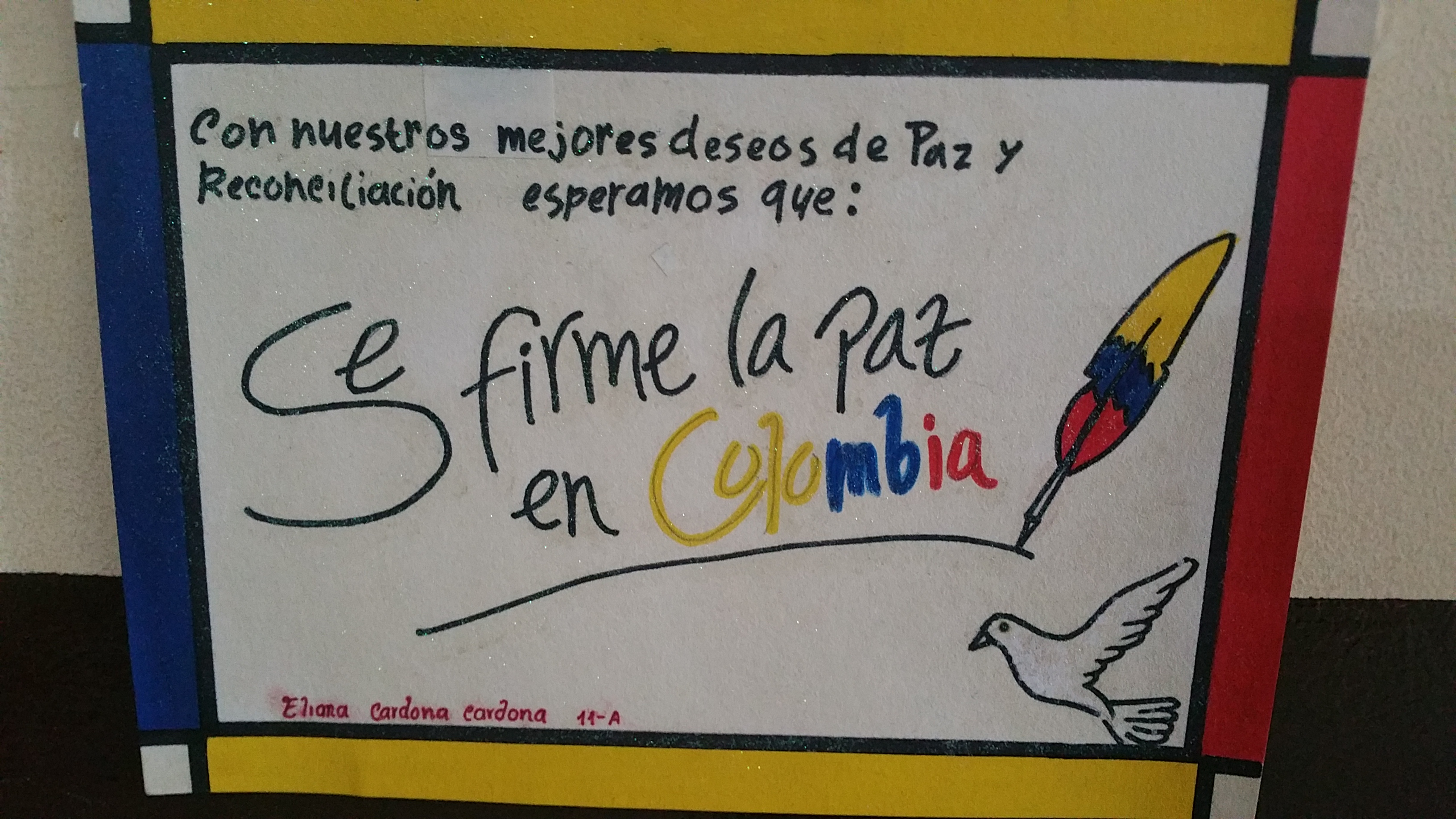
Photo: School-Children in Pereira draw their hopes for peace, August 2016, by Gwen Burnyeat.

The new peace accord between the government and the Revolutionary Armed Forces of Colombia was signed in Bogotá’s Colón Theatre on 24 November. It was a more sober ceremony than the extravagant signing of the first agreement in Cartagena on 26 September, a week before Colombians narrowly voted against it in a referendum. The second signing was a closed event, and only President Juan Manuel Santos and the Farc commander, Timochenko, gave speeches. A subdued group of Colombians in the main plaza in Bogotá watched it on a big screen. The right-wing TV channel RCN, meanwhile, held a panel featuring only figures opposed to the deal, for ‘balance’.

Comments closed

Brexit, Northern Ireland and UK-Irish Relations

CB profileThis post by GJA Director, Professor Christine Bell, was first published on the Centre on Constitutional Change blog on 26 March 2016, co-published with European Futures.

Amid pronouncements about the UK as an island nation, scant media or political attention has been paid to its only land border with the EU – between Northern Ireland and the Republic. However, says Professor Christine Bell in this extended analysis, the impact of Brexit on the institutions built up as part of the Peace Process would be considerable.

The EU referendum and the possibility of ‘Brexit’ raise distinct questions for Northern Ireland as a devolved region within the UK as part of the peace process. In the referendum debate, more attention needs to be given in the rest of the UK to Northern Ireland, the one part of the UK which has a land border with another EU country.

Political Divisions and the EU Referendum Campaign

The first key question as regards the EU referendum’s impact in Northern Ireland relates to the distinctiveness of its political settlement: how will the Brexit campaign affect political relationships – ever fragile – within Northern Ireland?

Comments closed

War: Art and Creativity in Conflict Zones

IPOW borderLeah Davison reports on an evening workshop that examined the role of art and creativity in conflict zone.  Leah organised this with support from the Global Justice Academy’s and Global Development Academy’s Innovative Initiative Funds.

On 18 March the Edinburgh University International Development Society (EUID), in collaboration with University of Manchester based organisation In Place of War (IPOW), hosted an evening of talk and performance on the subject of art and creativity in conflict zones. The question at hand: what role can creativity play in the realm of social, political and economic development in areas of conflict, war and revolution?

Comments closed

Myths and Realities – What is the Women, Peace and Security Agenda?

Rosie Ireland is a GJA Student Ambassador for 2015-16, and is reading for an LLM in Human Rights. Rosie co-authored our first student report on international law and peace negotiations with her colleague, Siobhan Cuming. In this report, Rosie reflects on the 2015 Crystal Macmillan Lecture, which was delivered by Madeleine Rees. 

Last semester on the 26 November, the distinguished international lawyer and human rights advocate Madeline Rees, Secretary General of the Women’s International League for Peace and Freedom, delivered the second Chrystal Macmillan Lecture of 2015. The report provides a brief summary and covers some of the key points made during the lecture.

Law has developed since 1948 to address conflicts, promote peace and end war. Addressing the root causes of conflict – such as inequalities between people and nations – is essential to the prevention of future conflict.

Comments closed

Serving women in Iraq and Syria: has UNSCR 1325 made a difference?

Rosie Ireland is a student on this year’s LLM in Human Rights at The University of Edinburgh. This is Rosie’s second report as a Global Justice Academy Student Ambassador – from the 2015 Montague Burton Lecture, which was delivered by Frances Guy on 2 November. Frances Guy is the Head of the Middle East region at Christian Aid. Rosie’s report outlines the key points made during the lecture, which was entitled ‘Serving women in Iraq and Syria: has UNSCR 1325 made a difference?’.

It is nearly the fifteenth anniversary of the UNSCR 1325; the first ever resolution aimed to enhance the role of women in peace building. Frances Guy analysed the effectiveness of the resolution in the context of Iraq and Syria in relation to four key areas: participation, protection, prevention, and relief and recovery.

Comments closed

International Law and Peace Negotiations

The Global Justice Academy has launched its Student Ambassadors programme for the 2015-16 academic year. Rosie Ireland and Siobhan Cuming are both students on the LLM in Human Rights. As GJA Student Ambassadors, they co-authored this report on a recent seminar by Phillip Kastner.

In this report we summarise the key points made by Professor Phillip Kastner (University of Western Australia) at a seminar on 9 October titled ‘The Role of International Law in the Context of Peace Negotiations.’

International Law and the Resolution of Internal Armed Conflicts

Today, internal armed conflicts are significantly more prevalent than inter-state conflicts. The resolution of internal armed conflicts is generally more complex than inter-state conflicts; involving a higher level of interdependence and giving rise to a multitude of issues.

Comments closed
css.php

Report this page

To report inappropriate content on this page, please use the form below. Upon receiving your report, we will be in touch as per the Take Down Policy of the service.

Please note that personal data collected through this form is used and stored for the purposes of processing this report and communication with you.

If you are unable to report a concern about content via this form please contact the Service Owner.

Please enter an email address you wish to be contacted on. Please describe the unacceptable content in sufficient detail to allow us to locate it, and why you consider it to be unacceptable.
By submitting this report, you accept that it is accurate and that fraudulent or nuisance complaints may result in action by the University.

  Cancel