Last Thursday, PeaceRep, Gender.Ed, and the Global Justice Academy hosted the Scottish Premiere of ‘Devi’ a documentary on the life of Devi Khakda—former member…
Leave a CommentCategory: Peace
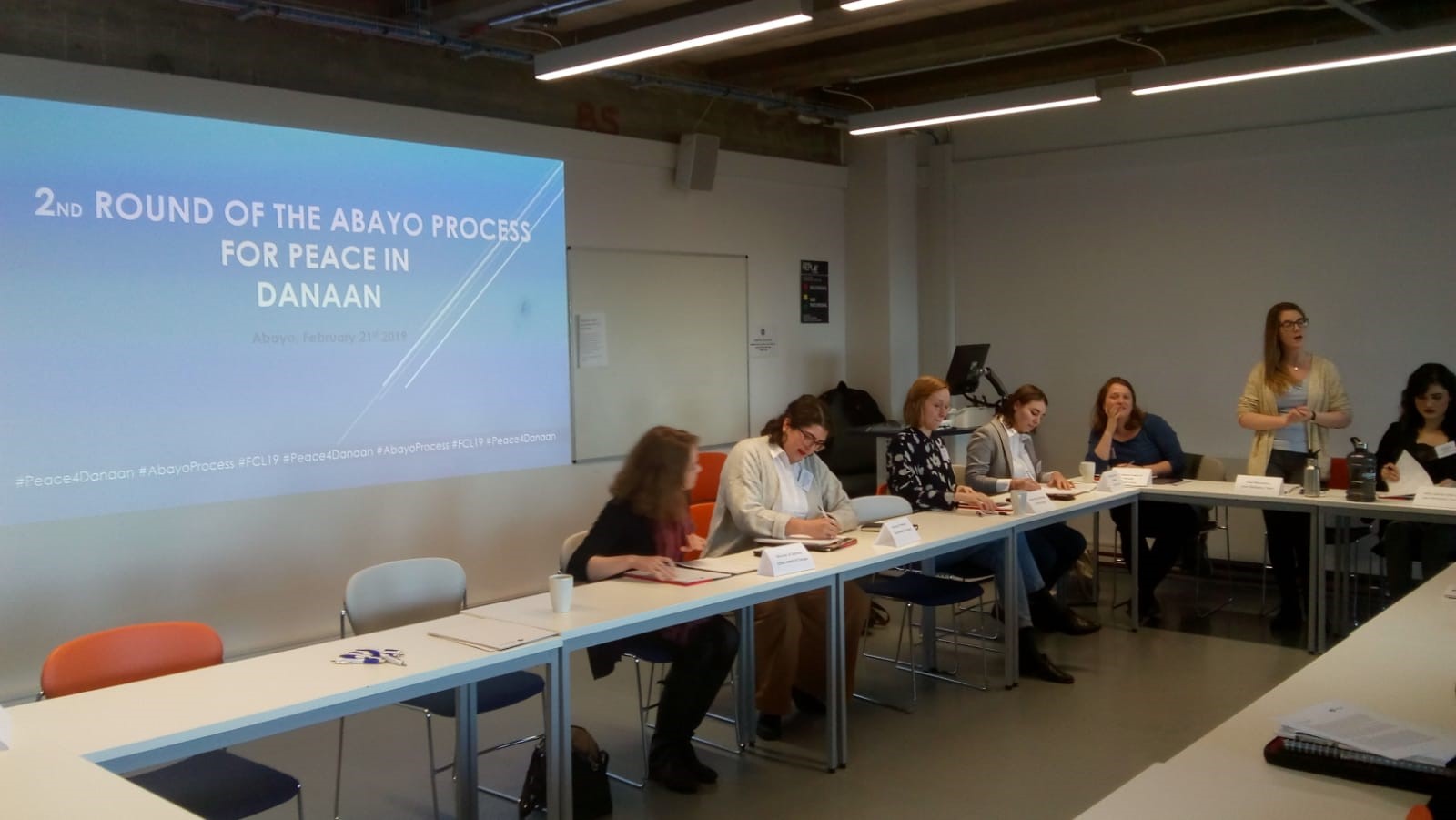
In this post, Edinburgh Law School postgraduate student Phoebe Warren reflects on her experience of taking part in the peace process simulation ‘Building Inclusive Dialogue in Danaan’, organised as part of the 2019 Festival of Creative Learning.
It is frequently bemoaned that theory-heavy subject areas such as politics and law rarely provide opportunities from within the university setting to put education into practice. In an age where student loans continue to accrue for an entire generation while prospects of the job market dwindle, there is room for real concern regarding the employability of those interested in these disciplines. As a postgraduate student on the LL.M. Human Rights programme at Edinburgh Law School, the issue of lacking practical experience in my chosen field is one that worries me greatly. How can I one day participate in high-stakes politico-legal negotiations without being able to first make mistakes and grow from them in a low-risk environment? A useful solution has been the discovery of conflict resolution simulations.
Comments closed Between 13-15 October 2018, the Global Justice Academy co-hosted a weekend of events joining Relief & Reconciliation for Syria with peacebuilding communities in Scotland. This post from Dr George R. Wilkes, reflects on the series of events that took place.
The prospect of an inclusive peacebuilding process in Syria looks bleak now. From the perspective of millions of Syrians who have fled regime controlled areas, atrocity, terror and armed extortion all confront attempts to straddle divisions to talk about peace. Refugees face daily existential pressures in the face of which peace talks appear distant and untimely. Critics of regime ‘reconciliations’ see the concept reduced to the mechanics of overpowering the regime’s outlaws. In regime territory, a more inclusive embrace of populations controlled by Islamist armed groups is undercut by the sense that violence and terror were the inevitable result of a religious fundamentalism shared widely within those populations, and by the international supporters of those forces.
Comments closedIn this post, PSRP researcher Laura Wise reflects on symbolic representations of handshake moments at high-level peace summits, and what we miss when we consistently focus on comprehensive peace agreements. This is a longer version of remarks delivered at the IICR 2nd Annual Conference ‘Networked Cultures: Translations, Symbols, and Legacies’, as part of a session convened by the IICR Cultures of Peace and Violence Network. PSRP and the Global Justice Academy are proud members of this interdisciplinary network that enables discussions on how symbolic representations constrain or facilitate cultures of peace and violence, and we look forward to participating in future events.

Handshake moments are currently a hot topic, as journalists rush to interpret the symbolism of the Singapore Summit between North Korea and the United States. From the diplomatic menu to the moment the leaders of each country make physical contact, no aspects of negotiation process are above being scrutinized for what they can tell us about the potential for achieving peace. Meanwhile, participants and commentators often hail the agreements themselves as historic and comprehensive even before crucial details of a done deal are released to the public, with parties keen to credit themselves as having achieved what no other figure has managed to do thus far.
Over twenty years ago, another high-level summit was capturing the world’s attention, as leaders from the former Yugoslavia and other interested parties gathered at Wright-Patterson Air Force Base near Dayton, Ohio, to negotiate yet another comprehensive peace plan for Bosnia and Herzegovina.
Comments closedDagmar Topf Aguiar de Medeiros is reading for a PhD in Law at the University of Edinburgh, and is an intern at UN House Scotland.…
Comments closedThe Edinburgh Institute for Advanced Studies in the Humanities (IASH) recently hosted a workshop on “Thomas Hobbes and Peace”. The event brought together political theorists,…
Comments closedThe Global Justice Academy (GJA) and Political Settlements Research Programme (PSRP) recently hosted a free Peace Photography Masterclass at the University of Edinburgh. The workshop…
Comments closedThis post was written by Sara Valencia and Alejandra Londoño. It reports from a series of recent workshops on the Colombian peace process, led by…
Comments closedWhat can social and political scientists learn from data science? And what can data science contribute to the research on peace and conflict?
‘Most importantly, one has to know what questions to ask’, says Gabriele Schweikert, Research Fellow at the School of Informatics at the University of Edinburgh. ‘And secondly, one needs the necessary data to answer that question.’
For example, researchers on urban conflict might be interested to find out how different instances of violence distribute across a city over time. Available data from media on the location and intensity of violence can be harvested with the help of automatised bots searching for keywords. ‘But if researchers have only a vague idea of their question and do not know what data can do and what not, they might end up with a trivial answer’, she says, adding: ‘Such as the simple result that violent conflict in cities tends to take place in streets.’
Can data predict conflict?
Gabriele’s colleague, Guido Sanguinetti, a Reader in Machine Learning in Informatics at Edinburgh, is an expert in running prediction models, usually in the field of computational biology. But when a friend who worked as a data scientist for the New York Times sent him a visualisation of violent incidents in Afghanistan, taken from the WikiLeaks Afghan War Diaries, he realised that he could ‘do much more with the available data’.
Comments closedThe University of Edinburgh’s research expertise on peace and conflict is growing fast, making it ever more important to connect and communicate across disciplinary lines. To this effect, a new blog series titled Rethinking Peace and Conflict Research in Edinburgh will foster exchange and make this ongoing research and its challenges more visible. Its aim is to build new interdisciplinary capacity and exchange around challenges and themes that connect experts working on peace and conflict across and beyond the University.
Comments closed