Any views expressed within media held on this service are those of the contributors, should not be taken as approved or endorsed by the University, and do not necessarily reflect the views of the University in respect of any particular issue.
Between 13-15 October 2018, the Global Justice Academy co-hosted a weekend of events joining Relief & Reconciliation for Syria with peacebuilding communities in Scotland. This post from Dr George R. Wilkes, reflects on the series of events that took place.
The prospect of an inclusive peacebuilding process in Syria looks bleak now. From the perspective of millions of Syrians who have fled regime controlled areas, atrocity, terror and armed extortion all confront attempts to straddle divisions to talk about peace. Refugees face daily existential pressures in the face of which peace talks appear distant and untimely. Critics of regime ‘reconciliations’ see the concept reduced to the mechanics of overpowering the regime’s outlaws. In regime territory, a more inclusive embrace of populations controlled by Islamist armed groups is undercut by the sense that violence and terror were the inevitable result of a religious fundamentalism shared widely within those populations, and by the international supporters of those forces.
The Global Justice Academy recently sponsored one of the workshops at the 10th Anniversary Edition of the Edinburgh Legal Theory Festival. In this blog post, the co-convenors of the Edinburgh Legal Theory Research Group—Richard Latta and Joaquín Reyes—report on the issues raised during the workshop.
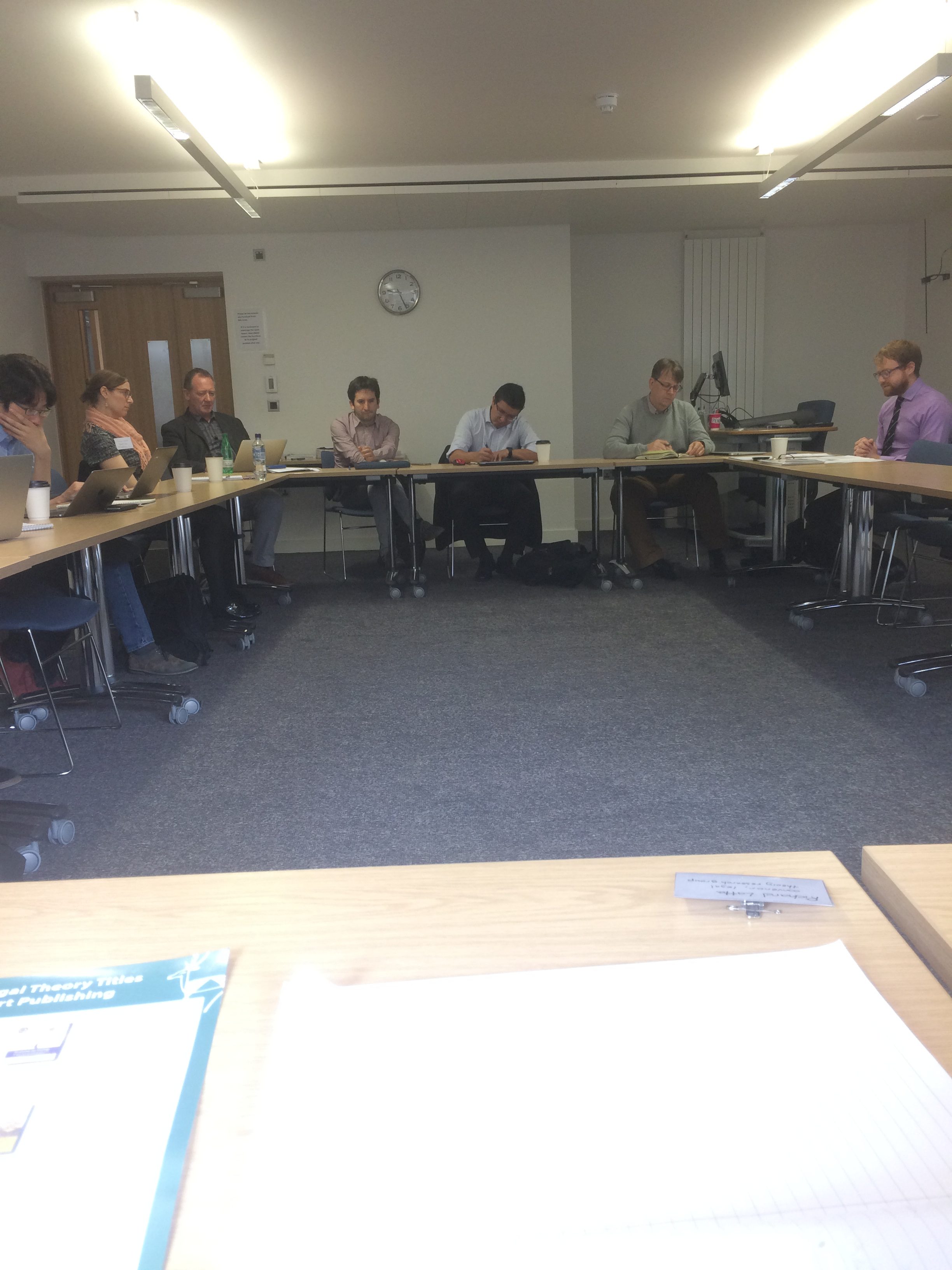
The workshop on ‘Virtue ethics, Markets, and the Law’—held on Tuesday 5thJune, the second day of the week-long Edinburgh Legal Theory Festival (4th-8thJune)—was devoted, as its name suggests, to explore the implications of a virtue-centred approach to legal theory for a wide-ranging variety of related topics, including the relationships between power, virtue and the constitutional state (Dominic Burbidge), algorithmic governance (René Urueña), the Rule of law and the law of equity (Irit Samet), intent to contract and trust (Prince Saprai), and the future of virtue jurisprudence (Chapin Cimino). All sessions were followed by a lively discussion in which the participants had the opportunity to give and receive important feedback on their ongoing research projects.
In this blog, the organisers of this IIF-sponsored film series reflect on the three events and issues raised. The series took place which took place between January and April 2018 at The University of Edinburgh.
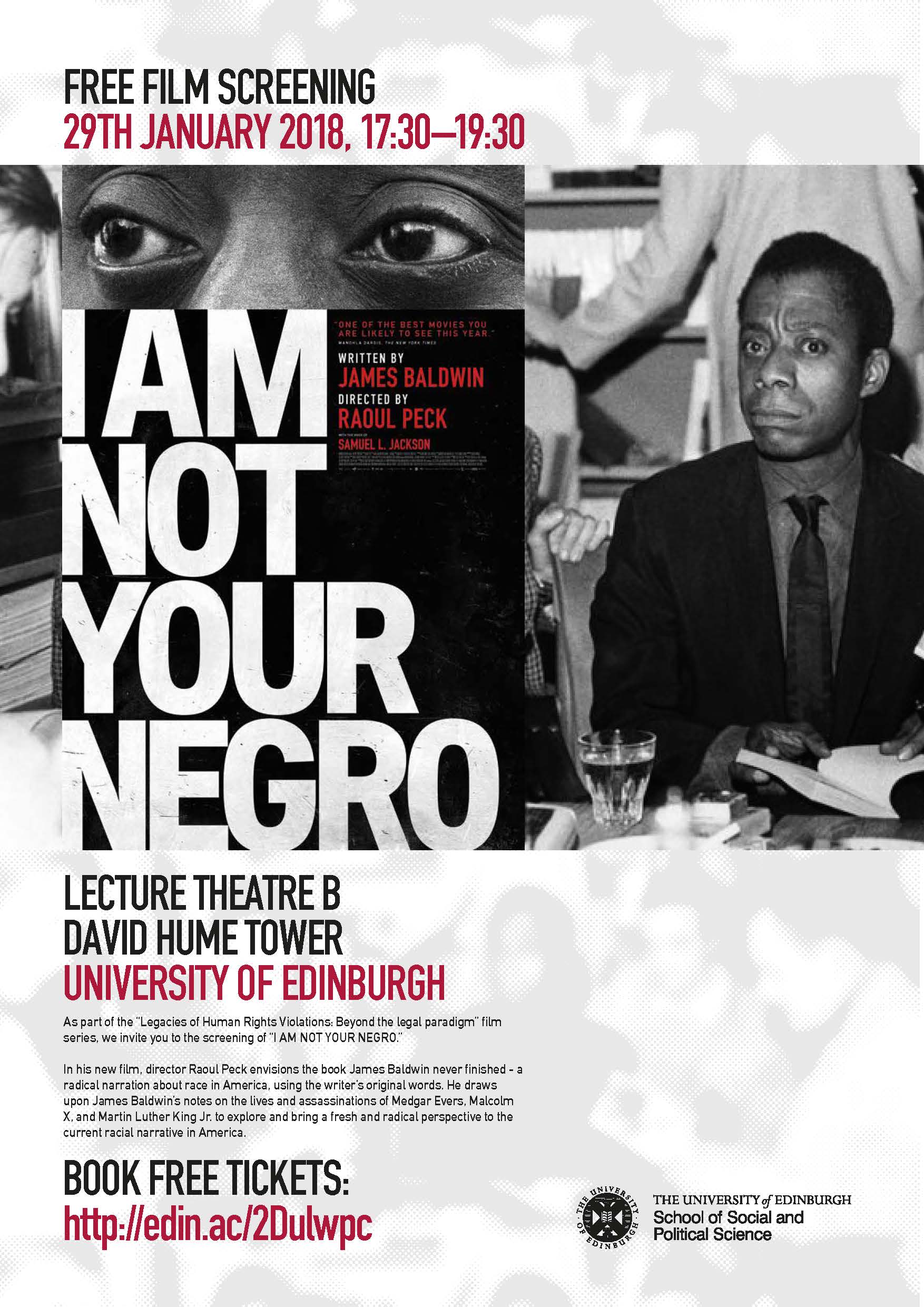
The film series ‘Legacies of Human Rights Violations’ addressed the contemporary legacies of human rights violations from an artistic, cinematic perspective. The series involved showing four films: I Am Not Your Negro, My Beautiful Laundrette, REwind: A Cantata for Voice, Tape and Testimony, and Kamchatka. The selected films tackled issues as diverse as racial oppression, gender norms and agency and institutionalised state violence. Specifically, the films focused the experiential reality of human rights issues that stands beyond the grasp of the legalist perspective and its disembodied standards of right and wrong. Indeed, our purpose was to shed light on how the structural, deeply entrenched practices of oppression and discrimination affect people’s everyday lives, intimate domestic spheres and interpersonal relationships, while also unearthing the everyday, relational forms of dissent, solidarity and resistance that arise in response. The film screenings ensued in a fruitful dialogue across the fields of political theory, anthropology, law, film and music studies. They were well attended and engaged students, staff and the broader public in a discussion on the ethical potentials and limitations of cinema as a mode of creative learning and democratic education.
The first film, I Am Not Your Negro, perhaps most explicitly exposed the limits of the Western liberal understanding of democracy and the supposed neutrality of its legal institutions, as revealed by the structural nature of racial oppression. In the film, the director Raoul Peck tells the story of James Baldwin, an American novelist and social critic, based on his unfinished manuscript Remember This House. At the forefront stands Baldwin’s conversations and friendships with prominent figures of the American civil rights movement, such as Medgar Evers, Malcom X and Martin Luther King Jr, bringing forth an emotional insight into the struggles for racial equality in the US.
In this guest post, Coline Constantin reflects on the recent seminar that tackled issues around incarceration in Scotland. Coline is reading for an LLM in Human Rights at Edinburgh Law School, and applied for funding for this event from the Global Justice and Global Development Academies’ Innovative Initiative Fund.
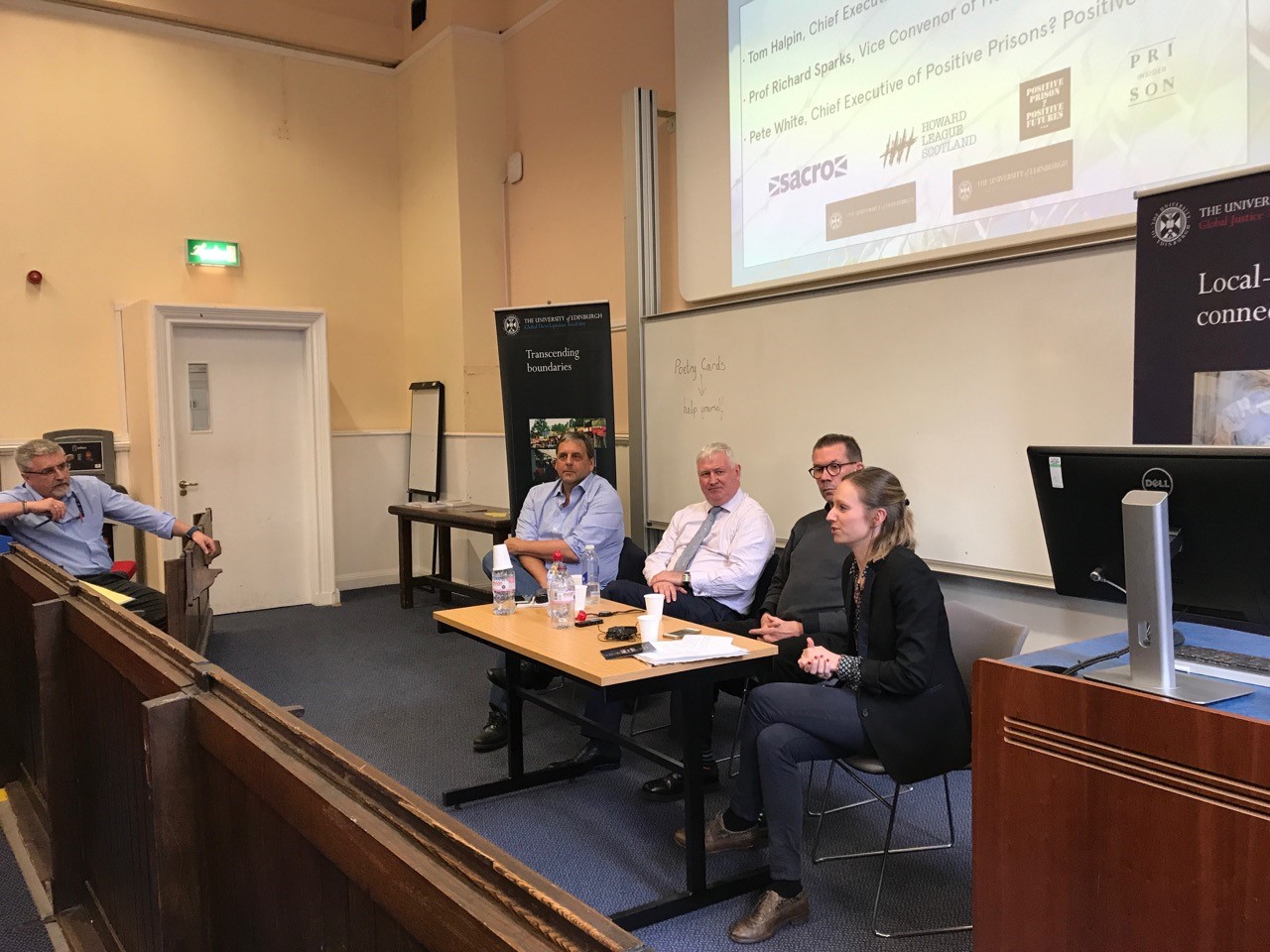
Scotland has the second highest imprisonment rate in Europe. Although English headlines for issues of overcrowding, under staffing, rising rates of self-harming cases do not find an echo north of the border, the statistic still makes it worth taking a closer look at its system. On Thursday 26 April, an engaged audience gathered at the University of Edinburgh to hear more about the positive developments and challenges of the Scottish system of detention.
Three panellists from different fields of expertise and different view angles on the Scottish situation were invited to cover topics from policy-making, to the implementation and analysis of these policies. Professor Richard Sparks, Convenor of Howard League Scotland and criminologist specialised on the different systems of detention in the UK, took us through his analysis of the particularities of the Scottish case within the UK and European context. Tom Halpin, Chief Executive of Sacro and prominent figure in the reduction of inequalities in the Scottish criminal justice system, gave us a sense of the work that is being done with communities and specific groups of people with convictions to go towards better mentoring and guidance throughout the process. Pete White, Chief Executive of Positive Prisons? Positive Future and fascinating storyteller, treated the audience with a story of his personal experience from his time inside and the aftermath of this life-changing event.
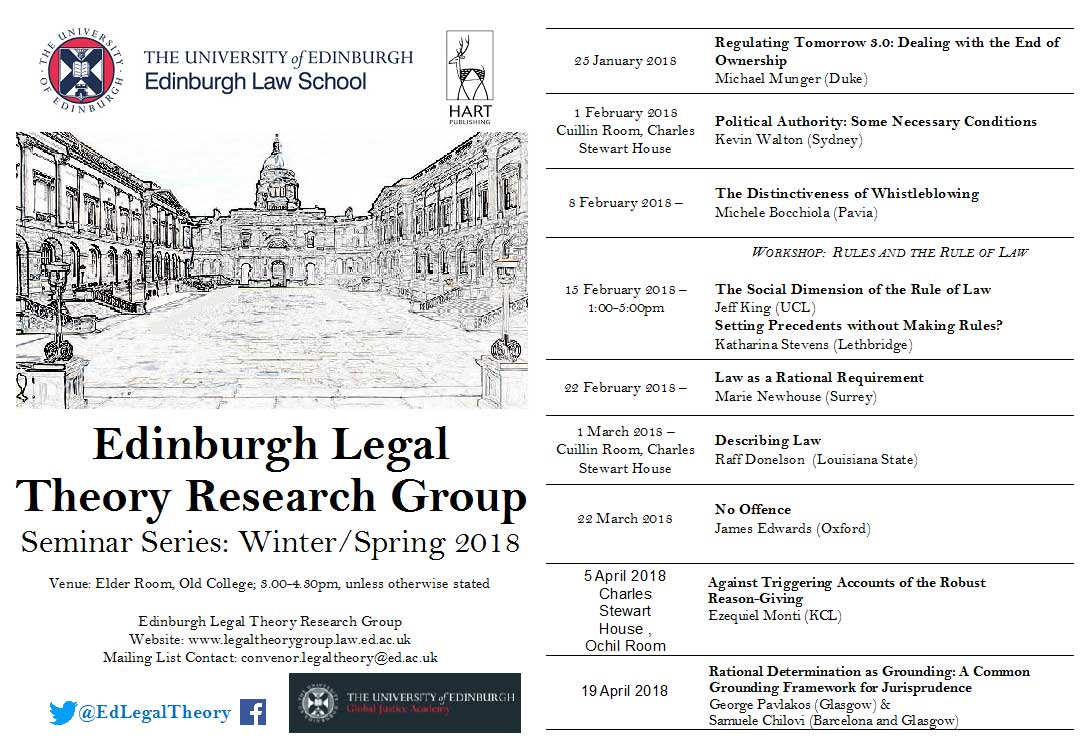
In this post, the Co-Convenors of the Edinburgh Legal Theory Research Group for 2017-18, Richard Latta and Joaquin Reyes, report on their recent Winter/Spring seminar series and the topics discussed.
The Edinburgh Legal Theory Research Group is very grateful for the support of the Global Justice Academy for the Edinburgh Legal Theory Research Group’s Seminar Series of Spring 2018. This semester we hosted speakers from all over the world to discuss issues in legal theory and beyond legal theory.
The Liberating Comparisons network emerged out of a workshop by the same name in Edinburgh on 8 December 2017. The workshop drew together scholars from across the UK to explore the potential of comparative methods.
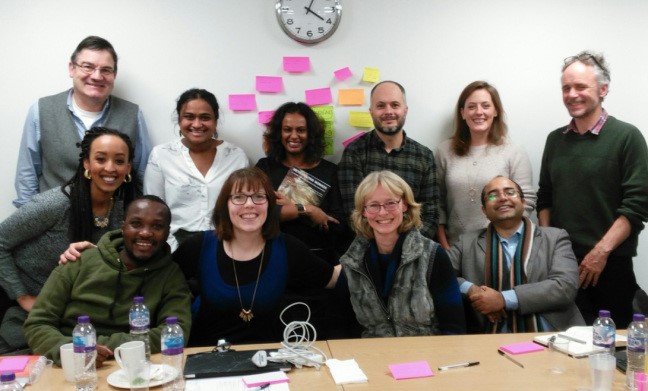
From back left: Jonathan Spencer, Sneha Krishnan, Kesi Mahendran, Juliano Spyer, Sarah Linn, Ian Harper, Mikal Woldu, Patrick Mutahi, Simone Lamont-Black, Indrajit Roy
The workshop started from the premise that comparative methods had the potential to reify or disrupt the way we see the world and our place within it. Our workshop drew together scholars who were interested in the latter: the transformative insights that comparative methods could bring to the complex and important issues of our day.
The Global Justice Academy recently sponsored the Edinburgh Legal Theory Group Past Convenors’ Colloquium in collaboration with the Edinburgh Legal Theory Research Group. In this blog post, Paul Burgess – a third year PhD candidate in the Edinburgh Law School and Co-Convenor of the Edinburgh Legal Theory Research Group – reports on the issues raised.
The Colloquium was well attended by staff and students from across The University of Edinburgh. This included several new PhD candidates who had only arrived in the university for the first time that week. Some participants and presenters had travelled from other parts of the world.
The Edinburgh Institute for Advanced Studies in the Humanities (IASH) recently hosted a workshop on “Thomas Hobbes and Peace”. The event brought together political theorists,…
Dr Callum McGregor (Lecturer in Education, University of Edinburgh) reports and reflects on a recent Edinburgh lecture on digital citizenship and digital education, funded by the…
Dr. Leila Sinclair-Bright is a Career Development Fellow in Social Anthropology at the University of Edinburgh. In this article, she reflects on the notion of ‘the…
 Between 13-15 October 2018, the Global Justice Academy co-hosted a weekend of events joining Relief & Reconciliation for Syria with peacebuilding communities in Scotland. This post from Dr George R. Wilkes, reflects on the series of events that took place.