The Global Justice Academy recently attended an event at the Academy of Sport with visiting professor, Professor Lucia Trimbur (City University of New York; John…
Comments closedCategory: Inequalities
Dr Dimitrios Kagiaros (Edinburgh Law School) reports on a recent workshop, ‘Specifying and Securing a Social Minimum’, held at the International Institute for the Sociology…
Comments closedDr Callum McGregor (Lecturer in Education, University of Edinburgh) reports and reflects on a recent Edinburgh lecture on digital citizenship and digital education, funded by the…
Comments closedThis blog post was written by Heather Milligan, Communications Intern for the Global Justice Academy. The blog reports on a recent seminar event hosted by the…
Comments closedDr. Leila Sinclair-Bright is a Career Development Fellow in Social Anthropology at the University of Edinburgh. In this article, she reflects on the notion of ‘the…
Comments closedMahlea Babjak is reading for a PhD in Religious Studies and is researching human trafficking in South Asia. She is a Global Justice Academy Student…
Comments closedSean Molloy is a Principal’s Scholar in Law, reading for a PhD at Edinburgh Law School. Sean researches the relationship between business and human rights, and contributes to the LLM in Human Rights as a guest lecturer. In this post, he considers what a Trump presidency might mean for human rights and how this applies to businesses in the USA.
As the world comes to terms with the shock election of Donald Trump, our thoughts quickly turn to the implications of the choice of the American people (or more precisely the electoral colleges). From issues such as US foreign policy in Syria to US relations with Russia, the rights of Muslims and Mexicans, to abortion and the rights of women, both America and the world are left in a state of unease and uncertainty as to what the next four (or possibly even eight) years hold. As the dust settles, further potential consequences on other thus far unmentioned rights-related issues become the topics of thought. One such issue is that of Business and Human Rights (BHR) and in particular what Trump’s election might mean for the protection of rights in respect of the actions of businesses both in America and in regards to American companies operating abroad (see generally Business and Human Rights Resource Centre).
Comments closedThis post was first published on the author’s Remotely Balkan blog, and is re-blogged here with permission.
This post is by Laura Wise. Laura is an Analyst on the Global Justice Academy’s Political Settlements Research Programme. Her research interests include minority mobilisation, state-society relations, and conflict management in South-Eastern Europe.
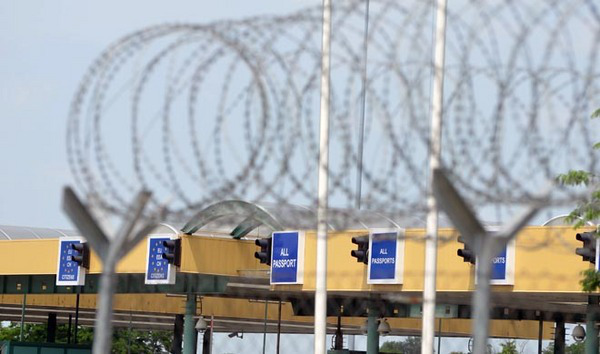
Képen: Szögesdrót a röszkei határátkelőnél.
fotó: Segesvári Csaba
The Balkan Express is no more.
Replaced by luxury international coaches from Vienna to Sarajevo, with on-board toilets that work, Wi-Fi, and conductors who serve drinks, gone are the potholed, unreliable minibus journeys that make classic travellers’ tales for the Western backpacker. Last month I made a fleeting visit back to the Balkans; the kind of trip where you spend hours on the aforementioned buses just to meet friends for coffee. It was also a chance to reunite with rakia, and revisit bars where the pop-folk of Dado Polumenta is an acceptable choice of music. However, most of my conversations and experiences kept returning to a more sobering topic: Europe.
Comments closedThis was the question Professor David Miller from Oxford University addressed on 4 February 2016 in a well-attended lecture hosted by Edinburgh University’s Global Justice Academy and Just World Institute.
In this blog report from the lecture, Yukinori Iwaki reflects on the day’s discussion and points raised. Yukinori Iwaki is a PhD student in Politics and International Relations at the University of Edinburgh. Click here to read more about his research.
 Professor Miller began his talk by noting the 2014 UK government decision not to support Triton, a search-and-rescue operation proposed by the EU that could have potentially saved the lives of sea-crossing migrants, or “boat people”. The main reasoning behind this decision was the claim that search-and-rescue encourages people to attempt dangerous sea crossings in the greater expectation of being rescued, and therefore, in the long term, will bring about more deaths. This seems to be a consequentialist argument that considers effects of alternative ways of using resources in order to minimise the loss of lives overall. Meanwhile, critics argue that European states have stringent obligations to protect rights of migrants. But is it true that the critics’ argument occupies the moral high ground while the UK government’s argument is morally defective? The answer Professor Miller gave us was: ‘Not necessarily’.
This guest post is by Sean Molloy, a Principal’s Career Development Scholar in Law at the University of Edinburgh. Sean completed his LLB Law at Queen’s University Belfast, continuing to read for an LLM in Human Rights Law and Transitional Justice at the Transitional Justice Institute. Following a period working as a research assistant for a human rights solicitor, Sean began his PhD research at Edinburgh in September 2013. He edits the monthly Global Justice Academy Newsletter, and is a founding member of the Global Justice Society.
Freedom of Conscience in Northern Ireland
 In December 2014 DUP MLA Paul Girvan introduced a Freedom of Conscience Bill aimed at allowing businesses to refuse services to a customer if they feel it is against their religious convictions. The Bill arose following the announcement of the Northern Ireland Equality Commission that they would be issuing legal proceedings against Ashers Baking Company for their refusal to accept an order for a cake with a pro-gay marriage slogan.
Comments closed
