
Photo credit: Priscilla Du Preez This blog forms part of a series celebrating the 75th anniversary of the Universal Declaration of Human Rights…
Comments closedCategory: Inequalities
This blog forms part of a series celebrating the 75th anniversary of the Universal Declaration of Human Rights (UDHR). Recognising the numerous conflicts and the…
Comments closedThis is the second blog in a series written by LLM students on the Human (In)Security course at Edinburgh Law School. The series celebrates the…
Comments closedThis is the first blog in a series written by LLM students on the Human (In)Security course at Edinburgh Law School. This series celebrates the…
Comments closedThe global events occurring in the spring and summer of 2020 have ushered issues of racial discrimination and inequity into the foreground of social discourse.…
Comments closedThis blog, by Valentina Rioseco Vallejos, concerns the current Chilean crisis. It aims to provide the context under which the crisis is occurring, while making…
Comments closed
In this guest post, Law PhD Candidate, Vivek Bhatt, reflects on Bryan Stevenson’s visit to Edinburgh Law School to give the 2019 Ruth Adler Memorial Lecture, and to receive an honorary doctorate as part of the School’s summer graduation ceremony.
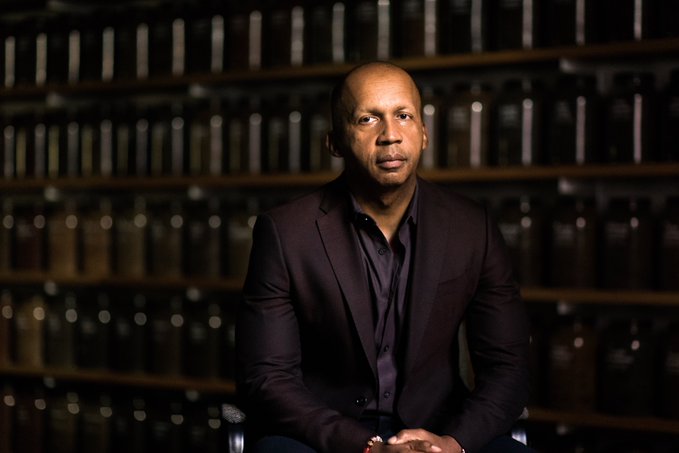
On 8 July 2019, the Global Justice Academy hosted a lecture by Bryan Stevenson, recipient of an honorary doctorate at the Edinburgh Law School. Stevenson is founder of the Equal Justice Institute (EJI) in Montgomery, Alabama, and a clinical professor at the NYU School of Law. Stevenson works as a legal representative for disadvantaged and marginalised individuals, particularly young and poor people who are on death row or serving life sentences. He and his colleagues at the EJI have achieved the exoneration or release of over 125 individuals on death row. Stevenson is also the author of Just Mercy: A Story of Justice and Redemption,[1] which was a New York Times bestseller and won the Carnegie Medal for the best nonfiction book of 2014.
Stevenson’s lecture circulated around a question that is as succinct as it is complex: how do we, as human rights advocates, address injustice? Firstly, he said, we must create justice by becoming proximate to those suffering inequality and injustice. Recounting his relationship with his grandmother, who wished that Stevenson would always be able to feel her embracing him, the skilful orator argued that we must know and seek to understand those who suffer injustice in order to affirm their humanity and dignity. Thus, human rights practice is not about the deployment of legal arguments from afar, but rather about stepping away from one’s legal expertise and embracing those who suffer violations of dignity.
Comments closedThis post continues the blog series by Dr Kasey McCall-Smith which examines some of the contentious legal issues raised in the US v. Khalid Shaikh…
Comments closedIn April 2018, the GJA sponsored its first ‘Spring School’ in a collaboration with Moray House School of Education. In this post, Spring School Co-organiser and GJA Management Group member, Dr Callum McGregor, reflects on the Spring School’s innovative community-university partnership, which fostered strong links with local organisations and social justice practitioners. It is hoped that a similar Spring School will run again next year. Callum is also the programme director for the online MSc in Social Justice and Community Action, which is sponsored by the Global Justice Academy.

The Global Justice Academy (GJA) is an institutional forum for dialogue with practitioners engaged in justice issues locally and globally. This short blog highlights one such example of local dialogue, in the form of a series of community-university workshops on Critical Discourse Analysis (CDA). CDA is a form of critical social research, whose purpose is to analyse the ways in which language can be used to both reproduce and challenge social injustice. Discourses can be thought of as representationsof various aspects of our social lives. These representations are made up sets of rules and statements that determine whatcan be expressed within a particular context, howit can be expressed, by whom and under what conditions. Discourses are important because they have real material effects on the distribution of burdens and benefits along different axes of inequality.
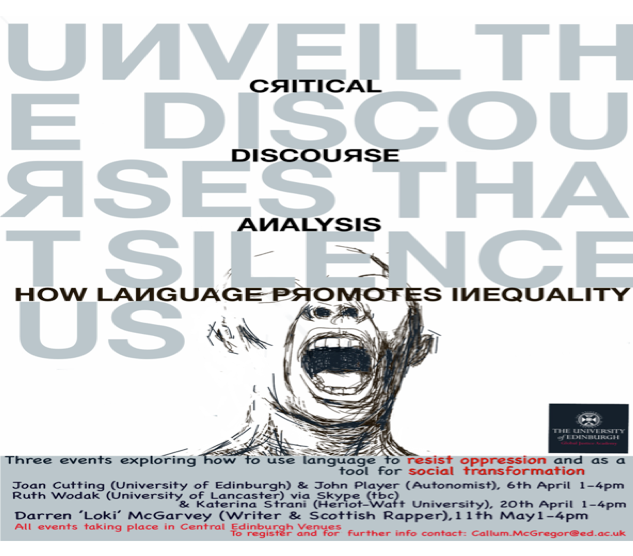
Between April and May 2018, three workshops were held, with the purpose of bringing together community practitioners, community-based adult learners, activists, students and academics to learn together about CDA. Specifically, the workshops focused on how CDA can be used creatively to link education to social action, through addressing the interests and struggles of ordinary people in communities.
Comments closed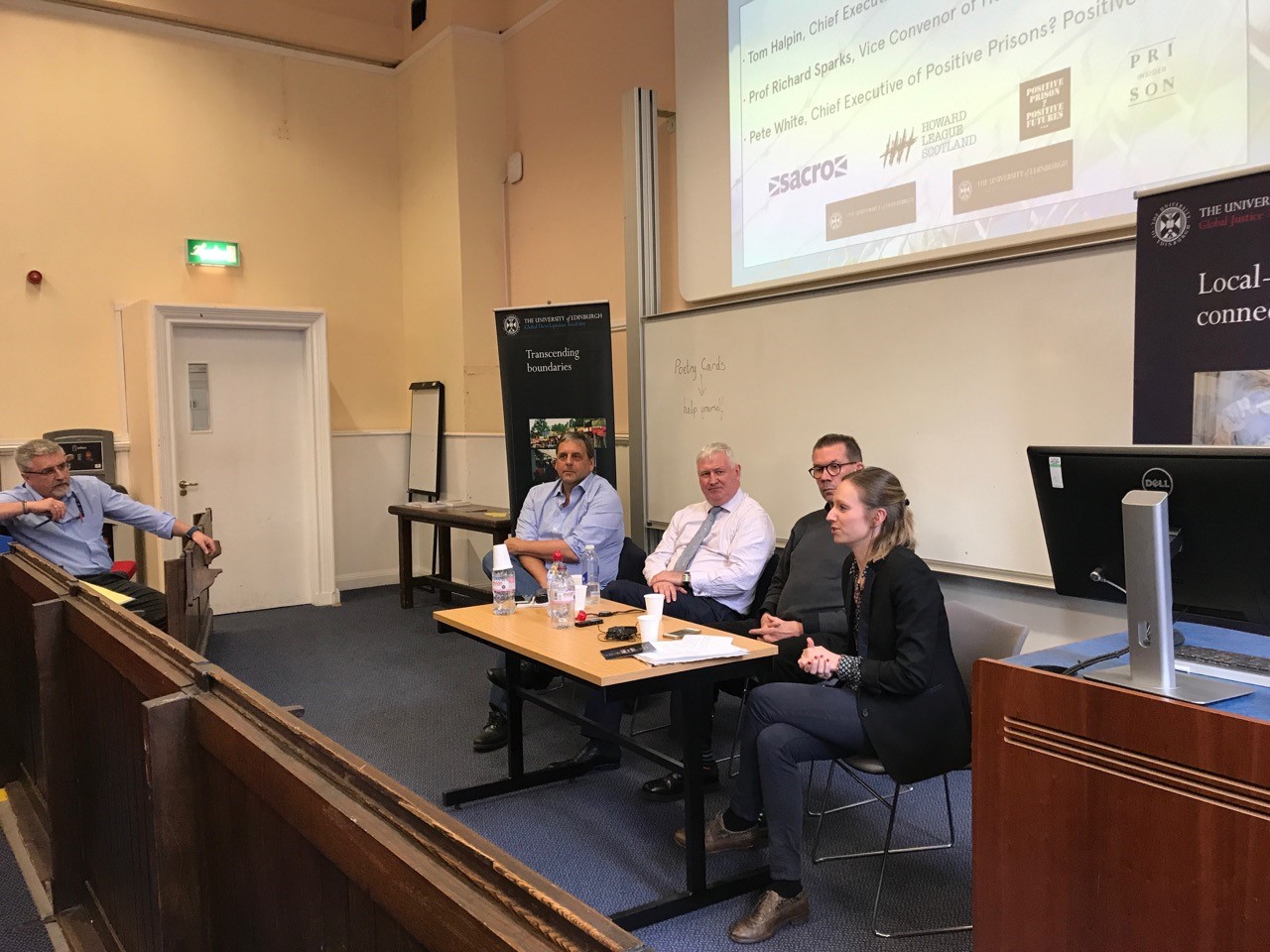 In this guest post, Coline Constantin reflects on the recent seminar that tackled issues around incarceration in Scotland. Coline is reading for an LLM in Human Rights at Edinburgh Law School, and applied for funding for this event from the Global Justice and Global Development Academies’ Innovative Initiative Fund.
Scotland has the second highest imprisonment rate in Europe. Although English headlines for issues of overcrowding, under staffing, rising rates of self-harming cases do not find an echo north of the border, the statistic still makes it worth taking a closer look at its system. On Thursday 26 April, an engaged audience gathered at the University of Edinburgh to hear more about the positive developments and challenges of the Scottish system of detention.
Three panellists from different fields of expertise and different view angles on the Scottish situation were invited to cover topics from policy-making, to the implementation and analysis of these policies. Professor Richard Sparks, Convenor of Howard League Scotland and criminologist specialised on the different systems of detention in the UK, took us through his analysis of the particularities of the Scottish case within the UK and European context. Tom Halpin, Chief Executive of Sacro and prominent figure in the reduction of inequalities in the Scottish criminal justice system, gave us a sense of the work that is being done with communities and specific groups of people with convictions to go towards better mentoring and guidance throughout the process. Pete White, Chief Executive of Positive Prisons? Positive Future and fascinating storyteller, treated the audience with a story of his personal experience from his time inside and the aftermath of this life-changing event.
Comments closed