Any views expressed within media held on this service are those of the contributors, should not be taken as approved or endorsed by the University, and do not necessarily reflect the views of the University in respect of any particular issue.
Can the UK’s Human Rights Act be repealed? What would the process need? Is it even possible? What are the legal implications?
Christine Bell, Professor of Constitutional Law at Edinburgh Law School, Assistant Principal Global Justice and Director of the Global Justice Academy, offers this review of the current debate on repealing the Human Rights Act, and points readers to other available resources.
In the past few days repeal of the Human Rights Act, and in particular its devolution implications have attracted a lot of attention. Today, a new report is launched from a legal expert seminar in April 2015, on the legal implications of repeal of the human rights act (see below). The report provides the full chapter and verse, but here are a few quick points on the devolution implications, with further more detailed and reasoned resources below.
This is a guest post by Sean Molloy, who is a Principal’s Development Scholar at the University of Edinburgh, where he is completing his PhD at the School of Law. Sean edits the Global Justice Academy newsletter, which you can subscribe to by clicking here.
In March of this year I attended a roundtable at Chatham House on the issue of business and human rights. Comprised of state officials, civil society organisations, academics, and corporate representatives, the focus of the event was on the extent to which (or not) a consensus is beginning to form on how to operationalise and implement the UNGP. In this post I wish to convey some of the discussions of that meeting in attempting to articulate the current position, the obstacles remaining and potential solutions going forward. Firstly, a little background is required.
On 26-27 February 2015, the Post-Conflict Research Center from Sarajevo, Bosnia and Herzegovina, visited the University of Edinburgh to present its award-winning “Ordinary Heroes” project. “Ordinary Heroes” won first place in the 2014 UN Alliance of Civilizations and BMW Group Intercultural Innovation Award in a ceremony hosted by UN Secretary General Ban Ki-moon in Bali, Indonesia. The Global Justice Academy at the University of Edinburgh sponsored PCRC’s travel to Edinburgh.
Mina Jahić is a widowed octogenarian from Rogatica, in eastern Bosnia and Herzegovina, whose husband and two sons lost their lives in the wars that followed the violent dissolution of Yugoslavia in the early 1990s. She lives by herself in an upper floor of a prefabricated apartment block not far from the capital Sarajevo. A devout Muslim, Mina’s hope for the future of her country lies in the youth, who she believes still have the power to change the ethnocratic system that has blocked any attempts for reconciliation and reform since the end of the war in 1995. What Mina’s wartime experiences separate her from her neighbours, however, are the risks she took to save a stranger escaping his execution. Mina is an ordinary hero.
Ferid Spahić, a gas station attendant in Ilijaš, a small town to the northwest of Sarajevo, was in his mid-twenties when the first shots were fired in Bosnia by Serb paramilitary forces bent on “cleansing the land” for a “Greater Serbia” under the guise of preserving Communist Yugoslavia from dissolution. A Bosniak Muslim, too, he and his neighbours were targets of ethnonationalist destruction that quickly engulfed Bosnia’s three main ethnic groups – Serbs, Croats and Bosniaks. One day in June 1992, a Serb man from his village, whom he had seen as a trusted neighbour, rounded the local Bosniak men into buses, telling them as they were separated from their wives and children that they would be transferred to Skopje, Macedonia, and later reunited with their families.
This guest post is by Sean Molloy,a Principal’s Career Development Scholar in Law at the University of Edinburgh. Sean completed his LLB Law at Queen’s University Belfast, continuing to read for an LLM in Human Rights Law and Transitional Justice at the Transitional Justice Institute. Following a period working as a research assistant for a human rights solicitor, Sean began his PhD research at Edinburgh in September 2013. He edits the monthly Global Justice Academy Newsletter, and is a founding member of the Global Justice Society.
Freedom of Conscience in Northern Ireland
In December 2014 DUP MLA Paul Girvan introduced a Freedom of Conscience Bill aimed at allowing businesses to refuse services to a customer if they feel it is against their religious convictions. The Bill arose following the announcement of the Northern Ireland Equality Commission that they would be issuing legal proceedings against Ashers Baking Company for their refusal to accept an order for a cake with a pro-gay marriage slogan.
Professor Toby Kelly is Head of Social Anthropology at the University of Edinburgh and Deputy Director of the Global Justice Academy.
Northern Ireland MLA, Paul Givan has proposed a Freedom of Conscience Bill. Invoking a three hundred year tradition of freedom of conscience and the Universal Declaration of Human Rights, Givan calls for greater toleration of different beliefs. Yet, Amnesty International has said the bill was ‘not welcome and is not needed at all’. Indeed, it went so far as to say ‘what is proposed is not a conscience clause, it is a discrimination clause’. At first glance this appears a little surprising, given that Amnesty first came to public prominence as an organization that campaigned explicitly for freedom of conscience, and Prisoners of Conscience still play a significant part in Amnesty’s activities.
The University of Edinburgh’s Annual Gifford Lecture Series has now begun. Professor Jeremy Waldron is University Professor at the New York University Law School. Professor Waldron’s work in jurisprudence and political theory is well known, as are his articles on constitutionalism, democracy, homelessness, judicial review, minority cultural rights, property, the rule of law, hate speech, human dignity, and torture. This post appeared originally on the Gifford Lecture Blog.
In a stimulating opening Gifford Lecture tonight, Professor Jeremy Waldron emphasised the urgency of not only eradicating ‘surface inequality’ in public legal relations, but in carrying out a theological and philosophical examination of what may underpin human equality in a world where ‘grotesque differences in economic lives’ create the risk of ‘leech and leak’ to undermine our commitment to a common humanity. We re-assure ourselves that the ‘surface inequality’ between rich and poor is compatible with an inviolate ‘basic human equality’ which underlies our mutual existence. But is that weakening in our society, such that the view may emerge that ‘the poor are not fully human’ and ‘only the prosperous live fully human lives’? Is there a danger now that a ‘conditional’ legal status due to the vicissitudes of life, such as that of an African-American in jail, becomes re-inforced as a ‘sortal’ status of permanent identity to delineate rights and all human potential, in like kind to the evils of slavery or apartheid in the past?
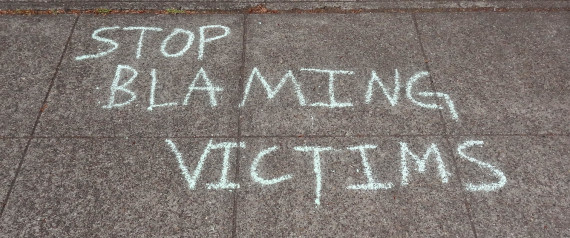
Dr Michelle Brock is an Assistant Professor of History at Washington and Lee University, specialising in British History. In this guest post, Mikki examines the culture of ‘victim blaming’ that has been reinvigorated in the United States over the past six months, from the perspective of an early-modernist who researches belief and the Devil.
From the decisions not to indict the officers who killed Michael Brown and Eric Garner to the disturbing Rolling Stone article on a brutal gang rape at UVA, this country has produced a harrowing month of news. The reaction of much of the American public to these stories has been as distressing as their content. Many have turned not to self-searching or activism, but to stereotype and judgement. They rush to point out that Brown and Garner had, after all, committed crimes, drawing on centuries-old racial tropes to point out their size or comment that they were acting like “thugs” with “bad attitudes.” When they hear about the epidemic of sexual assaults on college campuses across the country, they question the victim’s dress, behaviour, and alcohol consumption, wondering if not explicitly saying that she might have been “asking for it.” In short, we are a country that blames the victims.
This post by Dr Harriet Cornell, Development Officer for the Global Justice Academy, examines the relationship between mental illness and justice in light of the planned execution of Scott Panetti in Texas on Wednesday, 3 December 2014.
A Public Policy Polling national survey was published yesterday, 1 December 2014, showing that Americans oppose the death penalty for mentally ill defendants by a 2-1 margin. The Death Penalty Information Center reported that ‘opposition to the execution of people with mental illness was strong across lines of race, gender, geographic region, political affiliation, and education. Democrats (62%), Republicans (59%) and Independents (51%) all opposed the practice’. Tomorrow, 3 December 2014, the state of Texas plans to execute Scott Louis Panetti for the 1992 murders of his parents-in-law, Joe and Amanda Alvarado. With a long, documented history of severe mental illness, Scott Panetti’s case has garnered international news coverage and a notable spectrum of support for clemency.
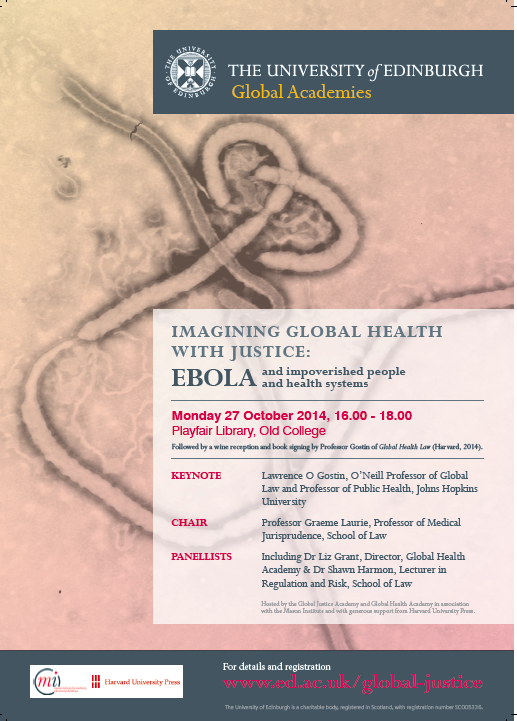
The University of Edinburgh’s Global Academies have announced their Autumn 2014 Ebola Series in response to the current global crisis. In this short post, Dr Harriet Cornell from the Global Justice Academy reflects on how the global response to Ebola has unfolded in the press, and criticisms that have been voiced by experts in the field.
This guest post is by Nicaylen Rayasa. Nicaylen is studying for a Bachelor’s degree in Meteorology and Environmental Studies at Ohio University. Along with fellow GJA-blogger, Janice Brewer, Nicaylen took the ‘Place-Making and Making-Places’ summer school module at the University of Edinburgh during July 2014 – you can read more about the group and their investigations of Global Justice here. In this post, Nicaylen considered the rise of Islamic State and how this intersects with climate change.
This past winter in the Fertile Crescent was particularly harsh for farmers, in what is usually the wettest part of the year. It ended up to be the hottest and driest winter on record.
While prolonged droughts and record heat have been commonplace for many parts of the world, the Iraq-Syria region brings an interesting political dynamic to the climate regime.The region’s climate is based historically on dry summers and rainy winters. However, climate change and the uptick in temperatures has transformed land use and increased desertification during extended droughts. Extreme versions of hot, dry summers have been more prevalent.
The Iraq-Syria conflict in the Middle East has been a growing regional issue for years now. ISIS (Islamic State of Iraq and Syria), the Sunni Jihadist organisation responsible for the newfound violence in the region, arose earlier this year. Their emergence coincidently occurred during the hottest March-May period on record in Iraq.
 In December 2014 DUP MLA Paul Girvan introduced a Freedom of Conscience Bill aimed at allowing businesses to refuse services to a customer if they feel it is against their religious convictions. The Bill arose following the announcement of the Northern Ireland Equality Commission that they would be issuing legal proceedings against Ashers Baking Company for their refusal to accept an order for a cake with a pro-gay marriage slogan.