On 23 January, the Global Justice Academy hosted Dr Johanna Hoekstra (Edinburgh Law School) and Dr Luis F Yanes (Guest Lecturer at Edinburgh Law School)…
Leave a CommentCategory: Health
This is the fourth blog in a series written by LLM students on the Human (In)Security course at Edinburgh Law School. This series celebrates…
Comments closedThis is the first blog in a series written by LLM students on the Human (In)Security course at Edinburgh Law School. This series celebrates the…
Comments closedThis post continues the blog series by Dr Kasey McCall-Smith which examines some of the contentious legal issues raised in the US v. Khalid Shaikh…
Comments closedThis post first appeared on the Centre for Criminal Justice and Human Rights blog from the Faculty of Law at University College Cork.
Dr Catherine O’Rourke is Senior Lecturer in Human Rights and International Law at Ulster University Transitional Justice Institute. She is currently also co-coordinator of the Gender Stream of the DFID-funded Political Settlements Research Programme, where she is investigating how international law norms for gender equality influence domestic power-brokering.
In the aftermath of last week’s High Court judgment declaring Northern Ireland’s prohibition of abortion to be incompatible with UK human rights legislation in specific instances, there has been much valuable consideration of the judgment’s legal and political implications, for this jurisdiction and others. In this contribution, I reflect on what the litigation and judgment say about human rights advocacy in Northern Ireland.
Comments closed
This post first appeared on the European Futures Blog.
In this extended article, Jane Rooney analyses the recent Northern Ireland High Court decision that current abortion law is not compatible with the European Convention on Human Rights. She suggests that the judgement could have gone further in testing the compatibility of the legislation with the ECHR, and that possible appeals are unlikely to take the politics of Northern Ireland as closely into account.
On 30 November 2015 in the case of The Northern Ireland Human Rights Commission’s Application [2015] NIQB 96, the High Court of Northern Ireland found that Northern Irish law regulating abortion was incompatible with Article 8 (right to private life) of the European Convention on Human Rights (ECHR). This was an historical judgement made possible through the conjoined efforts of many, including women directly affected by the legislation, the Northern Ireland Human Rights Commission and Amnesty International.
Comments closed
 Dr Michelle Brock is an Assistant Professor of History at Washington and Lee University, specialising in British History. In this second guest post for the Global Justice Academy, Mikki tackles the current controversy in the US around abortion and the politicisation and policing of women’s bodies – drawing striking parallels with early modern Europe.
In the United States, the last decade has witnessed a growing cacophony of calls from pro-life advocates seeking to overturn Roe v. Wade, the Supreme Court’s 1973 decision to legalise a woman’s right to an abortion. Every single current Republican candidate for president, fourteen men and one woman, has declared his or her opposition to abortion in most or all cases.
Comments closed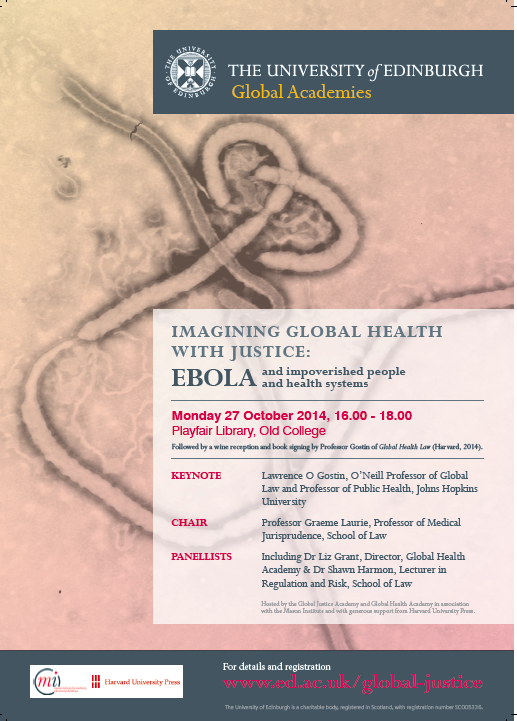
The University of Edinburgh’s Global Academies have announced their Autumn 2014 Ebola Series in response to the current global crisis. In this short post, Dr Harriet Cornell from the Global Justice Academy reflects on how the global response to Ebola has unfolded in the press, and criticisms that have been voiced by experts in the field.
This evening’s Ebola headlines are divided between pleas for world help from Liberia’s President, Ellen Johnson Sirleaf, and blame for the spread and devastation of the outbreak been laid squarely at the doors of the world’s supranational bodies: the World Health Organisation, and the United Nations. Then there is the intersect between the outbreak of the disease in West Africa, and the western media response, with The Guardian running a comment piece entitled ‘The problem with the west’s Ebola response is still fear of a black patient’.
Comments closed