On 23 and 24 February 2022, the Global Justice Academy, together with the Strathclyde Centre for the Study of Human Rights Law and Newcastle Forum…
Comments closedCategory: Engagement
In April 2018, the GJA sponsored its first ‘Spring School’ in a collaboration with Moray House School of Education. In this post, Spring School Co-organiser and GJA Management Group member, Dr Callum McGregor, reflects on the Spring School’s innovative community-university partnership, which fostered strong links with local organisations and social justice practitioners. It is hoped that a similar Spring School will run again next year. Callum is also the programme director for the online MSc in Social Justice and Community Action, which is sponsored by the Global Justice Academy.
The Global Justice Academy (GJA) is an institutional forum for dialogue with practitioners engaged in justice issues locally and globally. This short blog highlights one such example of local dialogue, in the form of a series of community-university workshops on Critical Discourse Analysis (CDA). CDA is a form of critical social research, whose purpose is to analyse the ways in which language can be used to both reproduce and challenge social injustice. Discourses can be thought of as representationsof various aspects of our social lives. These representations are made up sets of rules and statements that determine whatcan be expressed within a particular context, howit can be expressed, by whom and under what conditions. Discourses are important because they have real material effects on the distribution of burdens and benefits along different axes of inequality.
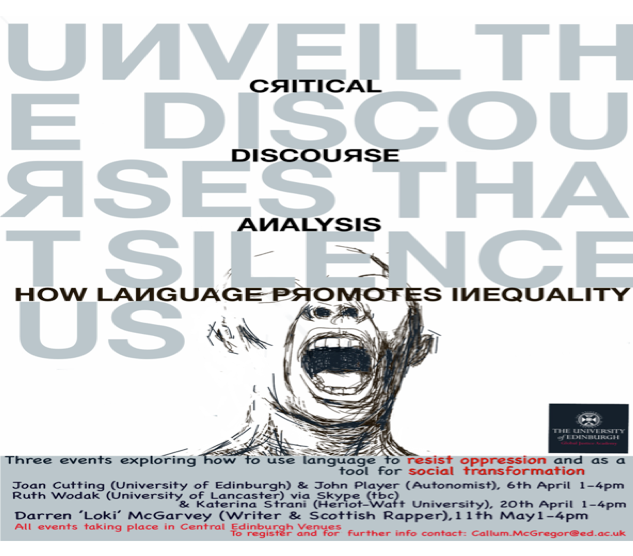
Between April and May 2018, three workshops were held, with the purpose of bringing together community practitioners, community-based adult learners, activists, students and academics to learn together about CDA. Specifically, the workshops focused on how CDA can be used creatively to link education to social action, through addressing the interests and struggles of ordinary people in communities.
Comments closedThe Global Justice Academy recently attended an event at the Academy of Sport with visiting professor, Professor Lucia Trimbur (City University of New York; John…
Comments closedDr Callum McGregor (Lecturer in Education, University of Edinburgh) reports and reflects on a recent Edinburgh lecture on digital citizenship and digital education, funded by the…
Comments closedThe Global Justice Academy (GJA) and Political Settlements Research Programme (PSRP) recently hosted a free Peace Photography Masterclass at the University of Edinburgh. The workshop…
Comments closed This summer, the Global Justice Academy ran its first Summer School in conjunction with the School of Political Sciences, and the School of History, Classics and Archaeology. GJA Co-Director, Dr Mathias Thaler, reflects on the success of the three-day course, and plans to revise the Summer School for 2016. Dr Thaler also reports on initial forays into establishing a ‘Democracy Lab’ at the University of Edinburgh, following the launch of his new honours course on democratic theory.
- Summer School on Political Violence
From June 24 to 26, 2015, SPS organised a Summer School on political violence, in collaboration with the Global Justice Academy and HCA.
Comments closedOn 26-27 February 2015, the Post-Conflict Research Center from Sarajevo, Bosnia and Herzegovina, visited the University of Edinburgh to present its award-winning “Ordinary Heroes” project. “Ordinary Heroes” won first place in the 2014 UN Alliance of Civilizations and BMW Group Intercultural Innovation Award in a ceremony hosted by UN Secretary General Ban Ki-moon in Bali, Indonesia. The Global Justice Academy at the University of Edinburgh sponsored PCRC’s travel to Edinburgh.
Mina Jahić is a widowed octogenarian from Rogatica, in eastern Bosnia and Herzegovina, whose husband and two sons lost their lives in the wars that followed the violent dissolution of Yugoslavia in the early 1990s. She lives by herself in an upper floor of a prefabricated apartment block not far from the capital Sarajevo. A devout Muslim, Mina’s hope for the future of her country lies in the youth, who she believes still have the power to change the ethnocratic system that has blocked any attempts for reconciliation and reform since the end of the war in 1995. What Mina’s wartime experiences separate her from her neighbours, however, are the risks she took to save a stranger escaping his execution. Mina is an ordinary hero.
Ferid Spahić, a gas station attendant in Ilijaš, a small town to the northwest of Sarajevo, was in his mid-twenties when the first shots were fired in Bosnia by Serb paramilitary forces bent on “cleansing the land” for a “Greater Serbia” under the guise of preserving Communist Yugoslavia from dissolution. A Bosniak Muslim, too, he and his neighbours were targets of ethnonationalist destruction that quickly engulfed Bosnia’s three main ethnic groups – Serbs, Croats and Bosniaks. One day in June 1992, a Serb man from his village, whom he had seen as a trusted neighbour, rounded the local Bosniak men into buses, telling them as they were separated from their wives and children that they would be transferred to Skopje, Macedonia, and later reunited with their families.
Comments closed
A guest blog from Sarah Anderson of the Beltane Public Engagement Network.
JUSTICE AT THE FRINGE!
Members of the Global Justice Academy are invited to stage their very own Edinburgh Fringe show in 2014.
It’s only a few months since the big purple cow in Edinburgh’s Bristo Square was dismantled, but planning for the 2014 Edinburgh Fringe is already well underway. The Beltane Public Engagement Network is one of the groups intending to stage shows when the crowds descend next August. With luck, members of the Global Justice Academy will be among Beltane’s star performers!
Comments closed