
Photo credit: Priscilla Du Preez This blog forms part of a series celebrating the 75th anniversary of the Universal Declaration of Human Rights…
Comments closedCategory: education
In April 2018, the GJA sponsored its first ‘Spring School’ in a collaboration with Moray House School of Education. In this post, Spring School Co-organiser and GJA Management Group member, Dr Callum McGregor, reflects on the Spring School’s innovative community-university partnership, which fostered strong links with local organisations and social justice practitioners. It is hoped that a similar Spring School will run again next year. Callum is also the programme director for the online MSc in Social Justice and Community Action, which is sponsored by the Global Justice Academy.
The Global Justice Academy (GJA) is an institutional forum for dialogue with practitioners engaged in justice issues locally and globally. This short blog highlights one such example of local dialogue, in the form of a series of community-university workshops on Critical Discourse Analysis (CDA). CDA is a form of critical social research, whose purpose is to analyse the ways in which language can be used to both reproduce and challenge social injustice. Discourses can be thought of as representationsof various aspects of our social lives. These representations are made up sets of rules and statements that determine whatcan be expressed within a particular context, howit can be expressed, by whom and under what conditions. Discourses are important because they have real material effects on the distribution of burdens and benefits along different axes of inequality.
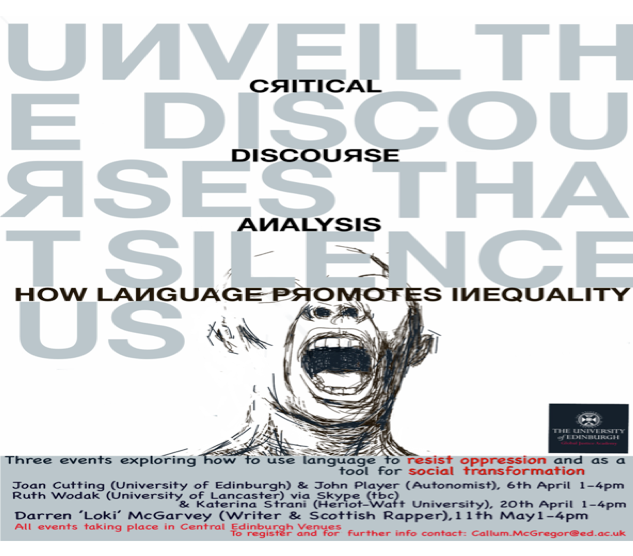
Between April and May 2018, three workshops were held, with the purpose of bringing together community practitioners, community-based adult learners, activists, students and academics to learn together about CDA. Specifically, the workshops focused on how CDA can be used creatively to link education to social action, through addressing the interests and struggles of ordinary people in communities.
Comments closedDr Dimitrios Kagiaros (Edinburgh Law School) reports on a recent workshop, ‘Specifying and Securing a Social Minimum’, held at the International Institute for the Sociology…
Comments closedDr Callum McGregor (Lecturer in Education, University of Edinburgh) reports and reflects on a recent Edinburgh lecture on digital citizenship and digital education, funded by the…
Comments closed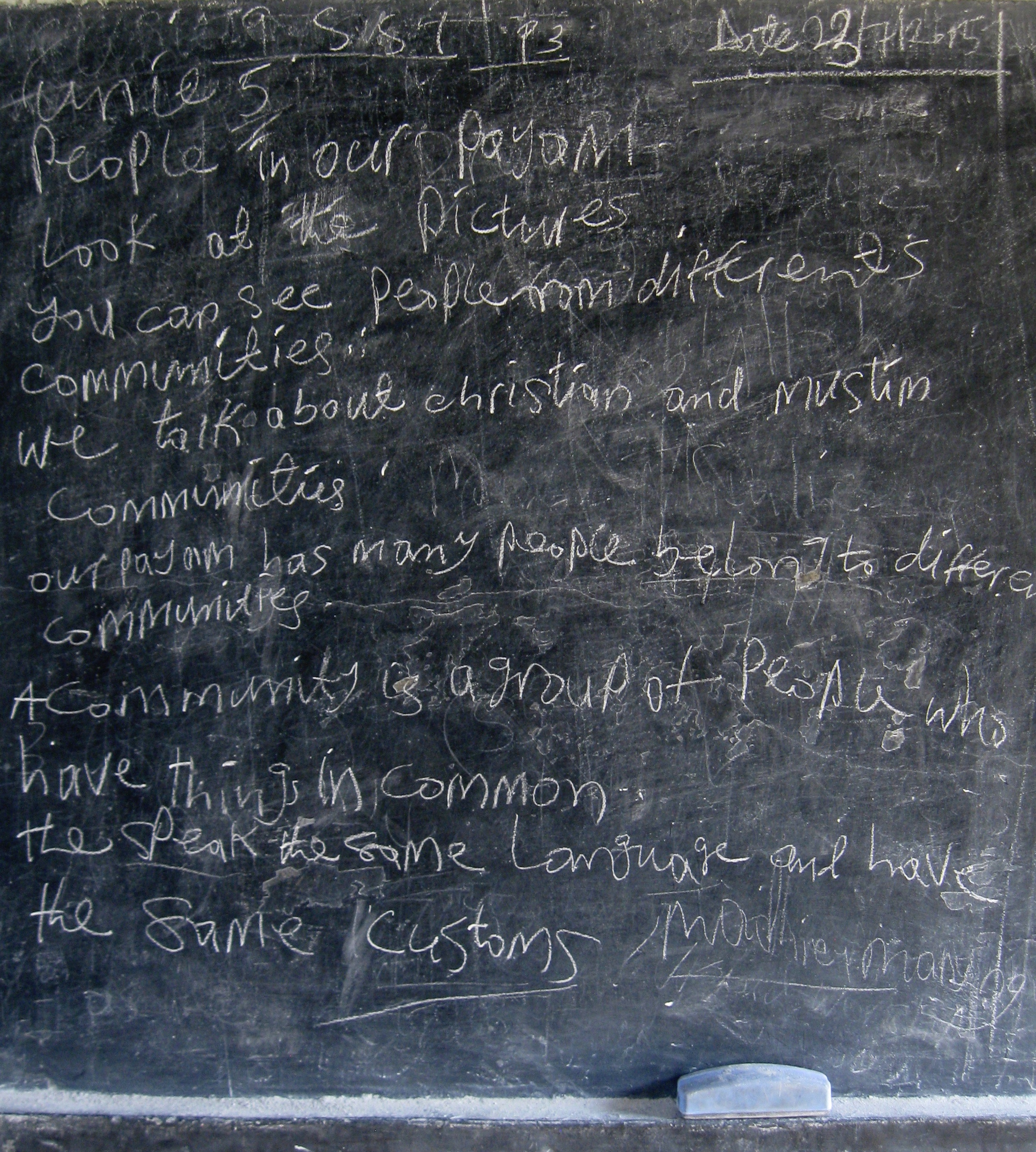 Sean Molloy is a Principal’s Scholar in Law at the University of Edinburgh, where he is completing his PhD. In this blog, Sean reflects on discussions about Peacebuilding and Education in South Sudan held during the Inclusive Political Settlements Summer School. He goes on to discuss the relationship between human rights and education in post-conflict settings from a critical perspective.
I had the pleasure of attending the Inclusive Political Settlements Summer School at the University of Edinburgh last June. While there in the capacity as a rapporteur for the third day, I found myself becoming increasingly engrossed in the discussions and presentations in what proved to be a highly informative and constructive day. While each individual presentation warranted further discussion, one presentation in particular invoked a series of questions pertaining to the place of education in societies attempting to emerge from the shackles of violent conflict.
Comments closed