Any views expressed within media held on this service are those of the contributors, should not be taken as approved or endorsed by the University, and do not necessarily reflect the views of the University in respect of any particular issue.
Press "Enter" to skip to content

Category: death penalty

‘We Need to Talk About an Injustice’: Bryan Stevenson delivers Ruth Adler Lecture at University of Edinburgh

Law PhD Candidate, Vivek Bhatt

In this guest post, Law PhD Candidate, Vivek Bhatt, reflects on Bryan Stevenson’s visit to Edinburgh Law School to give the 2019 Ruth Adler Memorial Lecture, and to receive an honorary doctorate as part of the School’s summer graduation ceremony.
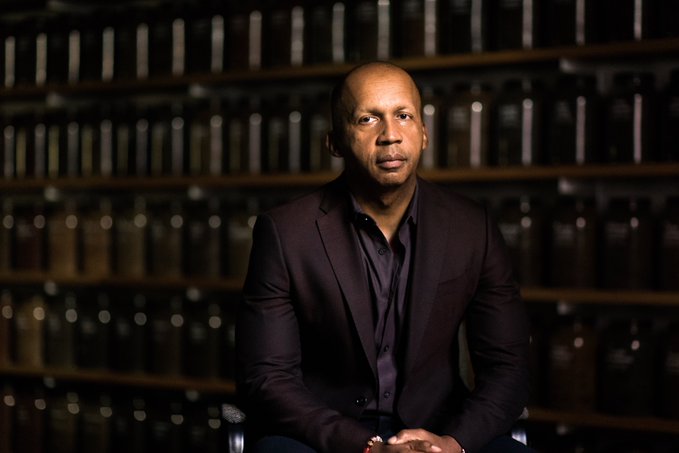
Bryan Stevenson (c) Nick Frontiero Photography 2019


On 8 July 2019, the Global Justice Academy hosted a lecture by Bryan Stevenson, recipient of an honorary doctorate at the Edinburgh Law School.  Stevenson is founder of the Equal Justice Institute (EJI) in Montgomery, Alabama, and a clinical professor at the NYU School of Law. Stevenson works as a legal representative for disadvantaged and marginalised individuals, particularly young and poor people who are on death row or serving life sentences. He and his colleagues at the EJI have achieved the exoneration or release of over 125 individuals on death row. Stevenson is also the author of Just Mercy: A Story of Justice and Redemption,[1]  which was a New York Times bestseller and won the Carnegie Medal for the best nonfiction book of 2014.

Stevenson’s lecture circulated around a question that is as succinct as it is complex: how do we, as human rights advocates, address injustice? Firstly, he said, we must create justice by becoming proximate to those suffering inequality and injustice. Recounting his relationship with his grandmother, who wished that Stevenson would always be able to feel her embracing him, the skilful orator argued that we must know and seek to understand those who suffer injustice in order to affirm their humanity and dignity. Thus, human rights practice is not about the deployment of legal arguments from afar, but rather about stepping away from one’s legal expertise and embracing those who suffer violations of dignity.

Comments closed

Getting to Grips with Guantánamo III: Torture Evidence

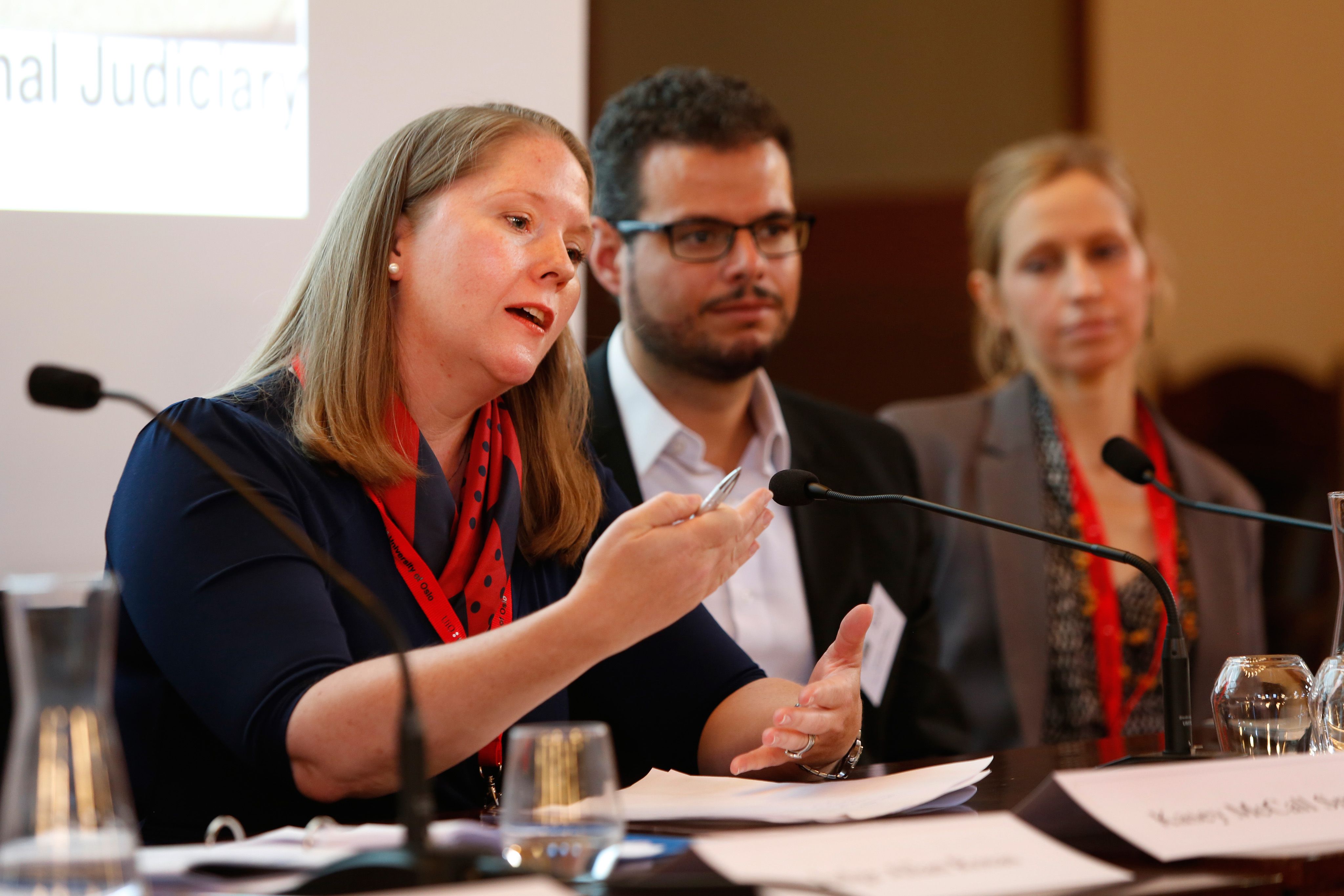
KMSThis post is by Kasey McCall-Smith: a lecturer in Public International Law and programme director for the LLM in Human Rights at Edinburgh Law School.

This post is the third in a series of blogs that chronicle the history and current state of play regarding the US rendition and detention programme in the immediate aftermath of 9/11. They were written during the author’s visit to Guantánamo Bay, Cuba, to observe military commission proceedings in the case of USA v. Khalid Shaikh Mohammad, et. al.  30 May – 3 June 2016, which is the initial phase of her project Getting to Grips with Guantánamo.

Right now, on a small island in the Caribbean, what will ultimately be one of the most comprehensive examinations of torture is taking place in the form of a military commission proceeding in the case of US v. Khalid Shaikh Mohammad, et. al. (KSM case). A common understanding among the observers that are witnessing KSM is that half are there to see the 9/11 trial and half are there to see the torture trial. In anticipation of what many view as a foregone conclusion, the defence lawyers are diligently representing their clients in order to ensure that if the ultimate penalty, death, is pursued in the sentencing phase of the trial; then the brutality that they suffered at the hands of the CIA is in the trial record. This record will be instrumental to mitigation of the death penalty and speak to the reality that much of the evidence presented may have been extracted or derived through torture, which is prohibited under international law.

Comments closed

Mental Health and Justice: the Execution of Scott Panetti

HC Profile PicThis post by Dr Harriet Cornell, Development Officer for the Global Justice Academy, examines the relationship between mental illness and justice in light of the planned execution of Scott Panetti in Texas on Wednesday, 3 December 2014.

A Public Policy Polling national survey was published yesterday, 1 December 2014, showing that Americans oppose the death penalty for mentally ill defendants by a 2-1 margin. The Death Penalty Information Center reported that ‘opposition to the execution of people with mental illness was strong across lines of race, gender, geographic region, political affiliation, and education. Democrats (62%), Republicans (59%) and Independents (51%) all opposed the practice’. Tomorrow, 3 December 2014, the state of Texas plans to execute Scott Louis Panetti for the 1992 murders of his parents-in-law, Joe and Amanda Alvarado. With a long, documented history of severe mental illness, Scott Panetti’s case has garnered international news coverage and a notable spectrum of support for clemency.

Comments closed

We kill people to tell people that killing people is wrong?

Harriet Cornell is the Development Officer for the Global Justice Academy. In this guest post, she reports on the botched execution of Clayton Lockett in Oklahoma, and the state of the death penalty in the United States.

Ohio drugs protocol
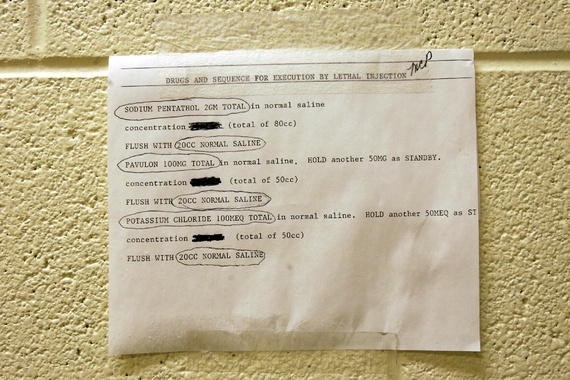
In 2005, this memo was posted next to the death chamber at the Southern Ohio Correctional Facility in Lucasville, Ohio. Credit: AP File Photo

The state of Oklahoma executed Clayton Lockett at 6pm local time on Tuesday 29 April 2014. Or, according to widespread news reports and a statement from Robert Patton (Director of Oklahoma Department of Corrections), the state attempted to execute Lockett but failed, and he died 43 minutes later from a massive heart attack. Charles Warner was due to follow Lockett to the gurney at 8pm, but has been granted a 14-day stay by Governor Mary Fallin, pending an investigation into what happened in that execution chamber.

Comments closed
css.php

Report this page

To report inappropriate content on this page, please use the form below. Upon receiving your report, we will be in touch as per the Take Down Policy of the service.

Please note that personal data collected through this form is used and stored for the purposes of processing this report and communication with you.

If you are unable to report a concern about content via this form please contact the Service Owner.

Please enter an email address you wish to be contacted on. Please describe the unacceptable content in sufficient detail to allow us to locate it, and why you consider it to be unacceptable.
By submitting this report, you accept that it is accurate and that fraudulent or nuisance complaints may result in action by the University.

  Cancel