
This blog forms part of a series celebrating the 75th anniversary of the Universal Declaration of Human Rights (UDHR). Recognising the numerous conflicts and the…
Comments closedCategory: Crime and Criminal Law
This blog is by Daniel Erhardt Nielsen, LLM Candidate in Human Rights at Edinburgh Law School. It presents some of the issues he examined during…
Comments closed
In this guest post, Law PhD Candidate, Vivek Bhatt, reflects on Bryan Stevenson’s visit to Edinburgh Law School to give the 2019 Ruth Adler Memorial Lecture, and to receive an honorary doctorate as part of the School’s summer graduation ceremony.
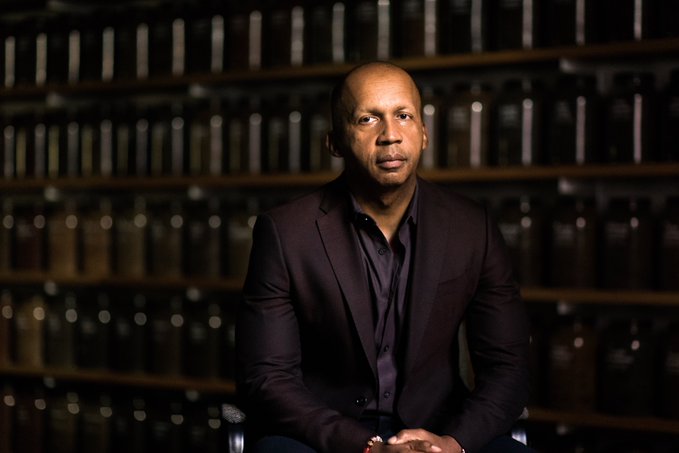
On 8 July 2019, the Global Justice Academy hosted a lecture by Bryan Stevenson, recipient of an honorary doctorate at the Edinburgh Law School. Stevenson is founder of the Equal Justice Institute (EJI) in Montgomery, Alabama, and a clinical professor at the NYU School of Law. Stevenson works as a legal representative for disadvantaged and marginalised individuals, particularly young and poor people who are on death row or serving life sentences. He and his colleagues at the EJI have achieved the exoneration or release of over 125 individuals on death row. Stevenson is also the author of Just Mercy: A Story of Justice and Redemption,[1] which was a New York Times bestseller and won the Carnegie Medal for the best nonfiction book of 2014.
Stevenson’s lecture circulated around a question that is as succinct as it is complex: how do we, as human rights advocates, address injustice? Firstly, he said, we must create justice by becoming proximate to those suffering inequality and injustice. Recounting his relationship with his grandmother, who wished that Stevenson would always be able to feel her embracing him, the skilful orator argued that we must know and seek to understand those who suffer injustice in order to affirm their humanity and dignity. Thus, human rights practice is not about the deployment of legal arguments from afar, but rather about stepping away from one’s legal expertise and embracing those who suffer violations of dignity.
Comments closedThis is the third post in a blog series by Dr Kasey McCall-Smith which examines some of the contentious legal issues raised in the US…
Comments closedIn this post, our Communications Intern, Jee-Young Song, reports from the second day of the recent GJA-sponsored GREYZONE summer school.
 26 June 2018 was the second day of the GREYZONE Summer School, and starting the day’s session was Danielle Celemajer, Professor of Sociology and Social Anthropology at the University of Sydney. Titled ‘The worlds that produce torture’, the main question put to us was:
“What causes torture?”
The straightforward answer to this would of course be obvious: doesn’t torture occur because a malignant perpetrator decided to inflict such an act on the victim?
However, this is an over-simplistic approach, as Professor Celemajer professed her view that there is in fact a complex map of causality for torture, with many contributory factors which extend beyond the scope of the individual perpetrator.
Comments closed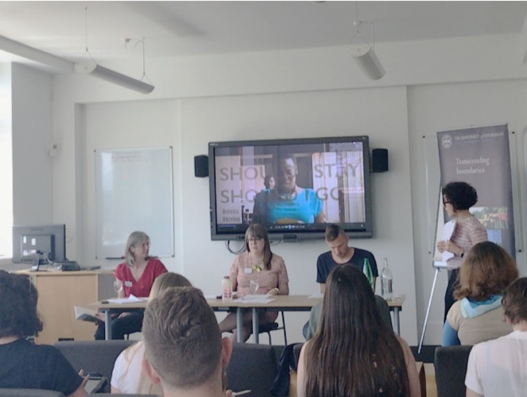 In her second post for this blog, GJA Communications Intern, Jee-Young Song, reflects on the recent GJA GREYZONE Summer School keynote session on ‘Conceptual Perspectives’.
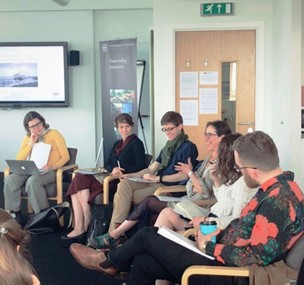
The Summer School kick-started on Monday the 25 June, the theme this year being ‘Navigating the Grey Zone: Complicity, Resistance and Solidarity’.The following is from the ‘Conceptual Perspectives’ talks, where expert speakers from the fields of human rights, philosophy, and political theory (Ruth Kelly, Charlotte Knowles and Lukas Slothuus, pictured above) each gave their unique insight on the key issues.
Storytelling as a way to reinforce human rights
First to speak was Ruth Kelly, who focused on the potential for narrative to help communities articulate approaches to the development of human rights. To give an example of such artistic intervention, she showed footage taken at a poetry workshop in Uganda, where a woman recites a poem about struggling to choose between action and complicity, entitled ‘Should I stay? Should I go?’.
Comments closed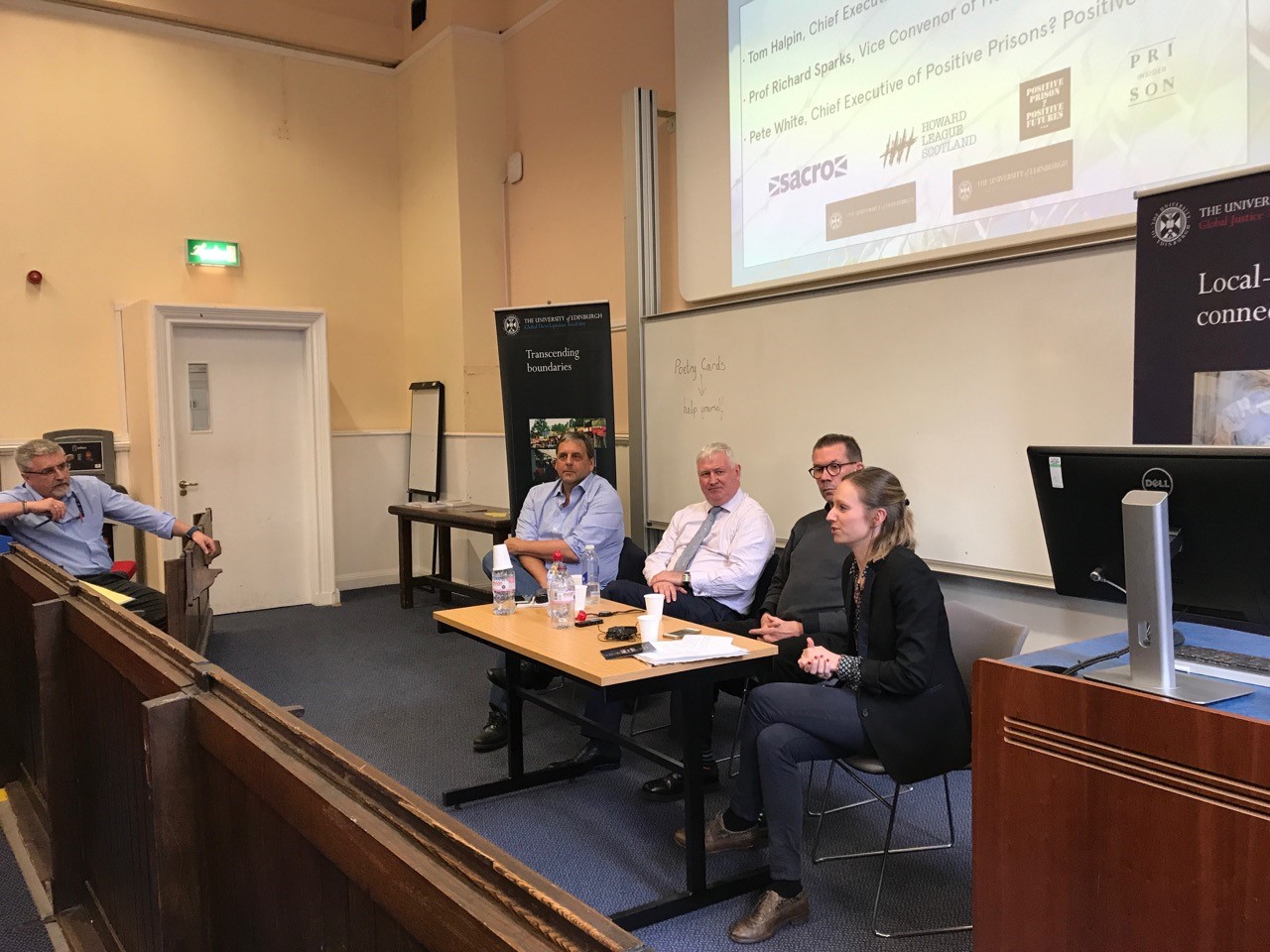 In this guest post, Coline Constantin reflects on the recent seminar that tackled issues around incarceration in Scotland. Coline is reading for an LLM in Human Rights at Edinburgh Law School, and applied for funding for this event from the Global Justice and Global Development Academies’ Innovative Initiative Fund.
Scotland has the second highest imprisonment rate in Europe. Although English headlines for issues of overcrowding, under staffing, rising rates of self-harming cases do not find an echo north of the border, the statistic still makes it worth taking a closer look at its system. On Thursday 26 April, an engaged audience gathered at the University of Edinburgh to hear more about the positive developments and challenges of the Scottish system of detention.
Three panellists from different fields of expertise and different view angles on the Scottish situation were invited to cover topics from policy-making, to the implementation and analysis of these policies. Professor Richard Sparks, Convenor of Howard League Scotland and criminologist specialised on the different systems of detention in the UK, took us through his analysis of the particularities of the Scottish case within the UK and European context. Tom Halpin, Chief Executive of Sacro and prominent figure in the reduction of inequalities in the Scottish criminal justice system, gave us a sense of the work that is being done with communities and specific groups of people with convictions to go towards better mentoring and guidance throughout the process. Pete White, Chief Executive of Positive Prisons? Positive Future and fascinating storyteller, treated the audience with a story of his personal experience from his time inside and the aftermath of this life-changing event.
Comments closedThis guest post is by Michelle Burgis-Kasthala, who is currently a Research Fellow at the Centre for International Governance and Justice, RegNet, ANU. Michelle will be returning to Edinburgh Law School in 2017-18. This post is re-blogged from ‘Regarding Rights: Academic and Activist Perspectives on Human Rights’ and is based on an article published recently in the Journal of International Criminal Justice: ‘Scholarship as Dialogue? TWAIL and the Politics of Methodology’.

ICC in Ivory Coast in 2013. Image: BBC News
Concerns about the International Criminal Court’s (ICC) continuing relevance in Africa following exit announcements by Burundi, South Africa, and Gambia are widespread. But the picture across the continent is more complex. While some African states have clearly rejected the Court, the majority remain members. How can we explain the fracturing of the Court’s support in Africa? More fundamentally – what is the best way of studying international criminal justice and its effects in the Global South – whether in Africa or elsewhere?
Comments closedThe Global Justice Academy is delighted to launch the second year of its Student Ambassador programme with a guest post by Vivek Bhatt. Vivek is an incoming student reading for a PhD in Law. He recently completed the MSc in Political Theory at the London School of Economics, and holds a Bachelor of Arts (Advanced) (Honours) and Master of International Law from the University of Sydney. His primary interest is in international laws relating to counterterrorism, conflict, and human rights.
Rodrigo Duterte’s war on drugs in the Philippines has recently been deemed an international crime. This post reflects upon issues arising from the condemnation of Duterte, asking whether international criminal law can enable the realisation of cosmopolitan ideals.
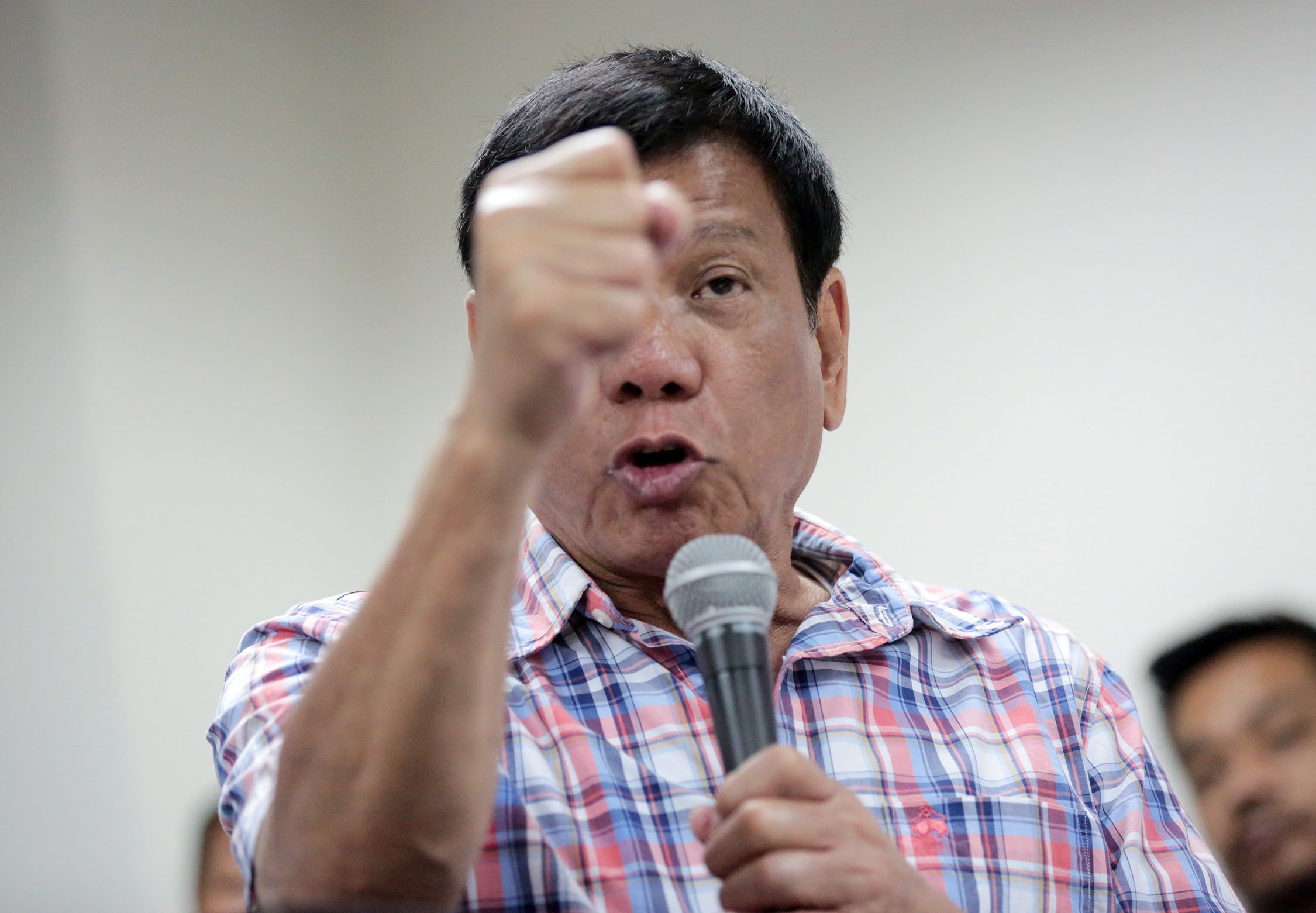
When elected President of the Philippines on 9 May 2016, Rodrigo Duterte vowed to reduce rates of drug-related crime within the state. Duterte has since waged a violent anti-drug campaign, authorising the extra-judicial execution of individuals thought to use, possess, or traffic illegal substances. The President’s “death squad” comprises select members of the police force and civilian volunteers. Most of these individuals were lured into their roles as amateur mercenaries through payment, and promises of impunity for their actions. Others were coerced into joining Duterte’s campaign; men and women were guaranteed immunity from punishment for their own drug-related offences in exchange for their services as assassins.[1] The OHCHR suggests that over 850 people have been killed since Duterte’s election, but reports that take into account unexplained deaths during that period suggest the number is closer to 3,000.[2]
Comments closed