Any views expressed within media held on this service are those of the contributors, should not be taken as approved or endorsed by the University, and do not necessarily reflect the views of the University in respect of any particular issue.
Press "Enter" to skip to content

Category: Conflict

Peace in Colombia?

This blog post by Gwen Burnyeat, Wolfson PhD scholar at UCL, was first published by the London Review of Bookson 1 December  2016. In this piece, Gwen comments on the recent development in the post-referendum context and the adoption of a new peace agreement in Colombia.
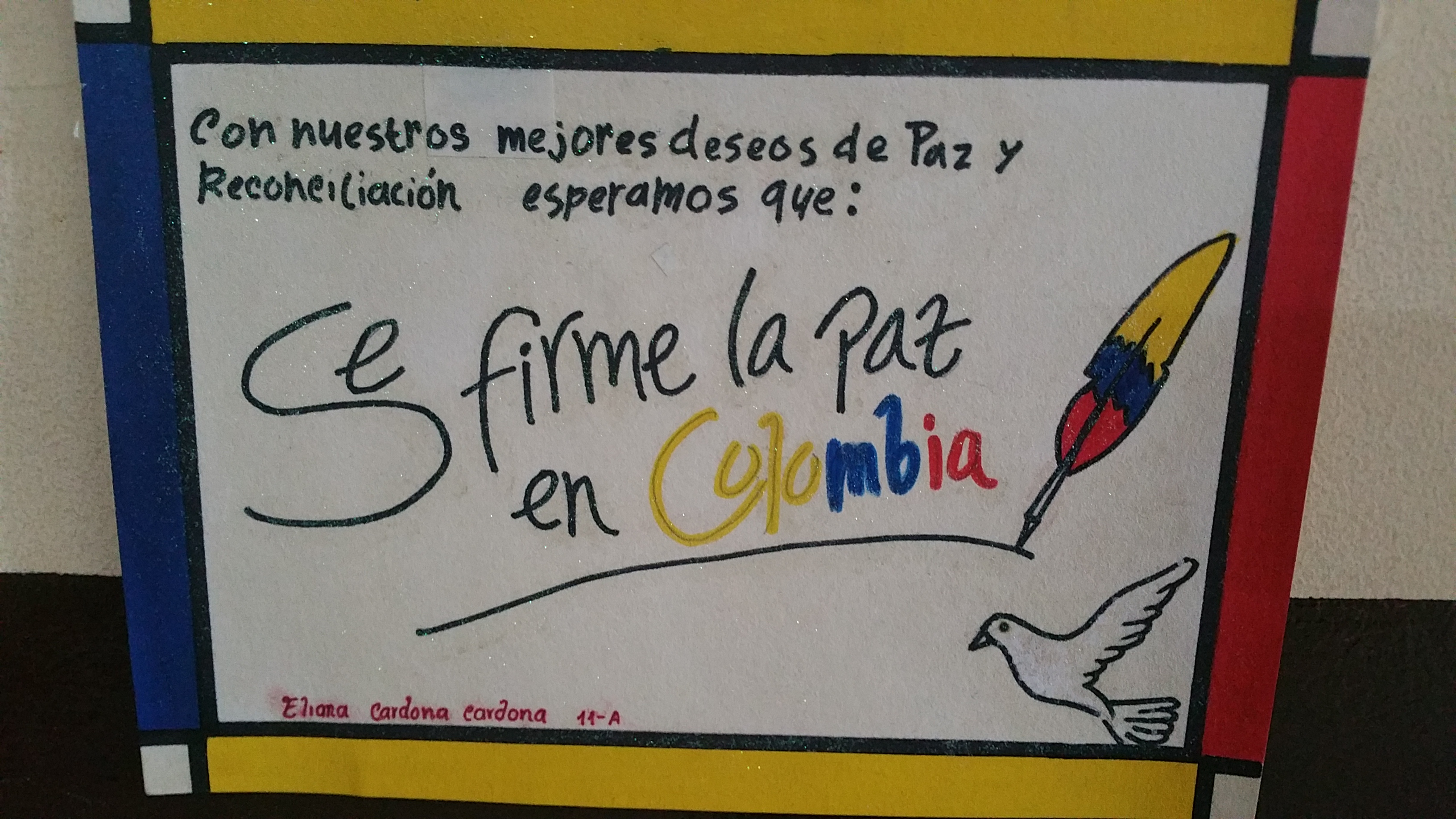
Photo: School-Children in Pereira draw their hopes for peace, August 2016, by Gwen Burnyeat.

The new peace accord between the government and the Revolutionary Armed Forces of Colombia was signed in Bogotá’s Colón Theatre on 24 November. It was a more sober ceremony than the extravagant signing of the first agreement in Cartagena on 26 September, a week before Colombians narrowly voted against it in a referendum. The second signing was a closed event, and only President Juan Manuel Santos and the Farc commander, Timochenko, gave speeches. A subdued group of Colombians in the main plaza in Bogotá watched it on a big screen. The right-wing TV channel RCN, meanwhile, held a panel featuring only figures opposed to the deal, for ‘balance’.

Comments closed
Report from an IIF Event – Academic Freedom: “national security” threats in Turkey, India and the UK

Can the university be a space where academic freedom reigns while restrictions are increasingly threatening voices and lives outside its gates? Or must spaces for politics be opened up on and off campus in order to address the invasion of national security (and capitalist) logics into the realms of open enquiry? On 27 October 2016, scholars and activists engaged these questions with a focus on the variable effects of the securitisation of university space in Turkey, India and the UK.

A panel on Turkey included academics and students who have lost their jobs as a result of the broader crackdown on dissent following the failed coup in July. They highlighted the connections between increasing violence in the Kurdish regions of Turkey—which precipitated the “Academics for peace” petition that has been used as a pretext for dismissing many signatories from their posts—and the attempts of the state to impose controls on its critics. They asked if the focus on the plight of academics may mean that this violence recedes from the view of international publics. Efforts to maintain solidarity among those now outside the academy and those still within it, as well as initiatives to take the university outside spaces the government controls, provide hope for continued resistance in fearful times and carve out a more universal idea of the University as institution and spirit that always has had to be fought for and salvaged from strategies of subjection from various quarters, not only outside the University. In this way, this panel was inspiring for all university struggles, not just those related to Turkey.

Comments closed

Educating Human Rights in Post-conflict Settings

sm-blogSean Molloy is a Principal’s Scholar in Law at the University of Edinburgh, where he is completing his PhD. In this blog, Sean reflects on discussions about Peacebuilding and Education in South Sudan held during the Inclusive Political Settlements Summer School. He goes on to discuss the relationship between human rights and education in post-conflict settings from a critical perspective.

I had the pleasure of attending the Inclusive Political Settlements Summer School at the University of Edinburgh last June. While there in the capacity as a rapporteur for the third day, I found myself becoming increasingly engrossed in the discussions and presentations in what proved to be a highly informative and constructive day. While each individual presentation warranted further discussion, one presentation in particular invoked a series of questions pertaining to the place of education in societies attempting to emerge from the shackles of violent conflict.

Comments closed

War: Art and Creativity in Conflict Zones

IPOW borderLeah Davison reports on an evening workshop that examined the role of art and creativity in conflict zone.  Leah organised this with support from the Global Justice Academy’s and Global Development Academy’s Innovative Initiative Funds.

On 18 March the Edinburgh University International Development Society (EUID), in collaboration with University of Manchester based organisation In Place of War (IPOW), hosted an evening of talk and performance on the subject of art and creativity in conflict zones. The question at hand: what role can creativity play in the realm of social, political and economic development in areas of conflict, war and revolution?

Comments closed

MBA Team Syria: Making a Difference to the Community

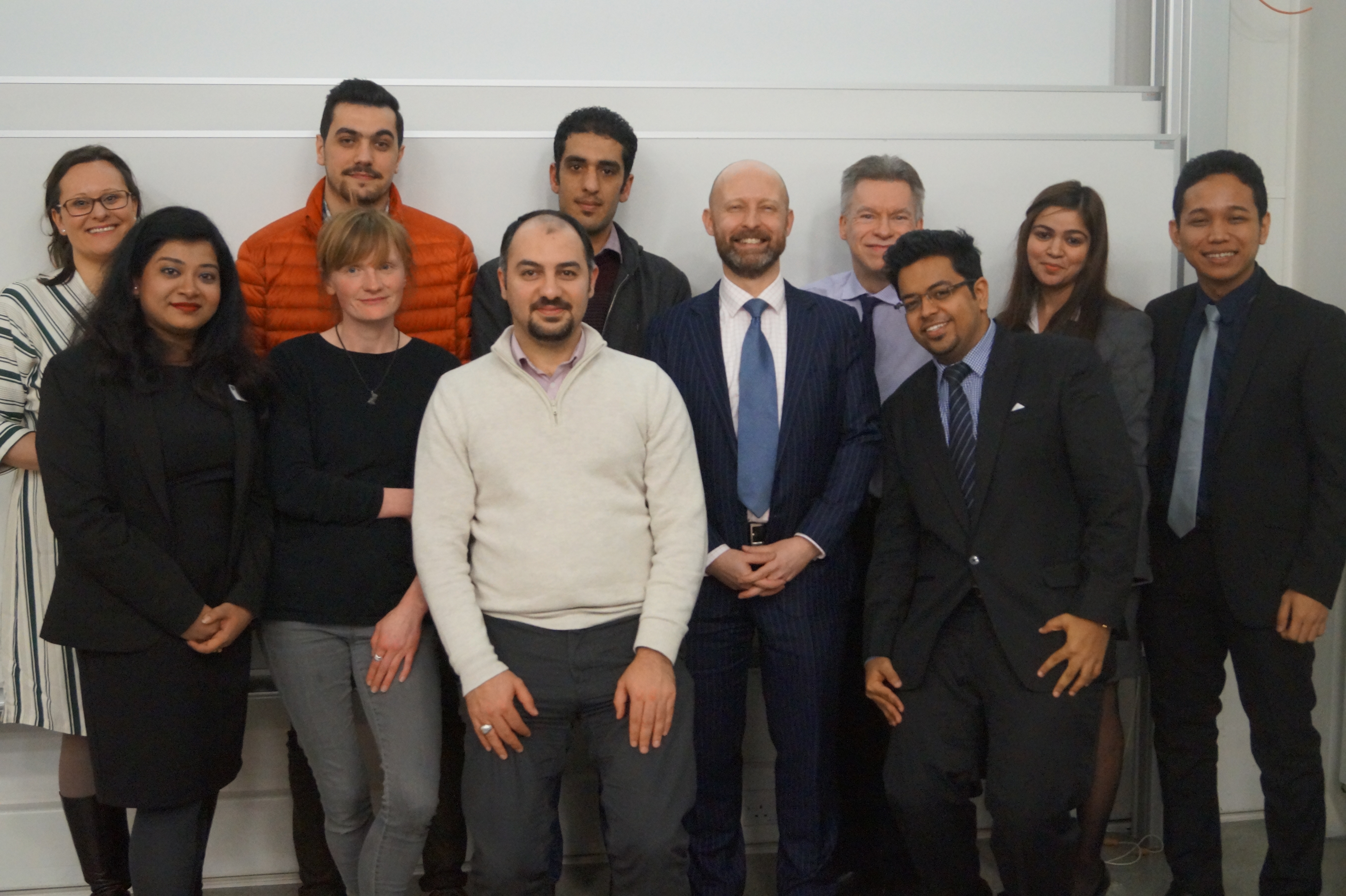
DSC00990As a part of the Strategic Leadership course on Edinburgh’s MBA programme, a group of five students organised a social event to help draw awareness to the Syrian refugee crisis. In this guest post, Debjani Paul offers an overview of the event, which centred around the the personal life experiences of three Syrians now settled in Edinburgh – Aamer Hanouf, Hussen Al Ajraf, and Amer Masri.

With the rising global concerns including climate change, an increase in global population, poverty, and terrorism, world leaders have much to focus on. It is becoming a new norm for companies to be socially responsible by promoting sustainability and contributing at least in one of the global concerns, also known as Corporate Social Responsibility. This is the ethical way to do business that every future leader should practice.

Comments closed

What obligations, if any, does a state in Europe have towards boat people attempting dangerous sea crossings?

This was the question Professor David Miller from Oxford University addressed on 4 February 2016 in a well-attended lecture hosted by Edinburgh University’s Global Justice Academy and Just World Institute.

In this blog report from the lecture, Yukinori Iwaki reflects on the day’s discussion and points raised. Yukinori Iwaki is a PhD student in Politics and International Relations at the University of Edinburgh. Click here to read more about his research.

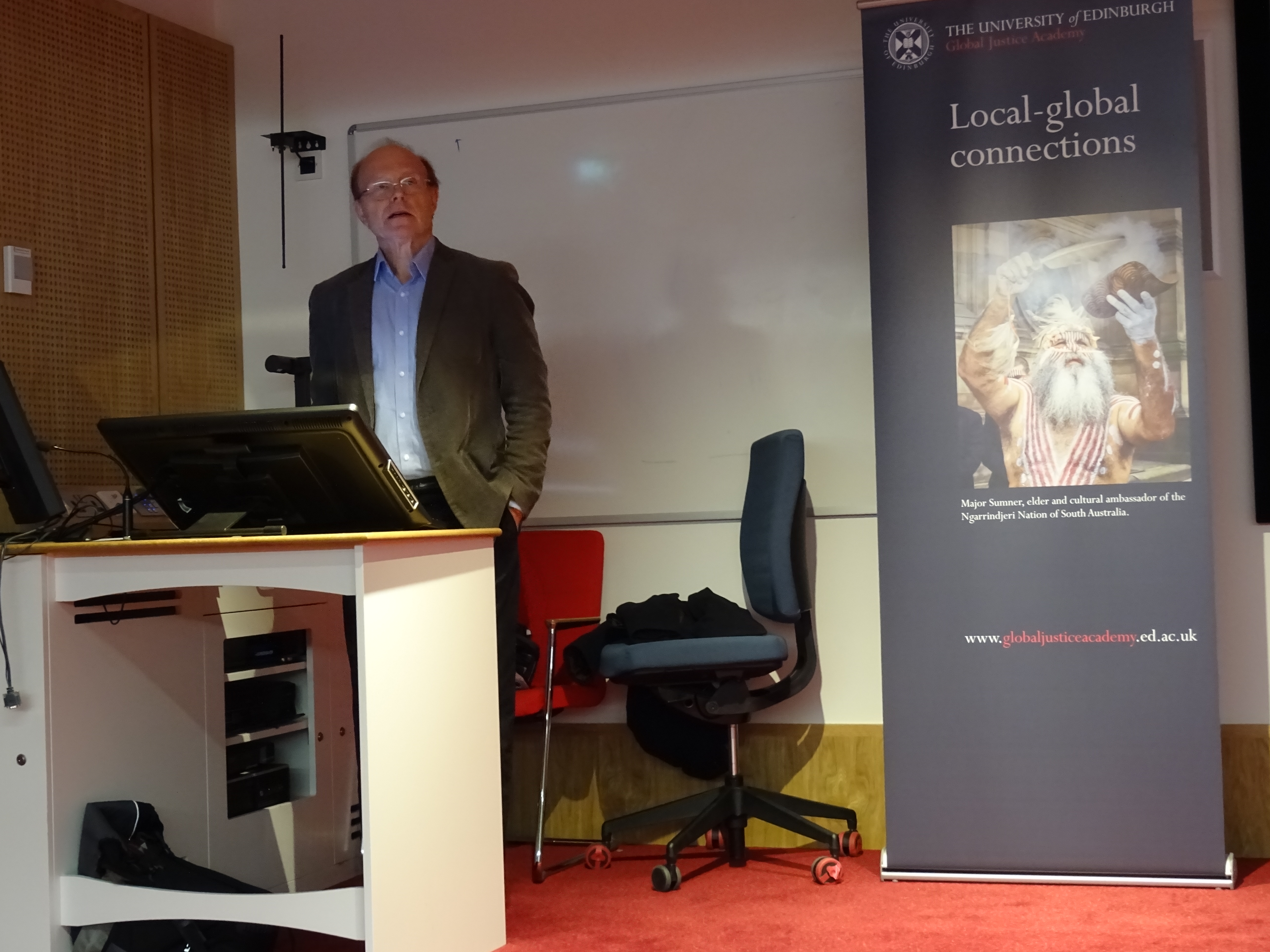
D.Miller in Edinburgh_01 Professor Miller began his talk by noting the 2014 UK government decision not to support Triton, a search-and-rescue operation proposed by the EU that could have potentially saved the lives of sea-crossing migrants, or “boat people”. The main reasoning behind this decision was the claim that search-and-rescue encourages people to attempt dangerous sea crossings in the greater expectation of being rescued, and therefore, in the long term, will bring about more deaths.  This seems to be a consequentialist argument that considers effects of alternative ways of using resources in order to minimise the loss of lives overall.  Meanwhile, critics argue that European states have stringent obligations to protect rights of migrants.  But is it true that the critics’ argument occupies the moral high ground while the UK government’s argument is morally defective?  The answer Professor Miller gave us was: ‘Not necessarily’.

Comments closed

What Can Scotland Do?

Rebecca Smyth is a Global Justice Academy Student Ambassador for 2015-16. In this post, Rebecca reflects on the third in our series of Rapid Response Roundtables on the current refugee crisis. Rebecca also report from the second roundtable, ‘Is the Global Refugee Regime Fit for Purpose?’.

Chaired by Dr Patrycja Stys of the Centre of African Studies, this event was the last of three organised by the Global Justice Academy in relation to the current refugee crisis.

It began with a screening of LIVED’s Learning to Swim, a short documentary that aims to share something of the everyday lives of displaced young Syrians in the Zaatari Refugee Camp, the village of Zaatari, and Amman in Jordan. It’s a very special piece. Through seemingly disjointed snippets of interviews and footage, it gives a sense of the inner lives and daily routines of children and young people caught up in the Syrian conflict. We meet a girl who loves football, kites and fried food, and whose favourite place is Homs, a place of roses and affectionate people.

Comments closed

Is the International Refugee Regime Fit for Purpose?

Rebecca Smyth is a Global Justice Academy Student Ambassador for 2015-16. In this post, Rebecca reflects on the second in our series of Rapid Response Roundtables on the current refugee crisis. Rebecca will also report from the final roundtable, ‘What Can Scotland Do?’.

This panel discussion was a follow-on event from the first panel discussion held at the beginning of October on the roots of the current Syrian crisis. The panel was comprised of Professor Christina Boswell and Dr Lucy Lowe from the School of Social and Political Science; campaigner Amal Azzudin of the Mental Health Foundation; and Jamie Kerr, Partner at Thorntons Solicitors specialising in Immigration Law. It was chaired by Dr Mathias Thaler.

“The international refugee regime is spectacularly not fit for purpose”

Drawing upon her academic research and own experience working with the UNHCR in the mid-1990s, Professor Boswell demonstrated the ways in which the origins of the current global refugee regime have combined with EU policy to create an unsustainable system for dealing with the current refugee crisis.

Comments closed

Serving women in Iraq and Syria: has UNSCR 1325 made a difference?

Rosie Ireland is a student on this year’s LLM in Human Rights at The University of Edinburgh. This is Rosie’s second report as a Global Justice Academy Student Ambassador – from the 2015 Montague Burton Lecture, which was delivered by Frances Guy on 2 November. Frances Guy is the Head of the Middle East region at Christian Aid. Rosie’s report outlines the key points made during the lecture, which was entitled ‘Serving women in Iraq and Syria: has UNSCR 1325 made a difference?’.

It is nearly the fifteenth anniversary of the UNSCR 1325; the first ever resolution aimed to enhance the role of women in peace building. Frances Guy analysed the effectiveness of the resolution in the context of Iraq and Syria in relation to four key areas: participation, protection, prevention, and relief and recovery.

Comments closed

Refugee Crisis Response Event I: The Roots of the Syria Crisis

As a contemporary and prominent topic, a panel event discussing the roots of the Syria crisis was always going to be well attended. In front of a packed lecture theatre, on October 6th 2015, Dr. Thomas Pierret, Dr. Manhal Alnasser, and Arek Dakessian presented their points of view on the causes and changing shapes of the crisis in Syria since the popular uprising in 2011, chaired by Dr Sarah Jane Cooper Knock. Each speaker brought their experiences as academics, practitioners and personal stories to the event.

Internal issues, not proxy war

Thomas began the discussion by raising the two prominent explanations for conflict in Syria: the first, which he subscribes to, that it was a domestic problem which became internationalised; and the second, that it was a proxy war from the outset. He argued that the conflict started with the popular uprising against Bashar al-Assad’s authoritarian regime, in which the power lies in family patronage networks rather than institutions. The immediately repressive state response, sectarian-social divides between police and protestors, and subsequent defections, all led to the formation of a crowdfunded armed movement against Assad, which was a well-established force before international actors became involved. Finally, he claimed that the regime is now compensating for its lack of manpower with increased firepower, and that this has led to mass displacement through the total destruction of rebel-held areas, especially cities.

Comments closed
css.php

Report this page

To report inappropriate content on this page, please use the form below. Upon receiving your report, we will be in touch as per the Take Down Policy of the service.

Please note that personal data collected through this form is used and stored for the purposes of processing this report and communication with you.

If you are unable to report a concern about content via this form please contact the Service Owner.

Please enter an email address you wish to be contacted on. Please describe the unacceptable content in sufficient detail to allow us to locate it, and why you consider it to be unacceptable.
By submitting this report, you accept that it is accurate and that fraudulent or nuisance complaints may result in action by the University.

  Cancel