Last Thursday, PeaceRep, Gender.Ed, and the Global Justice Academy hosted the Scottish Premiere of ‘Devi’ a documentary on the life of Devi Khakda—former member…
Leave a CommentCategory: Conflict
This post is the first of a two-part blog by Prof. Paul Clark comparing police discipline in the US and the UK. Part I focuses…
Comments closedThe Secretariat for the Association of Human Rights Institutes (AHRI), hosted by the Global Justice Academy (GJA) and Strathclyde Centre for the Study of Human Rights…
Comments closedThis is the third blog in a series written by LLM students on the Human (In)Security course at Edinburgh Law School. The series celebrates the…
Comments closedThis post by is by Oskar Granskogen Kjorstad, Alexandra Haider and Tess Gallagher. They are students enrolled in PLIT10063 ‘Human Rights in International Relations’, an honours-level…
Comments closedThis is the third post in a blog series by Dr Kasey McCall-Smith which examines some of the contentious legal issues raised in the US…
Comments closed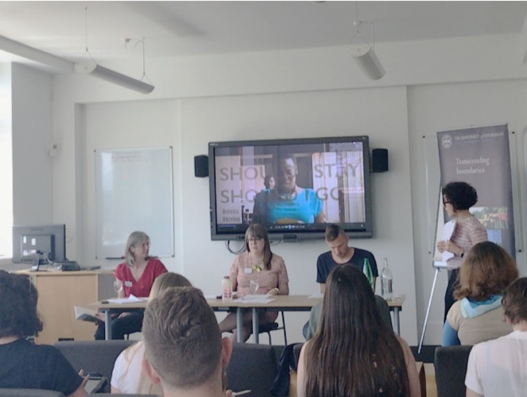 In her second post for this blog, GJA Communications Intern, Jee-Young Song, reflects on the recent GJA GREYZONE Summer School keynote session on ‘Conceptual Perspectives’.
The Summer School kick-started on Monday the 25 June, the theme this year being ‘Navigating the Grey Zone: Complicity, Resistance and Solidarity’.The following is from the ‘Conceptual Perspectives’ talks, where expert speakers from the fields of human rights, philosophy, and political theory (Ruth Kelly, Charlotte Knowles and Lukas Slothuus, pictured above) each gave their unique insight on the key issues.
Storytelling as a way to reinforce human rights
First to speak was Ruth Kelly, who focused on the potential for narrative to help communities articulate approaches to the development of human rights. To give an example of such artistic intervention, she showed footage taken at a poetry workshop in Uganda, where a woman recites a poem about struggling to choose between action and complicity, entitled ‘Should I stay? Should I go?’.
Comments closedDagmar Topf Aguiar de Medeiros is reading for a PhD in Law at the University of Edinburgh, and is an intern at UN House Scotland.…
Comments closedWhat can social and political scientists learn from data science? And what can data science contribute to the research on peace and conflict?
‘Most importantly, one has to know what questions to ask’, says Gabriele Schweikert, Research Fellow at the School of Informatics at the University of Edinburgh. ‘And secondly, one needs the necessary data to answer that question.’
For example, researchers on urban conflict might be interested to find out how different instances of violence distribute across a city over time. Available data from media on the location and intensity of violence can be harvested with the help of automatised bots searching for keywords. ‘But if researchers have only a vague idea of their question and do not know what data can do and what not, they might end up with a trivial answer’, she says, adding: ‘Such as the simple result that violent conflict in cities tends to take place in streets.’
Can data predict conflict?
Gabriele’s colleague, Guido Sanguinetti, a Reader in Machine Learning in Informatics at Edinburgh, is an expert in running prediction models, usually in the field of computational biology. But when a friend who worked as a data scientist for the New York Times sent him a visualisation of violent incidents in Afghanistan, taken from the WikiLeaks Afghan War Diaries, he realised that he could ‘do much more with the available data’.
Comments closedThe University of Edinburgh’s research expertise on peace and conflict is growing fast, making it ever more important to connect and communicate across disciplinary lines. To this effect, a new blog series titled Rethinking Peace and Conflict Research in Edinburgh will foster exchange and make this ongoing research and its challenges more visible. Its aim is to build new interdisciplinary capacity and exchange around challenges and themes that connect experts working on peace and conflict across and beyond the University.
Comments closed